









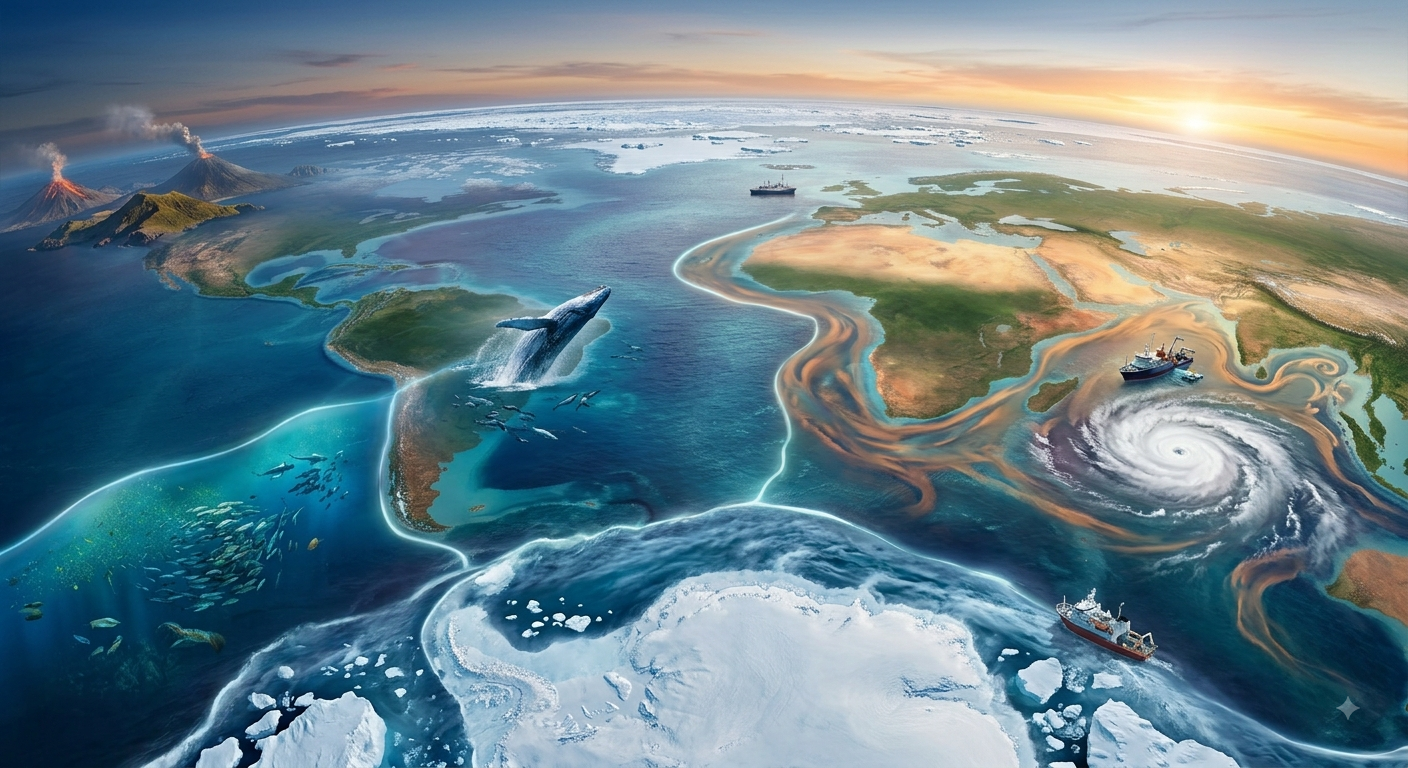
Although we often learn that Earth has five oceans, scientists say they are all connected. So why do we still give them different names?
Look at a world map.
You will see the Pacific, Atlantic, Indian, Southern and Arctic oceans.
It appears as though they are five separate bodies of water.
But they are not.
In reality, all of Earth’s oceans are connected. There are no walls or barriers separating one ocean from another. A drop of seawater can eventually travel from one ocean to another through natural currents.
So why do we still say there are five oceans?
The answer lies in geography rather than the water itself.
One Global ocean, Five named regions
Scientists often describe Earth’s oceans as one global ocean.
The five names simply help us identify different parts of this vast body of water.
Just as continents have different names despite being part of the same planet, oceans are divided into regions based on their location, surrounding land and unique characteristics.
These names make it easier to study weather, climate, marine life and ocean currents.
Meet the five oceans
Today, the world officially recognises five oceans:
- Pacific Ocean
- Atlantic Ocean
- Indian Ocean
- Southern Ocean
- Arctic Ocean
Together, they cover about 71% of Earth’s surface and contain around 97% of all the water on the planet.
Without them, life on Earth would not exist.
Each Ocean has its own identity
Although connected, every ocean behaves differently.
The Pacific Ocean is the largest and deepest. It contains the Mariana Trench, the deepest known place on Earth, and is surrounded by the Ring of Fire, one of the world’s most active earthquake and volcano zones.
The Atlantic Ocean has played a major role in world history. It connected Europe, Africa and the Americas through trade, exploration and migration. It is also home to powerful currents that help regulate Earth’s climate.
The Indian Ocean is especially important for South Asia. It drives the monsoon system, bringing rainfall that supports farming, rivers and drinking water for millions of people.
The Southern Ocean, which surrounds Antarctica, is the newest officially recognised ocean. Its powerful Antarctic Circumpolar Current helps regulate global temperatures by connecting the Atlantic, Pacific and Indian oceans.
The Arctic Ocean is the smallest, but it is one of the most important for climate research. Rising global temperatures are causing Arctic sea ice to melt rapidly, affecting weather patterns across the world.
Invisible boundaries
If all the oceans are connected, where does one end and another begin?
The simple answer is that there is no visible line.
The boundaries exist only on maps.
Scientists divide the oceans based on geography, ocean currents, temperature and other physical features.
That is why the water itself never “knows” which ocean it is in.
The Oceans keep earth alive
The oceans do much more than hold water.
They help control Earth’s climate by storing and moving heat around the planet.
Tiny marine plants called phytoplankton produce nearly half of the oxygen we breathe.
The oceans also absorb large amounts of carbon dioxide, helping slow the effects of climate change.
They are home to countless species, from tiny plankton to the largest animal ever known—the blue whale.
Even today, much of the deep ocean remains unexplored.
Scientists continue to discover new species and mysterious underwater landscapes.
One ocean, many names
The five-ocean system helps us understand our planet, but it does not change one important fact.
Earth has one continuous ocean.
Humans gave different names to different regions because it makes studying geography and climate much easier.
The water, however, never stops at those invisible borders.
Perhaps that is the most fascinating part of the story.
We call them five oceans.
Nature simply calls them one.
Subscribe Deshwale on YouTube


