




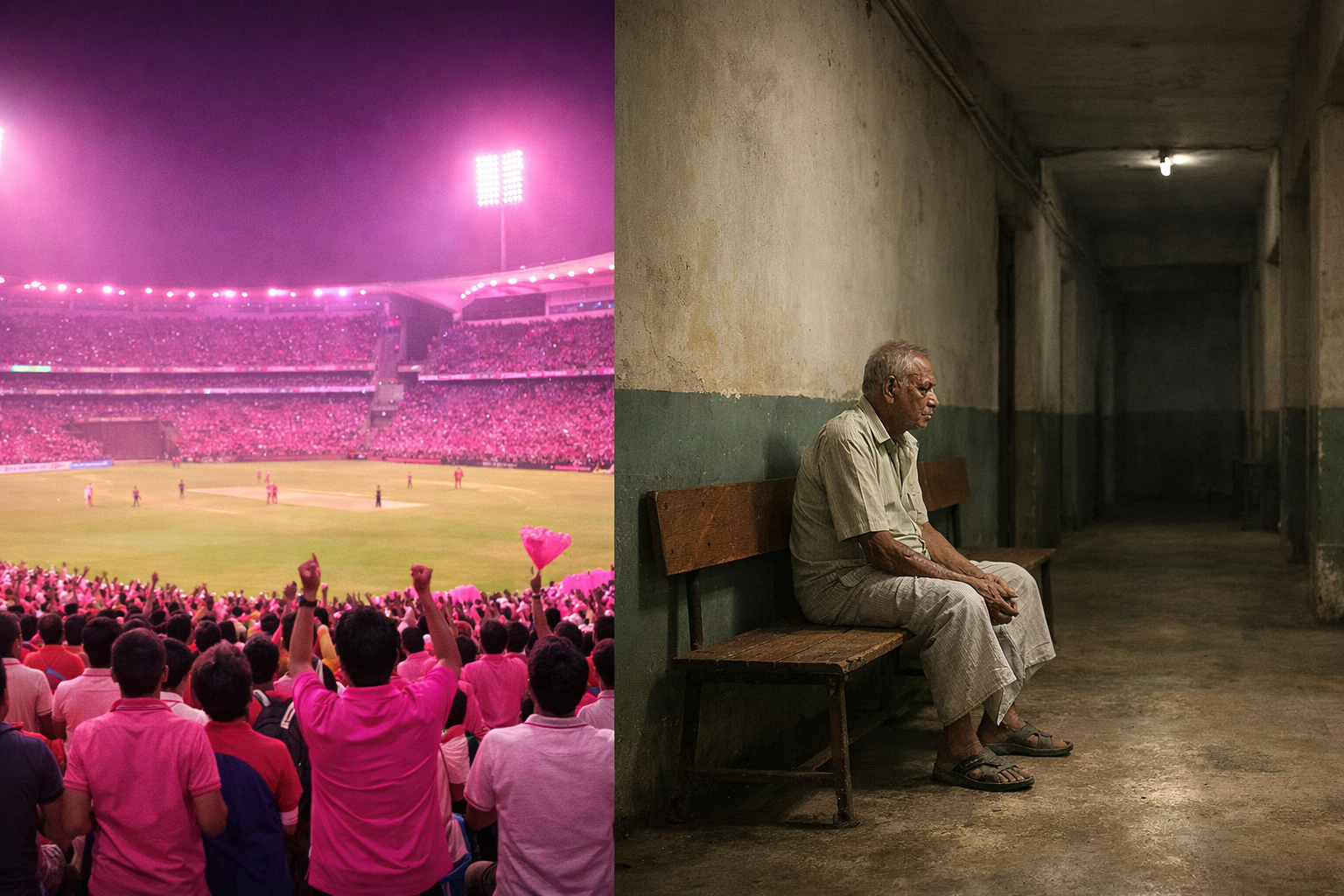
Ramesh Kulkarni was 61 when he finally went to a doctor. Not because anyone had told him to go for a check-up. Not because he had seen a campaign, read a pamphlet or heard a public health announcement. He went because the pain had become impossible to manage with the paracetamol he had been quietly taking for eight months. The diagnosis was prostate cancer, stage four. His oncologist told his son, gently, that if it had been caught two years earlier the conversation would have been very different. Ramesh died fourteen months later. His wife told a community health worker afterwards that she had never once heard the words prostate cancer before his diagnosis. Neither, it turned out, had he.
Ramesh’s story is not unusual. It is, in fact, representative of how prostate cancer moves through Indian men of his generation: silently, undetected and almost always too late. Roughly 40 percent of prostate cancer cases in India are diagnosed at stage three or stage four, when treatment options narrow sharply and survival outcomes worsen considerably. In the United States, where at least some awareness infrastructure exists around PSA testing, nearly 70 percent of cases are caught at a localised stage. That gap is not biological. It is not inevitable. It is the direct consequence of a global public health culture that has never properly decided that men’s cancers deserve the same urgent, visible, funded attention as women’s.
Every October, the world turns pink.
Stadiums glow in rose-tinted floodlights. Cricketers pull on pink jerseys. Multinational corporations rebrand their logos. Charity walks fill city parks. Breast cancer awareness has, over decades, become one of the most recognisable public health movements on the planet. It has funding, infrastructure, celebrity endorsement and genuine policy traction. That is a good thing. Nobody serious disputes it.
But here is the question that rarely gets asked in polite health policy circles: where is the equivalent campaign for prostate cancer?
The Numbers Tell an Uncomfortable Story
Prostate cancer is not a minor illness that affects a small subset of men. It is the second most commonly diagnosed cancer in men worldwide. In India, incidence rates have been rising steadily, particularly in urban populations. Globally, it kills hundreds of thousands of men every year. In many high-income countries, it rivals breast cancer in terms of both incidence and mortality burden. Yet the awareness infrastructure around it remains, by comparison, skeletal.
Breast cancer has Susan G. Komen. It has the Pink Ribbon, one of the most recognisable charity symbols in history. It has an entire month, October, designated to it across dozens of countries. It has policy commitments, national screening programmes and dedicated funding streams that dwarf what prostate cancer research receives in most low and middle-income countries.
Prostate cancer has Movember. A moustache-growing campaign that began in Australia in 2003 and, while admirable in intent, has never achieved remotely the same cultural penetration or policy influence as its breast cancer counterparts.
The Funding Gap Is Not Small. It Is Enormous.
Let us look at the numbers. In the United States, the National Cancer Institute allocated approximately 764 million US dollars to breast cancer research in the 2023 financial year. Prostate cancer received roughly 303 million US dollars in the same period. That is a funding ratio of nearly 2.5 to 1, in a country where prostate cancer incidence in men is broadly comparable to breast cancer incidence in women. In the United Kingdom, Cancer Research UK’s annual investment data consistently shows breast cancer receiving among the largest allocations of any cancer type, while prostate cancer, despite being the most common cancer in British men, receives a considerably smaller share. In Australia, the National Breast Cancer Foundation has raised over 200 million Australian dollars since its founding, backed by government co-contributions and corporate partnerships. No equivalent government-matched fund exists for prostate cancer research in Australia.
The Susan G. Komen Foundation in the United States alone has raised over three billion US dollars since 1982. The Prostate Cancer Foundation, founded a decade later, has raised approximately 900 million US dollars over the same broad period. These figures are not presented to diminish what breast cancer research has achieved. They are presented because the disparity is so wide it demands explanation rather than silence.
The UN Talks About One. Not the Other.
The World Health Organisation launched its Global Breast Cancer Initiative in 2021, a comprehensive multi-year programme aimed at reducing breast cancer mortality by 2.5 percent annually across member states. It has a dedicated framework, country-level implementation guidance and high-level institutional support. There is no equivalent WHO global initiative for prostate cancer. None.
UN Women has partnered on multiple breast cancer campaigns, weaving breast cancer awareness into its global health communications in ways that have become almost routine. The United Nations Population Fund folds breast cancer into its reproductive and women’s health frameworks. Which is fine, as far as it goes. World Cancer Day communications from the WHO and the International Agency for Research on Cancer regularly spotlight breast cancer with specific data, named campaigns and calls to action. Prostate cancer appears in the margins of these communications, if it appears at all. The disparity in institutional attention is not subtle. It is structural and it has been consistent across decades of global health policymaking.
Cricket, Campaigns and the Visibility Gap
The contrast in sports-linked advocacy is striking. Cricket Australia’s annual Pink Test, traditionally held at the Sydney Cricket Ground in January, raises millions for the McGrath Foundation, named after Jane McGrath, who died of breast cancer. The McGrath Foundation uses those funds to place breast care nurses in regional and rural Australia. It is emotionally powerful and practically effective.
Cricket South Africa has institutionalised a pink-day match in its domestic and international calendar. The Momentum One Day Cup, South Africa’s premier white-ball domestic competition, features a dedicated pink day each season. South Africa’s national team has also worn pink kit in at least one international white-ball fixture annually to raise breast cancer awareness, a tradition that has grown steadily in profile.
England’s white-ball teams have worn pink in limited-overs internationals. The West Indies, Pakistan, Sri Lanka and Bangladesh have all participated in pink-kit matches or pink-themed fixtures in various bilateral and tournament contexts. The Board of Control for Cricket in India organised a Day-Night Test in 2019 at Eden Gardens, Kolkata, where both India and Bangladesh played in pink-accented kits. The imagery was powerful and widely covered.
Nobody questions the value of these gestures. They raise funds and they raise awareness of a disease that kills women. But no international cricket team has ever worn blue for prostate cancer. No Test match has ever been played in a colour associated with men’s cancer awareness. The visual politics of sport, which reflect broader cultural attitudes, have simply not got there yet.
Why Did This Gap Open Up?
The breast cancer movement gained momentum in the 1970s and 1980s, when patient advocacy groups in the United States and Europe began pushing hard for disease-specific funding, clinical trials that included women as subjects and more responsive healthcare systems. They organised effectively, lobbied with precision and created the institutional infrastructure that made the Pink Ribbon campaign of the early 1990s so commercially and culturally potent.
Men’s health movements came later and with far less infrastructure. Male socialisation, the reluctance to discuss illness, the cultural prohibition on vulnerability, all of this made it harder to build grassroots advocacy around prostate or testicular cancer. Men simply did not organise around their health in the same way. That is a social reality with real medical consequences.
There is also a scientific complication worth acknowledging. Prostate-specific antigen testing, the primary screening tool for prostate cancer, has a genuinely contested evidence base. The United States Preventive Services Task Force issued a grade D recommendation against routine PSA screening in 2012, citing evidence of significant overdiagnosis and overtreatment, before partially revising that position in 2018 to a grade C for men aged 55 to 69, recommending individualised decision-making rather than blanket screening. The European Randomised Study of Screening for Prostate Cancer, one of the largest trials of its kind, found a 20 percent reduction in prostate cancer mortality with PSA-based screening, while the American Prostate, Lung, Colorectal and Ovarian Cancer Screening Trial found no significant mortality benefit. Two large, rigorous studies. Two conflicting conclusions. That scientific ambiguity gave policymakers a convenient reason to deprioritise prostate cancer advocacy, one that was never really available in the breast cancer conversation.
Is This Misandry in Policymaking?
Applied carefully to health policy, the concept points to something real: a structural indifference to male health outcomes that is not the product of deliberate malice but of accumulated, compounding neglect. When NGOs receive institutional funding to implement breast cancer screening programmes but no comparable pipeline exists for prostate cancer awareness, that is a resource allocation failure. When international sporting bodies and global health institutions mobilise repeatedly for one cancer and not another of comparable epidemiological weight, that is a prioritisation failure. Whether one calls it misandry or simply calls it neglect, the practical outcome is the same. Men die of cancers they did not know to look for, from diseases nobody told them to fear in time.
Men Must Also Learn to Campaign for Themselves
There is a broader cultural point that nobody in mainstream public health discourse wants to say loudly. Men have historically devoted enormous energy to campaigning for the welfare of others, their families, their communities, their colleagues, and have done so while neglecting their own bodies almost as a point of pride. That particular form of self-erasure has real costs. A man who dies of late-stage prostate cancer that was entirely detectable at stage one is not noble. He is a preventable death.
Men need to demand, loudly and consistently, that their cancers receive the same research funding, the same screening infrastructure, the same cultural visibility and the same institutional urgency that breast cancer receives. Not instead of breast cancer advocacy. Alongside it. The argument was never about competition. It has always been about parity.
The Case for Parity, Not Competition
What would genuine parity look like? It would mean a Blue Ribbon campaign with the same corporate commitment the Pink Ribbon commands. It would mean international cricket matches played in blue, with broadcast reach and charity structures comparable to what the McGrath Foundation and Cancer Research UK command. Somebody needs to make that call at a board level and nobody has. It would mean the WHO launching a Global Prostate Cancer Initiative with the same ambition as its breast cancer equivalent. It would mean ICMR and the National Health Mission in India developing structured prostate cancer awareness programmes for men over fifty in primary healthcare settings, not only in corporate hospitals where only the well-off get screened. It would mean NGOs that receive government funding to talk about cancer being held accountable for addressing men’s cancers with the same rigour they apply to women’s.
This Is Also About Class and Access
In India, the visibility gap has a class dimension that often goes unmentioned. Data from ICMR’s National Cancer Registry Programme tells a specific story. Prostate cancer is already among the top five cancers in men in cities like Delhi, Pune and Thiruvananthapuram, with age-adjusted incidence rates in Delhi recorded at approximately ten per 100,000 men. Yet awareness campaigns targeting men in these cities, let alone in smaller towns, are virtually nonexistent in the public health system. In states like Bihar, Uttar Pradesh and Odisha, where primary healthcare infrastructure is already stretched, prostate cancer does not feature in any structured outreach or early detection programme. Wealthy urban men do receive PSA tests and specialist consultations. The men who do not are from precisely those states and districts, where the cultural norm is to ignore bodily symptoms until they become impossible to ignore. By that point, prostate cancer has often advanced significantly. This is a public health failure with a very specific geography and a very specific demographic cost.
The pink campaigns, for all their success, sometimes feel as if they belong to a particular social stratum. Prostate cancer awareness, if it is ever properly built at scale, will need to reach a different one entirely.
And that work, honestly, has not even properly begun.
Some details in the opening portrait are composite and representative.
Subscribe Deshwale on YouTube
