



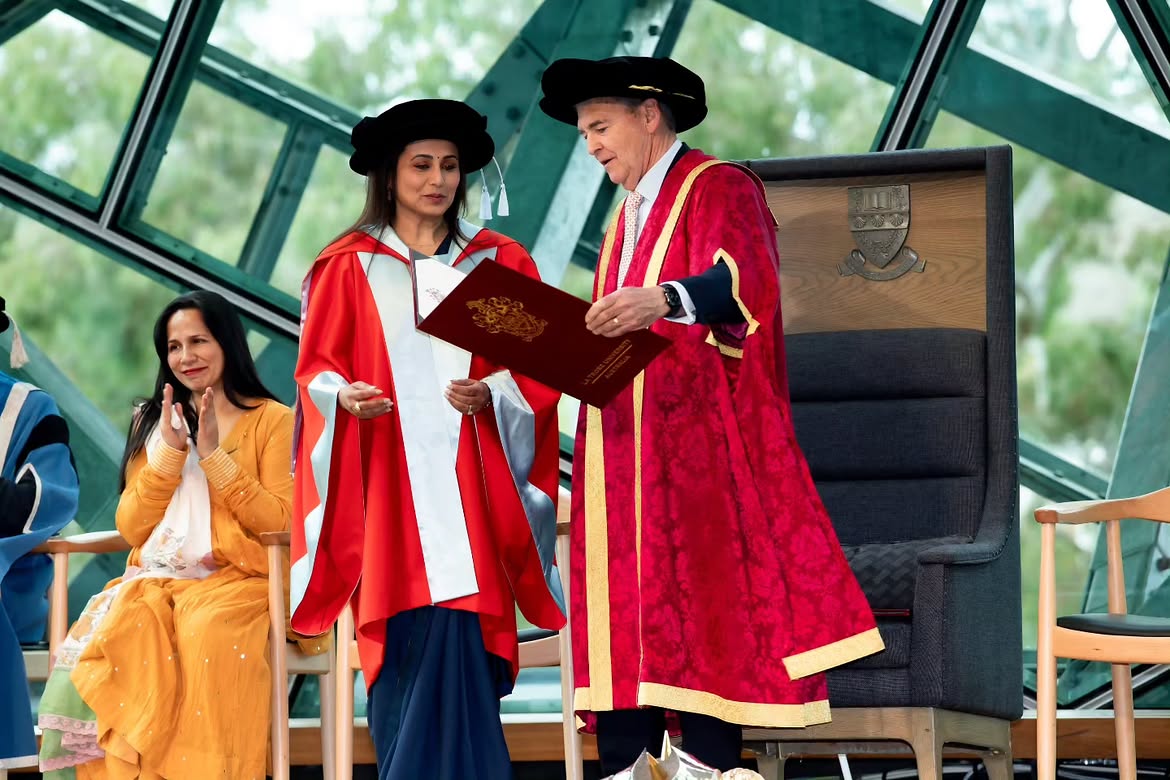
Bollywood actor Rani Mukerji has been conferred an Honorary Doctor of Letters (honoris causa) by Australia’s La Trobe University, recognising her nearly three-decade contribution to Indian cinema and her work highlighting issues affecting women and marginalised communities.
The honorary degree was conferred on 14 August 2026 at a special ceremony at Federation Square in Melbourne, held in partnership with the Indian Film Festival of Melbourne (IFFM) 2026. La Trobe had announced the honour in recognition of Mukerji’s contribution to Indian cinema and her commitment to humanitarian causes and social advocacy.
Mukerji becomes the second Indian film personality to receive an Honorary Doctor of Letters from La Trobe University, following Shah Rukh Khan, who was honoured by the university in 2019.
La Trobe awarded Khan its highest accolade for his achievements in the Indian entertainment industry and his humanitarian work, including his efforts towards women’s empowerment through the Meer Foundation. The university also announced a PhD scholarship in his name in 2019.
Accepting the honour, Mukerji described the recognition as one of the most humbling moments of her life. She reflected on her childhood ambition to make her family and country proud and said cinema eventually became the medium through which she could pursue that goal.
The actor also spoke about the choices she has made throughout her career. She said she had been a risk-taker from the beginning and consistently chose stories that moved her and addressed issues she believed deserved to be told.
Mukerji has frequently portrayed women facing difficult personal and social circumstances. Her filmography includes Black, No One Killed Jessica, Hichki, the Mardaani franchise and Mrs Chatterjee vs Norway. These films have explored subjects including gender-based violence, disability inclusion, access to justice, women’s rights and social prejudice. La Trobe specifically highlighted the way her performances have helped bring such issues into mainstream conversations.
For Mukerji, the recognition also carries a wider cultural meaning. She said artists have a responsibility that extends beyond their performances because cinema can influence how audiences understand people, communities and cultures.
She further described films as a way of creating empathy and encouraging dialogue. According to Mukerji, if her work has helped even one person understand India or Indian women better, she considers that an important responsibility fulfilled.
La Trobe University’s Chancellor John Brumby AO praised Mukerji’s contribution, saying her body of work had moved beyond entertainment to encourage conversations around social justice, equality and inclusion.
The honour also comes during the 2026 Indian Film Festival of Melbourne, which runs from 13 to 23 August. The festival has long served as an important platform for celebrating Indian cinema and strengthening cultural connections between India and Australia.
For Mukerji, the honorary doctorate adds another distinction to a career spanning almost three decades. More importantly, it recognises the influence of storytelling beyond the screen.
Accepting the honour as both an actor and an Indian, Mukerji dedicated the recognition to audiences and artists who believe cinema can build connections between people and nations.
The award therefore represents more than recognition for an individual performer. It highlights the growing cultural influence of Indian cinema and the ability of storytelling to open conversations about equality, inclusion and social change.
Subscribe Deshwale on YouTube
