



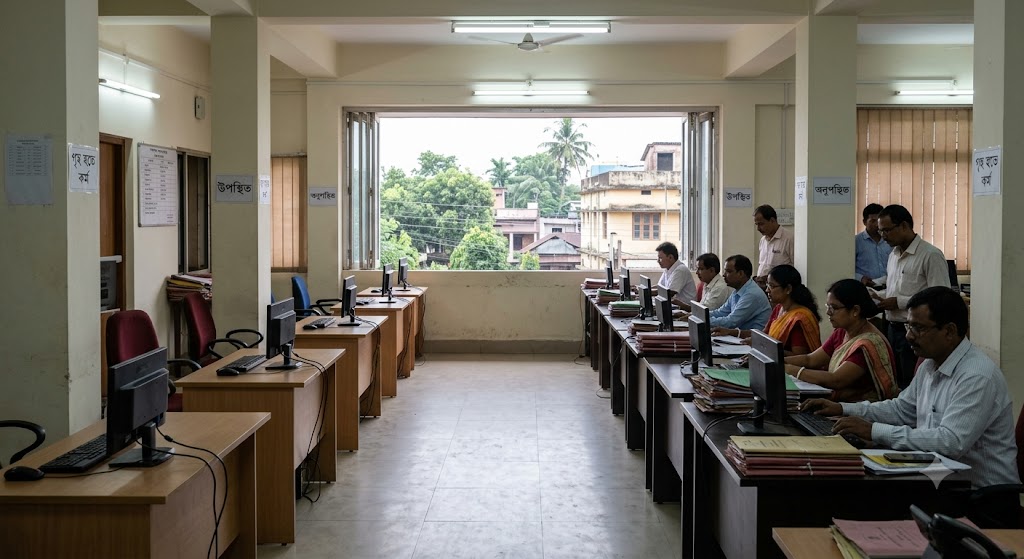
Imagine reaching a government office for some work and finding only half of the usual staff at their desks. The rest are at home, but they are not on leave. They are working.
That is the new arrangement introduced by the Tripura government. The state has directed departments to keep 50% of Group C and Group D employees in office each day, while the remaining 50% work from home on a rotational basis. The decision came into effect immediately and will continue until further orders.
The idea is fairly simple. Fewer employees travelling to work means fewer daily journeys, which can help reduce fuel consumption. It is also part of a wider austerity approach aimed at controlling government expenditure. The move followed an appeal to conserve fuel and use work-from-home arrangements wherever possible.
But this is not a holiday for the employees working from home.
Each department has been asked to prepare a weekly roster. Employees will be divided into groups so that office attendance continues while others work remotely. Those working from home must remain available through telephone and electronic communication. If an urgent task requires them to come to the office, they may be asked to report physically.
Interestingly, the government has also suggested that officials living close to their offices should be included in the first week’s roster. This is another small step aimed at reducing unnecessary travel and fuel use.
Tripura has around one lakh government employees, with a large share belonging to Group C and Group D categories. That makes the scale of the arrangement significant. The government has also suggested that similar measures could be adopted by public sector undertakings, local bodies, autonomous and statutory organisations and other subordinate offices.
There is, however, one important exception. Essential and emergency services will remain outside the work-from-home arrangement. In other words, services that need employees physically present cannot simply be shifted to a laptop or phone.
The decision also brings back memories of the large-scale work-from-home experiment during the Covid-19 pandemic. But this time, the reason is different. The government is not responding to a health emergency. It is using remote work as an administrative tool for fuel conservation and cost control.
The bigger question is whether government work can remain smooth when fewer employees are physically present each day. If the system works, it could show how even routine government offices can reduce travel without completely stopping their work.
For employees, it means a different weekly routine. For citizens, the real test will be whether their work at government offices continues without unnecessary delays.
For now, Tripura is trying something that many private companies already know well: sometimes, keeping the work moving does not necessarily mean keeping everyone in the office.
Subscribe Deshwale on YouTube
