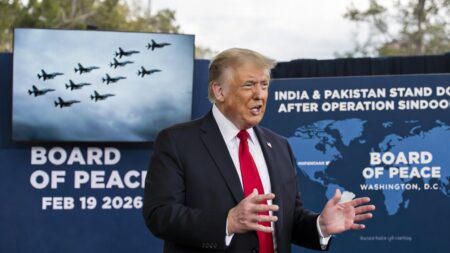






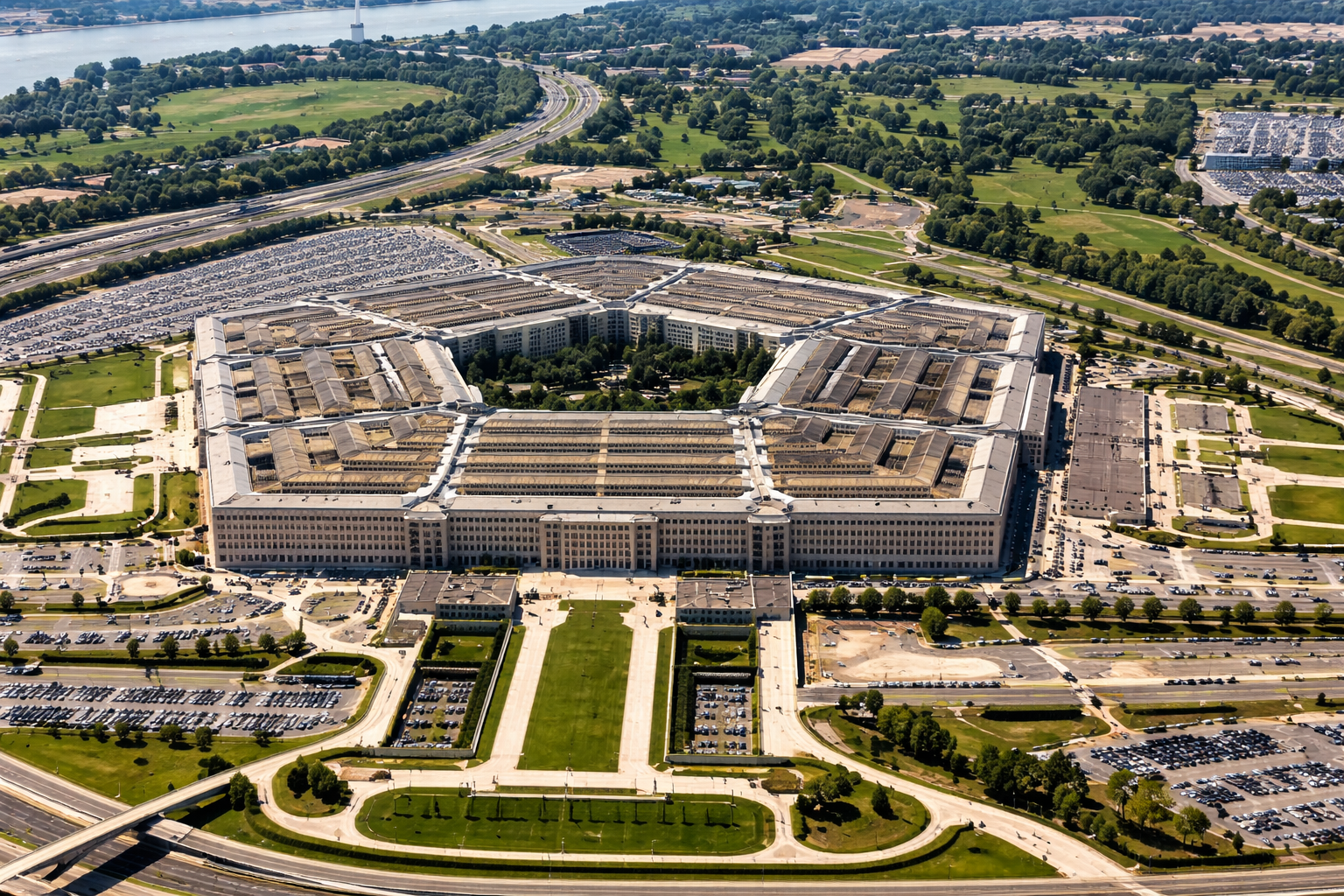
Seven decades of official silence on extraterrestrial life may be coming to an end. Or it may simply be acquiring a more elaborate set of institutional excuses. On the evening of February 19, 2026, President Donald Trump posted a directive on Truth Social instructing the Department of Defense and other federal agencies to begin identifying and releasing government records related to UFOs, unidentified aerial phenomena, alien life, and all connected information. The announcement was sweeping in ambition and sparse in detail. It named no timeline, defined no scope, and made no commitment on whether genuinely classified material would ever reach the public. Washington has heard versions of this promise before. What makes this moment different is the weight of everything that has been building behind it.
The Trigger Behind the Directive
The announcement did not emerge from a policy review or a legislative push. It emerged from a podcast. Days before Trump’s post, former President Barack Obama made remarks suggesting that extraterrestrial life very likely exists somewhere in a universe of staggering scale. The comment spread rapidly. Obama clarified that he was speaking statistically, not from any classified knowledge, and that he had seen no evidence of contact or hidden programmes during his presidency. Trump, speaking to reporters aboard Air Force One, accused Obama of potentially disclosing classified information and suggested that declassifying the relevant files himself would resolve the matter. By evening, the directive was live.
The sequence is revealing. This was not policy. It was a political counterpunch that happened to land on a subject with genuine and lasting public importance. That does not make the directive meaningless. It does mean the follow-through will require pressure from outside the White House to materialise into something real.
A Legislative Battle Already Decades Old
The demand for UAP transparency has been building with serious legislative momentum since 2017, when former Pentagon officials ensured that Navy videos of unidentified objects reached major publications. The footage reignited mainstream interest and forced a conversation that official Washington had long preferred to avoid. Congress held its first UAP hearings in fifty years in May 2022. The Pentagon created the All-domain Anomaly Resolution Office, known as AARO, in July 2022 to serve as a central repository for military encounter reports. In 2023, Congress passed the Unidentified Anomalous Phenomena Disclosure Act, and three military veterans testified before a House hearing that the government had been excessively secretive about incidents with genuine national security implications.
By 2024, AARO had logged 1,652 UAP reports, with 757 new sightings recorded in a single fourteen-month period. Most were resolved as drones, balloons, birds, satellites, or atmospheric events. A consolidated 2024 report covering investigations stretching back to the 1940s found no verified evidence of extraterrestrial technology or beings. Then, in January 2026, a House Republican released a whistleblower video appearing to show a US missile striking an unidentified glowing orb and deflecting off it. The footage had no official explanation. The public appetite for answers was already at a high point when Trump’s post appeared.
The National Security Reality
Remove the extraterrestrial framing and the harder question underneath becomes visible. A significant portion of unexplained UAP sightings near US military installations may not involve alien craft at all. They may reflect advances in drone technology, stealth capabilities, or aerial surveillance developed by foreign adversaries, particularly China and Russia. The Pentagon’s own reporting has noted that the wave of UFO sightings in the 1950s and 1960s was largely produced by classified American spy plane tests. The pattern, then as now, suggests the most consequential explanations are earthly ones.
If that is true of current unresolved cases, the classification of those files exists not to protect a cosmic secret but to protect intelligence collection methods, sensor data, and knowledge of where US air defences have gaps. Any serious declassification process will have to weigh each file against that risk individually. A social media directive does not override the Espionage Act. The intelligence community has substantial legal authority to resist or delay disclosures it considers harmful to national security. The security dimension makes the politics considerably more complicated than the announcement suggested.
The Politics of a Bipartisan Issue
UAP transparency is one of the few subjects in contemporary American politics that generates genuine cross-party energy. Unlike most issues, where positions lock along familiar lines almost immediately, questions about government secrecy on aerial phenomena draw in military veterans, civil libertarians, mainstream scientists, and ordinary citizens from across the political spectrum.
Republican Congresswoman Anna Paulina Luna, who chairs a congressional UAP task force, welcomed Trump’s directive. Republican Congressman Thomas Massie was more sceptical, arguing publicly that the announcement served as a distraction from unresolved questions about the Jeffrey Epstein files. His comparison resonated with a specific portion of the electorate that treats government secrecy as a single interconnected problem, regardless of subject. The split within one party alone illustrates that even among those who want disclosure, the question of motive matters.
The Scientific Stake
The scientific community has watched this debate with its own distinct interest. Researchers in astrobiology and related fields have long argued that raw government sensor data on unexplained aerial phenomena belongs in the scientific domain, where it can be independently examined and peer reviewed. The universe contains an estimated two trillion galaxies. The statistical probability that Earth is the only cradle of intelligent life in all of that is, by any serious mathematical measure, extremely low. But statistical likelihood is not evidence, and what scientists need from these files is not confirmation of a belief. They need data. If the 1,652 logged UAP reports contain instrument readings and sensor observations that have never been subjected to independent scientific analysis, their release would advance human knowledge regardless of what they ultimately show.
What the Next Six Months Will Reveal
Identifying and cataloguing relevant records across the Pentagon, the CIA, the NSA, the Office of the Director of National Intelligence, and multiple military branches is a substantial undertaking on its own. Legal review follows. National security redactions will be applied. Some files will almost certainly never reach the public in their complete form. The real measure of this directive is not the post that launched it. It is what has actually been released, examined, and verified by independent eyes six months from now.
Transparency promises on UAPs have been made before and have delivered less than they promised. This time the legislative groundwork is stronger, the bipartisan pressure is louder, and the public’s patience with official evasion is visibly shorter. Whether that combination is finally enough to produce genuine accountability, or whether it produces only a more polished version of the same institutional reluctance, is the question this directive has set in motion. History, on this particular subject, has always counselled patience and scepticism in equal measure. That counsel has not yet been proved wrong.
Subscribe Deshwale on YouTube