






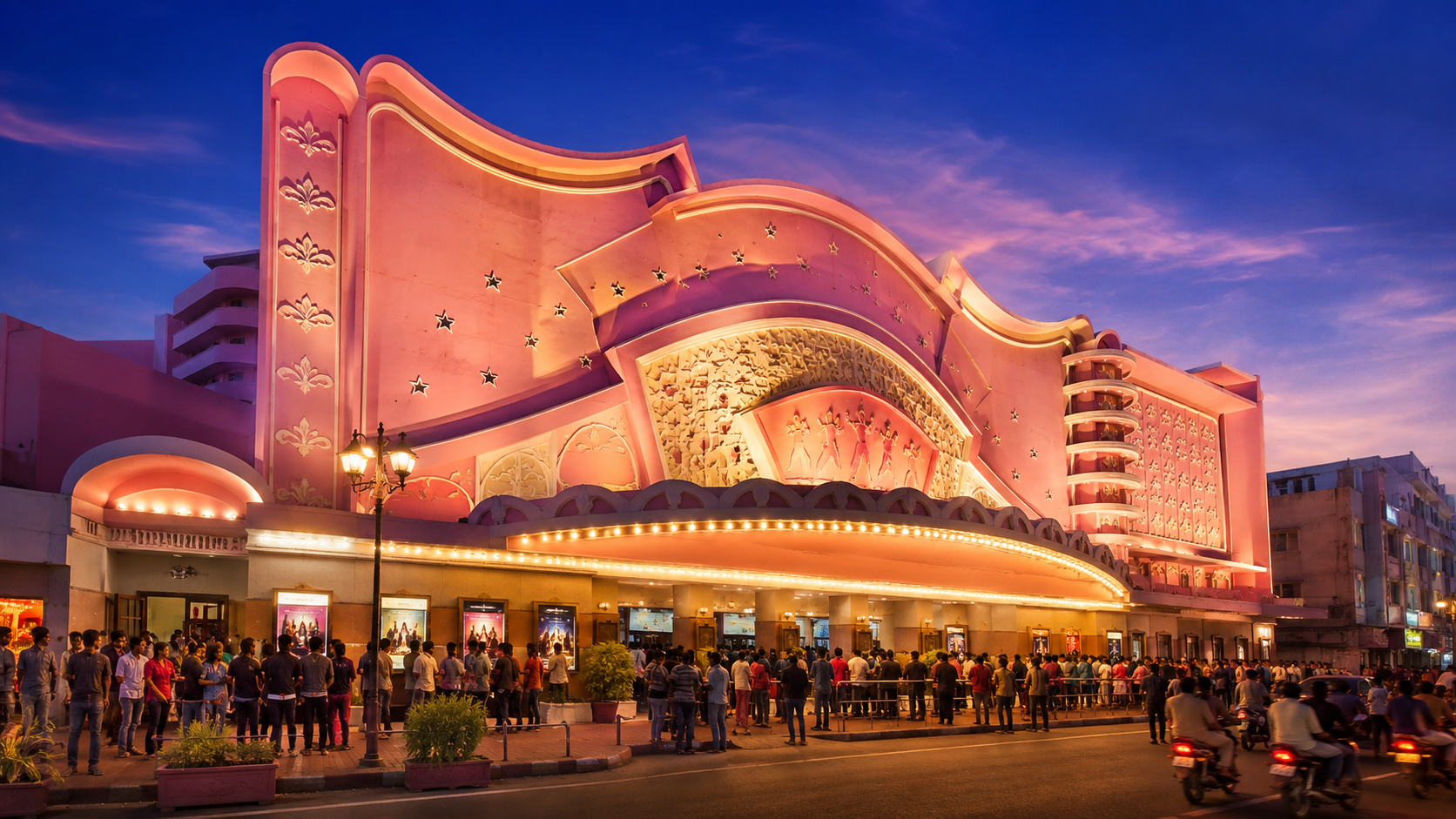
On July 28, Sunny Deol and director Rajkumar Santoshi will walk into a pink, meringue-shaped hall in Jaipur to unveil the trailer of Batwara 1947. It is a film about people torn from homes that no longer recognised them after Partition. There is something fitting about introducing that story inside a building that has spent fifty years refusing to be written off.
Single screens were not supposed to survive this long. India had close to 25,000 of them in the 1990s. Barely a quarter remain today, squeezed out by multiplexes, streaming platforms, and a business that no longer tolerates a slow opening weekend. Jaipur lost its own grand hall, the Golcha, built by the same family. Mumbai’s Minerva, which once ran Sholay for five uninterrupted years, downed its shutters in 2006. Raj Mandir alone kept going, and did it by becoming something far rarer than a nostalgia trip: a single screen that A-list stars now choose over the country’s biggest city.
A decade in the making
The story behind the theatre sounds almost like a film plot itself. In 1966, Rajasthan’s then chief minister Mohanlal Sukhadia reportedly asked Jaipur businessman Mehtab Chandra Golcha why a man who had already built cinemas in Mumbai and Delhi had never built one at home. Golcha rose to it, hiring architect W.M. Namjoshi, who had designed both those earlier halls, to build something grander still.
Getting there was not simple. Neighbours near St. Xavier’s School and Suraj Hospital objected to a cinema coming up so close by, and the resulting legal tangle nearly buried the project. It was Golcha’s brother-in-law, jeweller Rajmal Surana, who stepped in and saw it through, which is why the theatre has stayed in the Surana family ever since. The foundation stone went down in 1966; the doors finally opened a decade later, on June 1, 1976, with Ramanand Sagar’s Charas. Crowds spilled onto the street that first weekend, and old-timers still talk about mounted police being called in just to control them.
A palace built for one purpose
Namjoshi designed the exterior in the Streamline Moderne style, all sweeping curves and asymmetric lines, which is why it looks from a distance like a scoop of pink meringue set against the sky. Walk inside, though, and the fantasy changes direction entirely: the circular foyer, with its chandeliers and ornate stucco, feels closer to royal Rajasthan than to Art Deco Bombay. The lights along the ceiling shift colour through the show, white while the audience settles in and blue at interval, timed to a shehnai playing over the speakers. Nine stars set into the facade quietly reference the Suranas’ other family business, a century-old jewellery house that has made kundan and meenakari pieces for clients such as Gayatri Devi and Rekha.
The seating tiers borrow the same theme, named Ruby, Emerald, Diamond and Pearl, with prices still running from around ₹150 for the front rows to ₹500 for a box. At 73 feet by 33 feet, the screen dwarfs anything a modern multiplex can offer. Capacity has shrunk over the decades, from roughly 1,200 seats to about 800 after the theatre switched to push-back recliners, but almost nothing else about the place has been allowed to shrink with it.
A guest book that reads like film history
Raj Mandir’s visitors’ register is, in effect, an informal history of Hindi cinema. Hum Aapke Hain Kaun played there for 75 weeks, Ram Teri Ganga Maili for 74. Raj Kapoor once wrote that if every theatre owner in India ran their hall the way Raj Mandir was run, no film would ever flop; his grandson Ranbir Kapoor added his own entry decades later. The 92-year-old owner, Kushal Chand Surana, still turns up most weeks in his wheelchair to check on things, by his own admission not much of a film-watcher himself, more the custodian of a legacy he was handed.
For Sunny Deol specifically, the hall has become something close to a lucky charm. He brought Gadar – Ek Prem Katha‘s re-release here in 2023 ahead of Gadar 2, and returned in March this year for Jaat; both went on to do huge business. Vicky Kaushal has made the same trip for three films running. In 2023, the makers of Bhool Bhulaiyaa 3 broke from convention entirely and picked Jaipur over Mumbai for their trailer launch. Even Warner Bros. chose Raj Mandir for the first Hindi-dubbed premiere of a Jurassic World film.
Ask regulars why they keep returning, and the film playing that week rarely comes up first. It is the fact that everyone shares the same seats and the same samosas, whatever their budget. It is the ritual of watching the lights change colour at interval. Fifty years after it opened on a half-finished dream, Raj Mandir remains one of the last places in India where a film’s release still feels like an event, which is exactly why a story about a country splitting apart in 1947 will choose to introduce itself inside a theatre built to prove that magic still happens on a big screen.
Subscribe Deshwale on YouTube


