



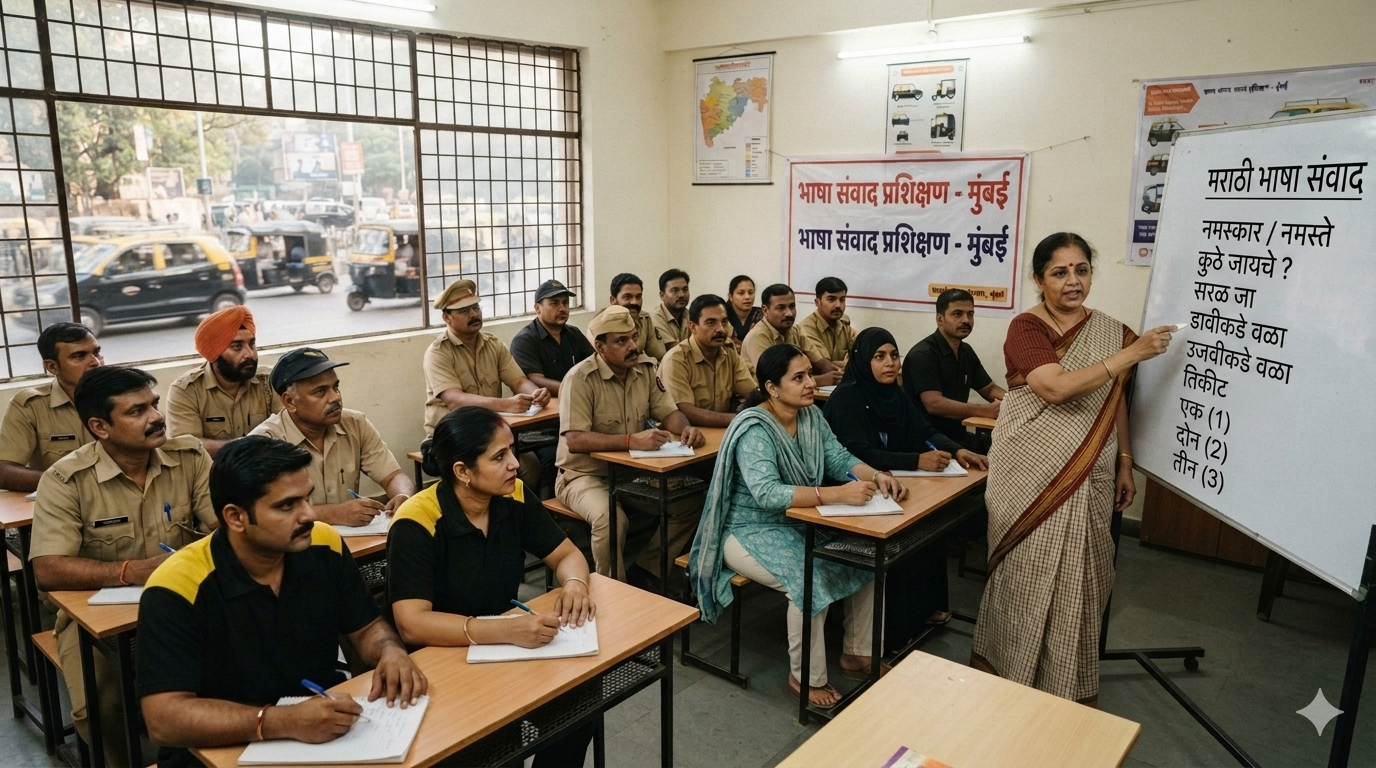
Every day, millions of people across Maharashtra rely on autos and taxis to get around. But with many drivers coming from different parts of India, language has often become a barrier. To address this, the Maharashtra government launched the Marathi Bhasha Samvad Pathyakram (Marathi Communication Course), a functional Marathi training programme for non-Marathi-speaking auto and taxi drivers. More than one lakh drivers have already completed the course, while the remaining drivers have been asked to complete the training before the government’s 15 August deadline. Under the programme, non-Marathi-speaking commercial passenger vehicle drivers are required to undergo basic Marathi communication training and obtain certification.
The logic behind the initiative is simple. Many non-Marathi-speaking auto and taxi drivers in Maharashtra were unable to communicate effectively in Marathi, making it difficult for some commuters to explain destinations, ask questions or hold basic conversations during their journey. To bridge this communication gap and improve the public transport experience, the Maharashtra government introduced the training programme. According to the government, people working in public-facing roles, such as auto-rickshaw and taxi drivers, should have a basic understanding of Marathi to communicate effectively with local commuters.
One important thing to note is that the government is not asking auto and taxi drivers to become fluent in Marathi. Instead, they are required to learn functional Marathi, such as greetings, directions, fare-related conversations, emergency-related communication and other commonly used phrases. The course is designed to teach practical Marathi used in everyday interactions rather than grammar or advanced language skills. After completing the training and a practical assessment, drivers receive a certificate from authorised institutions.
The training is being conducted with the support of organisations such as the Maharashtra State Marathi Language Department, Konkan Marathi Sahitya Parishad and Mumbai Marathi Sahitya Sangh. The course is offered free of cost, with both offline and online learning options available in many areas. According to the government, around 71 training centres and approximately 4,500 Marathi teachers have been involved in conducting the programme, making it accessible to drivers across the state.
It is also important to understand that the Maharashtra government’s initiative is not aimed at all residents or migrants living in the state. People who have moved to Maharashtra for work, education or other reasons are not required to learn Marathi under this programme. The requirement is limited to public service providers, such as auto-rickshaw and taxi drivers, who interact with commuters every day. So, if you are a resident who does not speak Marathi, there is no need to worry, as the programme does not apply to you.
The initiative has sparked debate across India. Many people have welcomed the move, arguing that those working in public-facing roles should know the local language to communicate better with residents and provide smoother services. Others believe that while learning Marathi is a positive step, making it mandatory could place an additional burden on migrant workers who have moved to Maharashtra to earn a living. The programme has reignited a broader discussion on the balance between preserving regional languages and ensuring that opportunities remain accessible to people from across the country.
Whether one sees it as a step towards better public service or an unnecessary requirement, the initiative has brought language, migration and public service into the national conversation. As more drivers complete the course, its long-term impact on daily commuting and passenger experience in Maharashtra will become clearer. What do you think? Should people working in public-facing jobs be required to learn the local language of the state they work in, or should it remain a personal choice?
Subscribe Deshwale on YouTube
