



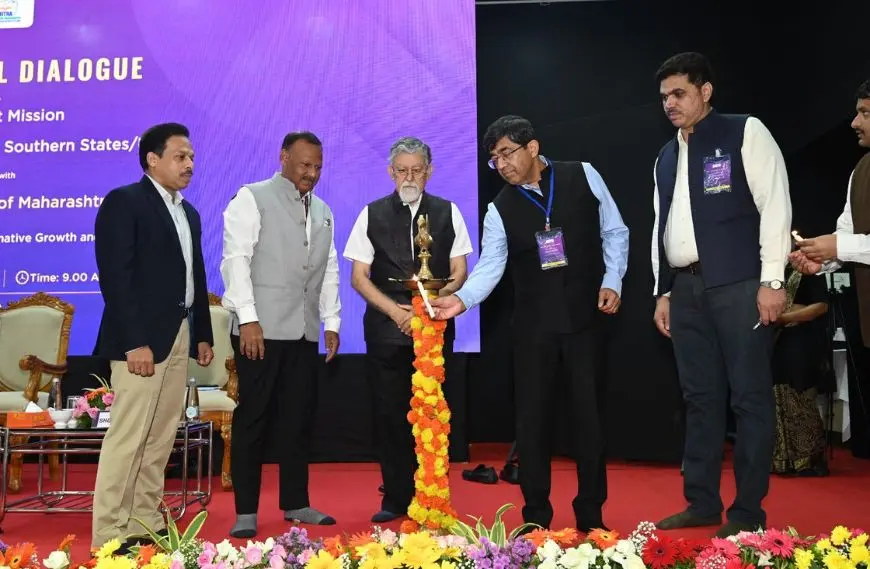
NITI Aayog and the Maharashtra Institution for Transformation (MITRA) successfully hosted the 2nd Regional Dialogue on State Support Mission on 25 September 2025 at YASHADA, Pune. Senior officials from 11 States and Union Territories of Western and Southern India joined the event to exchange ideas and share learnings from their reform efforts. This dialogue followed the first round held in Dehradun earlier this year with Northern States and UTs.
The discussions focused on the role of State Institutions for Transformation (SITs) in shaping state visions, advancing reforms, and aligning strategies with the national goal of Viksit Bharat @2047.
The opening session featured Dr Arvind Virmani, Member of NITI Aayog, Praveen Pardeshi, CEO of MITRA, Rohit Kumar, Additional Secretary, NITI Aayog, and other senior officials. Speakers highlighted SITs as drivers of reform and innovation.
Sessions during the day explored how SITs can function as multidisciplinary hubs for long-term visioning, evidence-based policymaking, and future-ready governance. Contributions came from MITRA, SETU Aayog Uttarakhand, Madhya Pradesh Rajya NITI Aayog, and the World Bank. They shared both national and global models that can inspire future state-level reforms.
One session focused on the 4Ds of Good Governance — Data to Decision, Decision to Development. Experts from DMEO, MoSPI, BISAG-N, and RBI showcased how States can use data and emerging tools like geospatial applications, PM Gati Shakti, and AI/ML models to strengthen governance delivery.
Another key theme was Frontier Technologies for Viksit Bharat @2047. Discussions covered AI, data centres, and other emerging technologies as catalysts for state-level innovation. The Frontier Tech Policy Repository was formally announced at the event.
The session on Growth Hubs highlighted a new urbanisation approach, positioning city regions as engines of prosperity. A special session on State Vision @2047 called for dynamic, data-driven roadmaps for development. The final discussions underlined the critical role of Lead Knowledge Institutions (LKIs) in advancing research, innovation, and policy excellence.
An exhibition was also inaugurated alongside the dialogue. It showcased digital governance tools such as the NITI for States portal, the Viksit Bharat Strategy Room, Meghalaya’s Mother Program, BISAG-N’s geospatial applications, Bhashini’s AI-based translation and transcription platform, and the Experience in a Box device for aspirational districts.
A Compendium capturing insights from more than 50 workshops conducted across India under the State Support Mission over the past two years was also released during the event.The Pune dialogue concluded with a clear consensus: SITs will remain the backbone of governance reforms, and strong, data-driven state institutions are key to realising the vision of Viksit Bharat @2047.
