




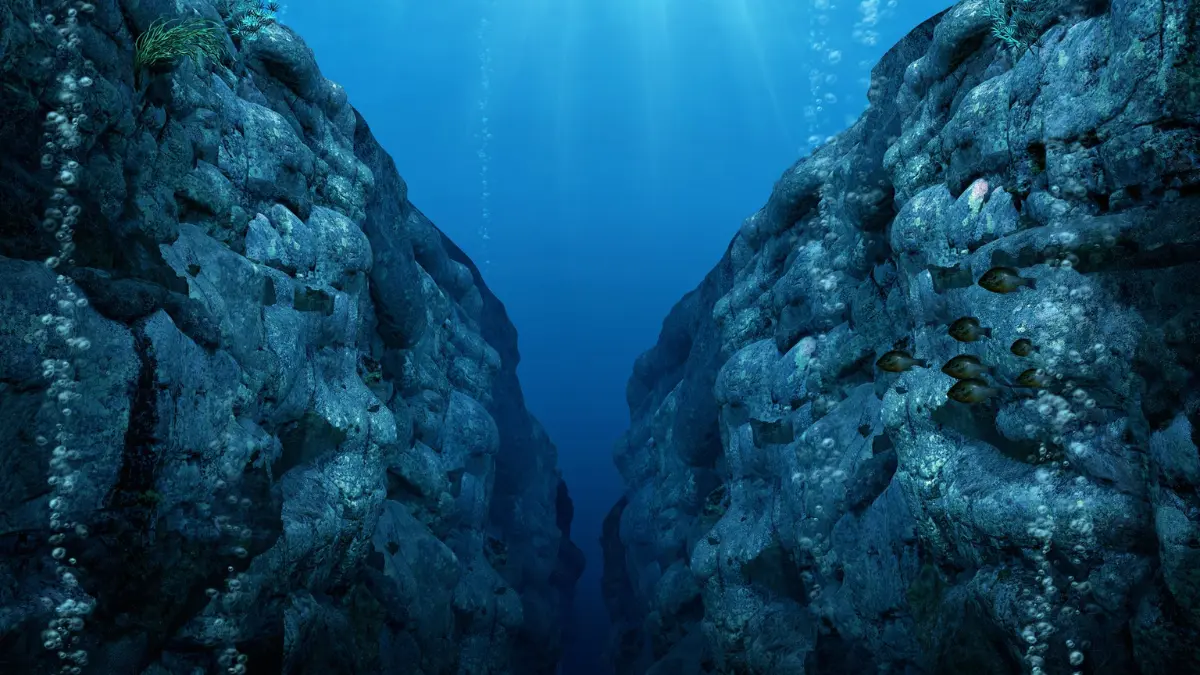
Far beneath the waves, where sunlight fades and pressure crushes, lies a mysterious world few have ever seen. Known as the midnight zone, this region stretches between 1,000 and 4,000 metres below the ocean surface. It is cold, dark, and silent. Yet remarkably, life endures.
Descending Into Darkness
As you descend from the sunlit surface, the ocean changes rapidly. Light dims through the twilight zone until it disappears entirely. The seabed below becomes an endless plain of black, interrupted only by deep trenches like the Mariana, where pressure soars to levels a thousand times greater than at sea level. Imagine stacking ten Eiffel Towers on your head, that is the kind of force creatures here must survive.
Nature’s Toughest Survivors
Despite the extreme conditions, life thrives by adapting in extraordinary ways. Many species have soft bodies, flexible membranes, and specialised proteins that allow them to survive without being crushed. These deep-sea creatures challenge everything we think we know about biology. As deep-sea explorer Edith Widder notes, “They thrive where we would be instant purée.”
Where Food Falls From Above
Since no sunlight reaches the midnight zone, plants cannot grow and photosynthesis is impossible. Instead, food drifts down from above in the form of marine snow, a slow fall of dead plankton, faecal matter, and bits of algae. Sometimes, entire carcasses sink to the depths. A whale fall, for instance, becomes a feast that sustains an entire ecosystem for decades.
Some animals, such as sea cucumbers and brittle stars, wait for food to settle on the ocean floor. Others, like shrimp and fangtooth fish, actively patrol the depths in search of meals.
Lighting Up the Dark
In this pitch-black environment, many deep-sea animals have developed the ability to produce light, a phenomenon known as bioluminescence. These glowing signals help them attract prey, deter predators, and even find mates.
The anglerfish, for example, dangles a glowing filament to trick smaller fish into swimming close enough to eat. Other species use flashing patterns to communicate. Tiny ostracods create stunning underwater light shows that serve as mating signals in the darkness.
Life Around Hydrothermal Vents
Even in this hostile zone, extreme ecosystems exist. Around hydrothermal vents and cold seeps, creatures gather where chemical-rich water emerges from the seafloor. Here, heat and minerals replace sunlight, supporting unique lifeforms.
Worms, clams, and shrimp live among vents that can reach temperatures above 400°C just millimetres from their bodies. These animals survive thanks to chemosynthesis, where bacteria turn chemicals into energy—a process completely independent of the sun.
Giants of the Deep
The midnight zone is also home to some of the ocean’s most elusive giants. The colossal squid, with eyes as large as dinner plates, lurks in the darkness. Sleeper sharks, slow-moving and ancient, cruise through Norwegian fjords. Massive jellyfish drift silently by, their long tentacles trailing like curtains in the black water.
Unlocking Secrets of the Trenches
Exploration of the midnight zone is still in its early stages. Robotic submersibles are helping scientists map trenches, collect samples, and measure environmental data. Each mission uncovers new species and surprises. It is estimated that as many as two million deep-sea species are yet to be discovered.
Beyond curiosity, these discoveries hold promise. They offer insights into the limits of life and inspire new materials and medical solutions. Enzymes that work under extreme pressure and cold, for instance, could transform how we build and heal.
A Fragile Frontier at Risk
Despite its remoteness, the midnight zone is under threat. Deep-sea mining targets rare metals found in polymetallic nodules on the ocean floor. Extracting them could destroy ancient ecosystems that take centuries to recover. Meanwhile, climate change is altering ocean circulation and reducing oxygen levels, with unknown consequences for trench-dwelling species.
Conservation is crucial. International protections must extend to the deepest parts of our oceans. Mining regulations should prioritise science and ecology over profit.
A World Worth Protecting
The next time you look out at the ocean, remember what lies beneath. Far below the waves, in cold and crushing darkness, life is thriving in forms we are only just beginning to understand. The midnight zone is not a lifeless void, but a living laboratory of resilience and wonder. It reminds us not only of nature’s creativity but of our responsibility to preserve even the most hidden corners of our planet.
