



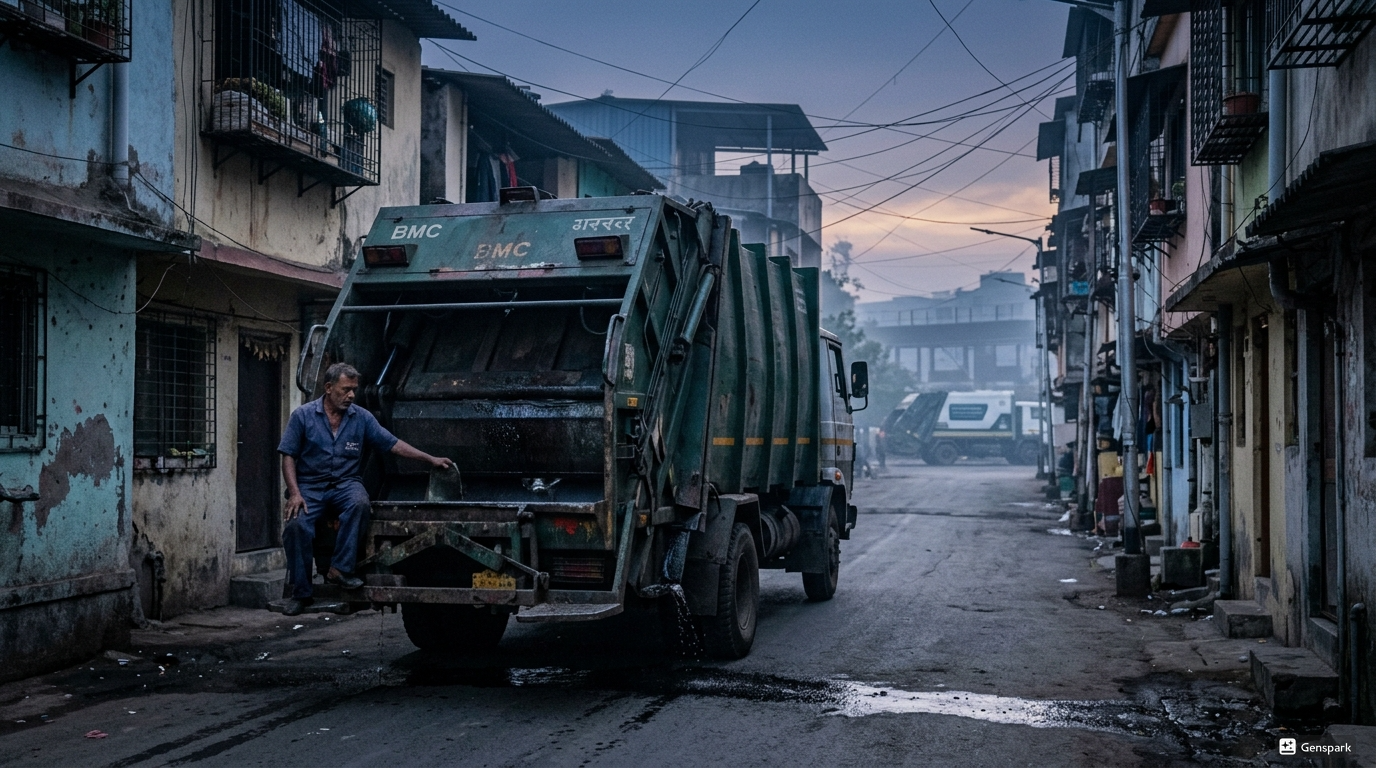
The truck arrives before the city wakes. It is a battered green compactor, older than some of the buildings it passes, grinding through a lane in Kurla at half past five in the morning. It leaks. It always leaks. A thin, dark trail follows it down the road, waste fluid seeping from a floor that was never adequately sealed and, in truth, was never adequately maintained. The sanitation worker riding the back has no air conditioning, no shelter from the heat already gathering at that hour, and no particular expectation that today will be different from any other day in a working life spent managing a city that produces waste faster than it can decide where to put it.
He is not one worker. He is many, and their accounts rhyme with a consistency that speaks less to coincidence than to institutional condition.
This account draws on conversations with several BMC sanitation workers across the eastern and western suburbs, and what they describe is a consistent picture. One worker from the Chembur ward says he has learned to wear an extra pair of socks on collection days because by the end of a morning shift, his boots are soaked through with leachate from the compactor floor. Another, from a depot in the western suburbs, notes that the vehicles break down often enough that drivers have developed informal workarounds for breakdowns mid-route. None of them use the word “dignity” when they talk about their work. But the word is implied in everything they say.
Mumbai generates nearly 7,000 tonnes of solid waste every single day. That figure is roughly the combined weight of 4,500 mid-sized cars, produced daily, requiring collection, transportation, and disposal across a metropolis of over 21 million people living at population densities that most of the world’s cities cannot imagine. The three major landfills serving the city, Deonar, Mulund, and Gorai, were each designed for a fraction of what they now hold. Deonar alone has been burning intermittently for decades, sending toxic plumes across the eastern suburbs, triggering High Court interventions, and producing, after all of that noise and litigation, very little sustained change on the ground.
Now, the Brihanmumbai Municipal Corporation is wagering that change can begin with 988 new vehicles and Rs. 4,000 crore.
The Fleet in Full
The new garbage trucks are blue and white. The colour change is not merely cosmetic. It is, in a city where the old green compactors have become a visual shorthand for civic failure, a deliberate institutional signal. These are different machines. They are meant to look different and, more importantly, to function differently.
The engineering upgrades address specific, documented failures of the existing fleet. Hydraulic closing systems and reinforced flooring are designed to eliminate the leachate trails that currently follow collection vehicles through residential streets every morning. The problem of waste fluid spilling onto roads is not a minor inconvenience. It is a public health issue, a source of persistent odour, and a daily indignity for residents whose mornings begin with the smell of someone else’s design failure. The new vehicles deal with this at the engineering level rather than the supervisory one.
Capacity has been calibrated to the actual geography of the city, which the old fleet largely ignored. The smallest units in the new fleet weigh 600 kg, built specifically for the narrow lanes of older neighbourhoods in the island city and the dense inner suburbs where a standard compactor physically cannot turn. These lanes have been underserved by collection for years precisely because the available vehicles could not reach them. On the other end, large compactors carry up to 7 tonnes for arterial road collections across the wider suburban belt. Between those poles, the fleet offers intermediate capacity vehicles suited to mid-density residential zones. It is, in other words, a fleet designed by someone who has actually studied the city’s street network rather than simply ordered a standard vehicle specification from a catalogue.
For the first time in the institutional history of the BMC’s sanitation operations, driver cabins will be air-conditioned. Front and rear cameras will enable real-time monitoring and, in theory, genuine accountability for collection quality and route compliance. Of the 988 vehicles, 144 will be electric, reducing both emissions and operating costs over the fleet’s working life. The full deployment is targeted for September, with rollout in phases across the city’s 24 administrative wards.
The BMC’s Solid Waste Management By-laws 2025 accompany this fleet with a regulatory framework that formally places responsibility on both the institution and the citizen. The by-laws set out graduated fines for littering and non-segregation, making residents and commercial establishments legally accountable for waste handling at the point of generation. The intent is to align infrastructure investment with behavioural enforcement. Whether the enforcement mechanism has teeth will become evident fairly quickly after the vehicles arrive.
On paper, the programme is impressive. In the context of Mumbai’s waste crisis and the age of the infrastructure it replaces, it is also roughly fifteen years overdue.
What the Rest of the World Built While Mumbai Waited
Germany’s model of circular economy waste management has been operational since the early 1990s. Municipal waste is sorted into a minimum of five categories at the household level. Landfilling of untreated organic waste has been illegal since 2005. The landfill diversion rate sits above 99 per cent, and this is not considered an achievement. It is considered the baseline.
Japan’s waste system is among the most demanding civic frameworks in the world for ordinary residents. In the town of Kamikatsu, communities sort waste into 45 separate categories. Tokyo’s municipal incinerators are clean enough that several have been built alongside public parks and observation decks. Seoul, Taipei, and Singapore treat waste infrastructure as a direct expression of civic values. Singapore’s Semakau Landfill, constructed on a reclaimed offshore island, is managed with such precision that it now functions as a nature reserve alongside its operational purpose. The country has set a target of zero landfill by 2030.
In the Americas, San Francisco has achieved a waste diversion rate of over 80 per cent through mandatory composting, robust recycling infrastructure, and financial penalties for non-compliance. The Brazilian city of Curitiba built something arguably more relevant to Mumbai’s context: in the 1990s it created a programme allowing low-income residents to exchange collected recyclables for bus tokens and food packets. Waste became a social resource. The informal sector, rather than being ignored or displaced, was folded into the city’s sanitation logic. Urban planners studied that model for the better part of three decades. Some are still studying it. Mumbai, meanwhile, has its own version of this informal infrastructure, largely unacknowledged and entirely unprotected. The kabadiwala network, the itinerant waste-pickers and scrap dealers who move through the city’s lanes collecting paper, metal, plastic, and glass, already performs a sorting and recovery function that the BMC has never formally integrated, never financially recognised, and never thought to treat as a civic asset rather than an invisible convenience.
Africa, which is routinely and lazily excluded from these comparative frameworks, provides the sharpest lesson of all. Kigali, Rwanda banned plastic bags in 2008. It enforces a mandatory monthly community cleaning exercise called Umuganda, in which all citizens participate in public sanitation work. The result is a city that is noticeably, measurably clean. Nairobi, Accra, and several other rapidly urbanising African cities have begun integrating their informal waste-picker sectors into formal collection systems, simultaneously improving sorting rates, cutting costs, and providing documented livelihoods to workers who currently operate entirely outside any regulatory protection in most Indian cities.
Mumbai, surveying all of this, is buying trucks. That is a start. It is only a start.
The Civic Catastrophe Nobody Will Own
Here is the section of this story that will not appear in any BMC press release and will certainly not feature in any inauguration speech. A substantial portion of Mumbai’s waste crisis is not infrastructural. It is cultural. It is behavioural. It is a question of what a very large number of this city’s residents have quietly decided they are comfortable with.
Stand outside Andheri station at evening rush hour. Visit Dadar market on a weekday afternoon. Walk along Juhu beach the morning after any large public celebration. The volume of waste deposited in public spaces by ordinary citizens, not the urban poor, not informal settlement residents, but working, educated, often prosperous Mumbaikars, is genuinely difficult to reconcile with a city that considers itself the country’s most sophisticated metropolis. Plastic cups are dropped mid-stride without a backward glance. Wrappers exit car windows on the Western Express Highway with the casualness of a reflex. Wet and dry waste are knotted together into the same bag and handed to the morning collection worker as though segregation is someone else’s responsibility. For most people in this city, that is precisely what they believe.
This is not, to be clear, a poverty story. The civic sense deficit in Mumbai cuts straight across income lines. A household in Pali Hill and a household in Govandi can share, with equal fidelity, the same working conviction that public cleanliness is the municipality’s problem and personal convenience is a private right. The city has cultivated, over generations, a remarkable tolerance for cohabiting with its own filth. Mumbaikars will argue with genuine passion about BMC’s failures at a dinner table while producing, over the course of that same evening, a small accumulation of napkins, bottles, and packaging that nobody will think to sort.
The gap between civic pride and civic behaviour in this city is one of the more arresting contradictions of urban Indian life, and it will not be resolved by 988 new vehicles. The BMC’s By-laws 2025 are written with this contradiction in mind. They attempt, through graduated fines and institutional accountability provisions, to make the cost of indifference legible to the citizen. But enforcement has historically been the weakest link in every previous iteration of this same ambition. The sub-contractors responsible for waste collection are paid by volume. Mixed waste is logistically simpler to handle than sorted waste, which means the payment model quietly undermines the segregation policy the BMC has officially mandated. Better trucks will not fix this. Cameras on those trucks will not fix this either, not unless the footage is watched and acted upon consistently, which has not been the pattern in this city’s administrative history.
The Larger Machine, and the Land Question
The fleet is the collection tier. What follows collection is equally consequential and, in places, considerably more complicated.
The Deonar Waste-to-Energy plant, scheduled for commissioning in October 2025, is still awaiting regulatory approvals. Once operational, it will process 600 tonnes of municipal waste daily and generate 7 megawatts of electricity. That is a modest figure against the city’s total output, but it represents a philosophically significant shift: waste treated as an energy resource rather than a disposal problem. The BMC has signed an agreement with Mahanagar Gas Limited for a Bio-CNG plant at Deonar capable of processing 500 tonnes of municipal solid waste per day, with an operational target of October 2027. At Mulund, bioremediation of legacy waste is expected to free approximately 24 hectares of land by March 2026. The 2026-27 BMC budget allocates Rs. 580.82 crore to solid waste management within an overall civic budget of Rs. 80,952.56 crore, a figure that reflects, at minimum, a serious institutional commitment to moving this agenda forward.
And then there is Deonar’s unfinished business.
The bioremediation of the Deonar landfill, a Rs. 2,500-crore project to treat 185 lakh tonnes of legacy waste, has not started. Environmental clearances are pending. The site’s location within an eco-sensitive zone requires no-objection certificates from the Coastal Regulatory Zone authority and several other departments, and the approvals process has been moving at a pace that nobody in civic administration has publicly explained or apologised for.
What makes the delay worth examining more carefully is the land beneath the waste. Once remediated, Deonar would yield roughly 110 hectares of potentially usable urban land in a city where developable land is among the most expensive and politically contested real estate on the planet. Mumbai’s history with large institutional landholdings is instructive here. The textile mill lands of Lower Parel, the slum rehabilitation schemes that repeatedly generated more towers than tenements, the salt pan controversies that resurface in every election cycle: all of these are stories of waste management becoming land management, with the civic justification gradually giving way to a real estate logic. This is not an accusation against any specific actor or administration. It is a structural observation that anyone who has watched this city for more than a decade would make. The fact that a project of this scale, with this much money allocated and this much court pressure behind it, remains stuck in a clearance queue is either an administrative failure or something more deliberate. Both possibilities deserve scrutiny that they have not yet received in any sustained way.
What September Must Mean
The September deployment deadline is specific enough to be held accountable. By October, it ought to be possible to assess in concrete terms whether the new fleet has materially changed collection quality across the city’s 24 wards: whether the electric vehicles are charged and maintained, whether the cameras are monitored and acted upon, whether the 600-kg units are actually reaching the lanes the old fleet never could.
The workers who currently ride the backs of leaking green compactors through Kurla at five in the morning are waiting for something more basic than any of that. They are waiting for a machine that does not soak their boots, a cabin that does not bake them through a summer shift, and an employer who has committed to treating their physical conditions as a design consideration rather than an afterthought. The air-conditioned cabins in the new fleet are, in the context of decades of institutional neglect of sanitation workers, a more significant detail than they might appear to a reader processing this story as urban policy.
But the deeper measure of this programme’s success will not be visible in September. It will be visible five years from now, in whether Mumbai has moved in any measurable direction towards the waste outcomes that German, Japanese, Singaporean, and Rwandan cities have demonstrated are achievable. That movement requires infrastructure. It also requires enforcement, revised contractor payment structures, a political willingness to hold citizens personally accountable for their share of the mess, and a civic culture that is prepared, finally, to be embarrassed by its own behaviour in public space.
Mumbai is a city of breathtaking ambition and equally breathtaking inertia, sometimes within the same week. It builds world-class concert halls and leaves the street outside them stained and scattered with the evidence of a crowd that never considered the footpath anyone’s particular responsibility. It produces some of the finest minds in global finance, medicine, and technology, and sends them home every evening to neighbourhoods where the morning begins with the smell of last week’s uncollected decisions.
The blue-and-white trucks are coming. That is genuinely, meaningfully good news. The question is not whether they arrive on schedule. The question is what kind of city they find waiting for them.
