



For decades, the story of Mumbai’s relationship with its own waste has been one of expensive disposal and environmental guilt. Every day, the city generates billions of litres of sewage, most of which eventually finds its way into the Arabian Sea after varying degrees of treatment. It has always been a cost centre, a massive, invisible drain on the municipal budget. But a quiet shift is occurring within the corridors of the Brihanmumbai Municipal Corporation (BMC). The city is finally beginning to view its wastewater not as a liability to be flushed away, but as a resource to be harvested, processed, and sold.
The recent decision by the BMC standing committee to sell treated wastewater from the Colaba Sewage Treatment Plant (STP) marks a significant moment in the urban evolution of the metropolis. By agreeing to supply 3 million litres per day (MLD) of treated water to private entities at a rate of Rs. 15 per 1,000 litres, the civic body is testing a model that could redefine the real estate economy and the industrial water cycle of the city.
The Colaba Experiment and the Price of Water
The Colaba STP is a sophisticated piece of infrastructure. While it has a total treatment capacity of 37 MLD, it is equipped with a tertiary treatment facility capable of processing 10 MLD. Tertiary treatment is the high end of the process. It involves filtration and disinfection that makes the water safe for almost any use other than drinking. However, for a long time, this high quality water had no takers. Nearly 4 million litres were being dumped back into the sea every single day simply because the logistics of moving it did not exist.
The math behind the new deal is telling. It costs the BMC roughly Rs. 12 to produce 1,000 litres of this tertiary treated water. By selling it at Rs. 15, the corporation is not just covering its operating costs but is also generating a modest surplus. For the buyers, in this case, a self-help group that will supply the water to infrastructure giant L&T for the Orange Gate tunnel project, the deal makes perfect sense. In the private market, non-potable water tankers usually charge between Rs. 15 and Rs. 18 for the same amount. By tapping into the BMC supply, the construction industry gets a reliable, environmentally friendly alternative at a competitive price.
Global Blueprints for a Thirsty City
Mumbai is hardly the first global megacity to realise that flushing wealth down the drain is bad business. In Singapore, the national water agency PUB has turned NEWater into a national brand. By treating sewage to a high grade of purity, Singapore provides nearly 40% of its total water demand, selling it primarily to industrial sectors like wafer fabrication plants that require ultra-clean water. This has not only generated massive revenue but has also insulated the city-state from water supply shocks.
Similarly, in Windhoek, Namibia, the municipality has been a pioneer in direct potable reuse for over 50 years. Facing extreme aridity, they treat wastewater so thoroughly that it goes straight back into the drinking water system, proving that the yuck factor can be overcome by rigorous science and transparent communication. Closer to a Mediterranean climate, Israel treats nearly 90% of its wastewater, redirecting it to the Negev Desert for agriculture. By selling this purple pipe water to farmers, the Israeli government has turned a waste product into the backbone of its food security. Mumbai’s move to charge Rs. 15 per 1,000 litres is a local echo of these sophisticated global markets where every drop is accounted for on a balance sheet.
Politics of the Pipe
However, the move has not been without its share of friction. In the BMC, where every drop of water is political, some corporators have voiced strong opposition. The argument is simple. Why should the city sell its recycled water to private contractors and builders when its own departments are starving for it?
Critics from the Shiv Sena (UBT) and other parties have suggested that this water should first serve the city’s internal needs. Mumbai’s fire brigade often struggles with water access during major blazes. The gardens department is constantly looking for ways to keep the city’s shrinking green cover alive. Even the transport wings, like the BEST, need massive amounts of water to wash their fleets every night. To these observers, selling water to a private tunnel project feels like a missed opportunity to build a self-sustaining municipal ecosystem.
The administration, however, views it differently. Generating a revenue stream allows for the partial recovery of the massive capital expenditure incurred in building these advanced STPs. It is a pragmatic approach to urban management, using private demand to subsidise public infrastructure.
The Science of the Second Cycle
From a scientific perspective, the shift toward tertiary treatment is essential for a coastal city like Mumbai. When we dump secondary treated water into the sea, we are still introducing high levels of nitrogen and phosphorus into the marine environment. This can lead to eutrophication, where oxygen levels in the water drop, killing fish and destroying the livelihoods of the Koli fishing communities.
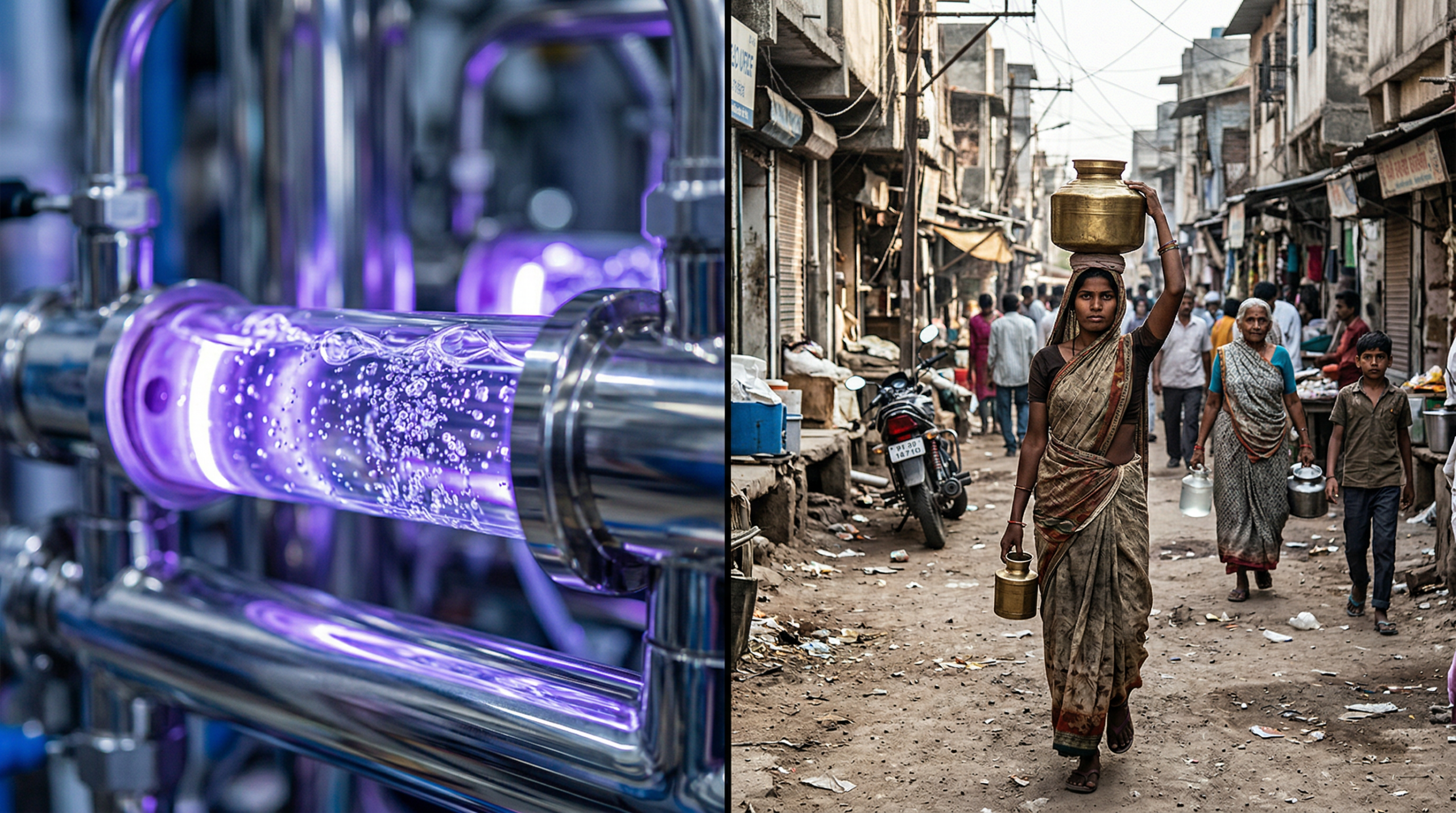
Tertiary treatment uses advanced membranes and ultraviolet (UV) disinfection to strip away these remaining pollutants. The resulting water is clear, odourless, and biologically safe. In a country where the groundwater table is plummeting and monsoon patterns are becoming increasingly erratic due to climate change, the ability to reuse water is no longer a luxury. It is a survival strategy. If Mumbai can successfully scale this model, it could significantly reduce the pressure on its seven massive dams, which are currently the only source of drinking water for over 20 million people.
A Human Stumble in the Master Plan
It is easy to get lost in the grand vision of a circular water economy. But on the ground, the implementation is often clunky. For instance, the BMC still has not figured out a comprehensive pipeline network for treated water. Right now, most of this water has to be moved by tankers. It is a bit of a funny sight if you think about it. A high-tech plant produces clean water, only for it to be pumped into a dusty, leaking truck that burns diesel and adds to the city’s traffic just to deliver it a few kilometres away.
This tanker-dependence is the Achilles’ heel of the project. Until the city invests in a dedicated purple pipe network, the international standard for recycled water lines, the scale of reuse will remain limited to large, localized projects like the Orange Gate tunnel or the Indian Navy’s requirements in the south of the city.
Real Estate and the New Water Mandate
The real estate sector is watching these developments with keen interest. In Mumbai, getting a water connection is often the most difficult part of a new development. Builders are frequently forced to rely on expensive and often illegal private tankers to keep their construction sites running.
If the BMC can guarantee a steady supply of treated water at a fixed rate of Rs. 15, it changes the feasibility of large-scale redevelopment projects. We are seeing a shift where water sustainability is becoming a selling point for premium housing. New complexes in areas like Lower Parel and Wadala are already installing their own mini-STPs, but having access to a municipal supply of recycled water would be a game changer for the middle-class housing societies that cannot afford to run their own treatment plants.
Looking Toward 2027
The Colaba project is just the beginning. The BMC has an ambitious roadmap to ensure 100 per cent sewage treatment by 2027. Massive new plants are coming up in Dharavi, Worli, Bandra, and Malad. The scale of these projects is staggering. The Dharavi plant alone is expected to be one of the largest in Asia.
The goal is to move away from the out of sight, out of mind philosophy of waste management. For too long, Mumbai has treated the Arabian Sea as its backyard dustbin. By putting a price tag on wastewater, the city is finally acknowledging its value. It is a slow, often messy process, but it is the only way to ensure that the city doesn’t run dry in the coming decades.
The Economics of Sustainability
Ultimately, the success of this revenue model will depend on consistency. The BMC needs to prove that it can maintain the quality of the treated water over a long period. If the filtration membranes are not cleaned or if the UV systems fail, the water becomes useless for construction and gardening.
There is also the question of the self-help groups involved in the distribution. While using these groups is a great way to provide local employment, it adds another layer of management to an already complex system. One wonders if the BMC has the oversight capacity to monitor every tanker and every transaction to ensure the water isn’t being diverted or sold at a premium elsewhere.
Final Reflections on a Thirsty City
Mumbai is a city that never stops growing, and its thirst is unquenchable. We have built ourselves into a corner where we are entirely dependent on rain falling in a specific part of the Western Ghats to keep our taps running. This new move to tap into the waste stream is a sign of maturity. It is an admission that we cannot keep taking from nature without learning how to recycle what we have already used.
The Rs. 15 per 1,000 litres might seem like a small figure in the context of a municipal budget that runs into thousands of crores. But it represents a shift in thinking. It is the first step toward a Mumbai where the water in our toilets and the water in our construction sites are part of the same, carefully managed cycle. It is not a perfect plan, and there will surely be some hiccups and perhaps a bit of corruption along the way. But it is a necessary plan.
As the city prepares for another sweltering summer and the inevitable anxiety over lake levels begins to grip the news cycles, the sight of treated water flowing into the Orange Gate project offers a small glimmer of hope. Maybe, just maybe, we are learning how to live within our means.
