



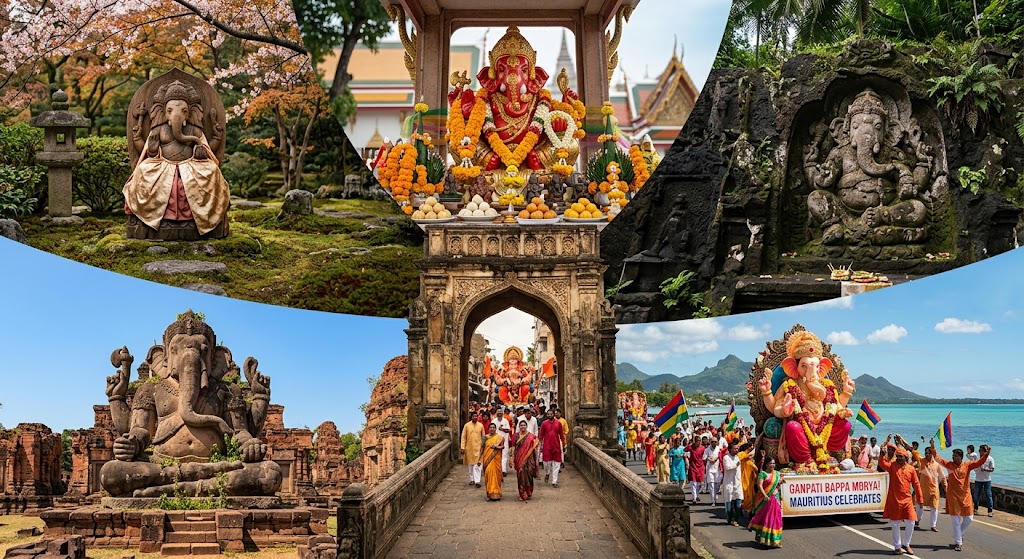
For Indians, Ganpati Bappa is family. He arrives with flowers, modaks, music and the familiar cry of “Ganpati Bappa Morya”. But the story of Ganesha does not stop at India’s borders. Over centuries, through trade, migration and cultural exchange, the elephant headed deity travelled across Asia and beyond, finding a place in different traditions and taking on new names and forms.
In Bali, Indonesia, the ancient Goa Gajah, or Elephant Cave, near Ubud offers a glimpse of Ganesha’s place in the region’s Hindu Buddhist cultural landscape. The archaeological complex dates to the medieval period and reflects the intermingling of religious traditions that shaped Bali.
Thailand knows Ganesha as Phra Phikanet. He is associated with knowledge, the arts, success and prosperity. His presence is particularly visible in Bangkok and other parts of the country, where people seek his blessings for creative and professional pursuits.
Japan offers perhaps one of the most unusual chapters in Ganesha’s journey. Here, he is known as Kangiten, within the esoteric Buddhist tradition. The form and manner of worship are distinctly Japanese, showing how a deity can travel across cultures and acquire a completely different identity. The tradition reached Japan through China around the eighth century.
Cambodia carries another important reminder of Ganesha’s ancient journey. The Khmer world absorbed several elements of Indian religious and artistic traditions. At Koh Ker, the 10th century archaeological complex contains evidence of the wider Hindu influence that shaped Khmer art and architecture. Koh Ker was inscribed on the UNESCO World Heritage List in 2023.
The story becomes more personal in countries where Indian communities carried their traditions with them. In Mauritius, where people of Indian origin form a significant part of the population, Ganesh Chaturthi has become an important public celebration. Temples and processions bring together faith, family and community.
In Singapore, the Sri Senpaga Vinayagar Temple on Ceylon Road has a history stretching back to the 19th century. In Malaysia, Melaka’s Harmony Street is home to the historic Sri Poyatha Moorthi Temple, standing alongside places of worship belonging to other faiths.
And then there is Nepal, where Ganesha worship is woven deeply into the religious traditions of the Kathmandu Valley. Temples such as Suryavinayak, Karyavinayak, Chandrabinayak and Jalavinayak remain important places of worship.
Perhaps that is the most beautiful part of Ganesha’s journey. He did not remain the same everywhere. Different societies gave him different names, stories and forms, while retaining the familiar idea of wisdom, prosperity and the removal of obstacles.
From a festival pandal in Mumbai to an ancient temple in Japan, Ganesha’s journey is more than a story of religion. It is a story of how cultures meet, travel and leave something of themselves behind.
Subscribe Deshwale on YouTube
