



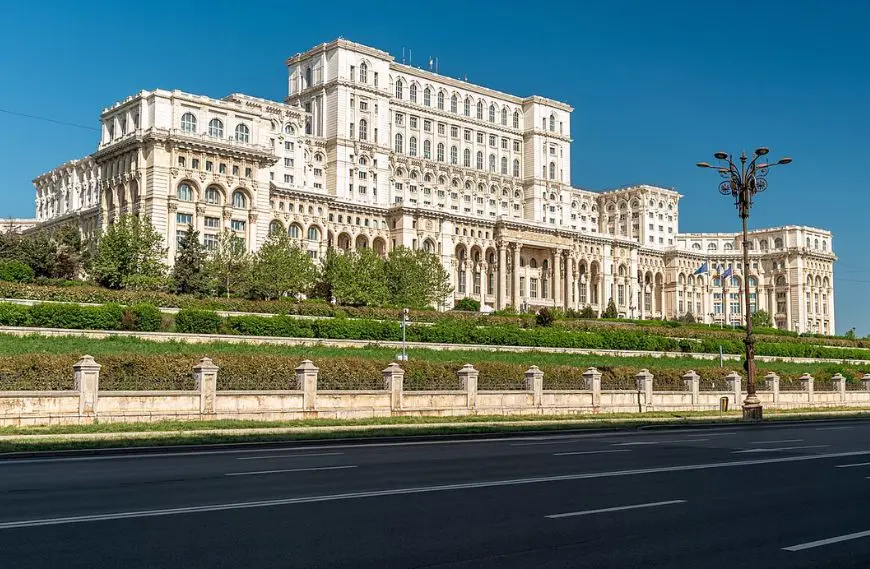
The Palace of the Parliament in Bucharest holds an unusual record. It is officially the world’s heaviest building, weighing more than four million tonnes. Made from steel, marble, wood, and crystal, the structure reflects both ambition and extravagance. While parts of it house Romania’s Senate and museums, most of its 1,100 rooms remain empty. The cost of keeping it running runs into millions every year.
A dictator’s vision turned concrete
The story of the Palace begins with Nicolae Ceaușescu, Romania’s Communist leader. After visiting North Korea in the 1970s, he launched a vast reconstruction plan in Bucharest. Much of the old city was demolished to make space for wide boulevards and monumental structures. At the centre stood his dream project: the House of the Republic, later renamed the People’s House, and today known as the Palace of the Parliament.
Built on a staggering scale
Construction started in 1984 and carried on for 13 years. The main architect, Anca Petrescu, was only 28 when she won the competition to design it. She led 700 architects and tens of thousands of workers, including soldiers and forced labourers. At its peak, up to 100,000 people worked in shifts. Official figures state that 27 people died during construction, though some believe the real number was much higher.
The building itself is colossal. It stands 84 metres tall, stretches 92 metres underground, and covers 365,000 square metres. Its weight is so extreme that it sinks about six millimetres into the ground each year.
Inside the grand halls
The interiors match the outside scale. The palace has over 1,100 rooms, many of them decorated with crystal chandeliers, velvet curtains, and handwoven carpets. More than 400 chandeliers and 1,400 ceiling lights illuminate the halls. Romanian resources were heavily used, with marble, oak, and walnut sourced locally. Yet despite this grandeur, only a third of the space is actually used today.
A costly landmark
The Palace now houses Romania’s Parliament, the Constitutional Court, and museums, including the National Museum of Contemporary Art. But it remains the most expensive administrative building in the world, valued at €4 billion in 2020. Annual running costs exceed $6 million, sparking ongoing debate in Romania.
Symbol of ambition and excess
Tourists flock to see the Palace, often stunned by its size. Yet it continues to divide opinion. Some see it as an architectural wonder, while others view it as a reminder of dictatorship and waste. Larger in volume than even the Great Pyramid of Giza, it stands as both a source of national pride and a monument to excess, leaving behind a legacy that still sparks awe and controversy today.
