



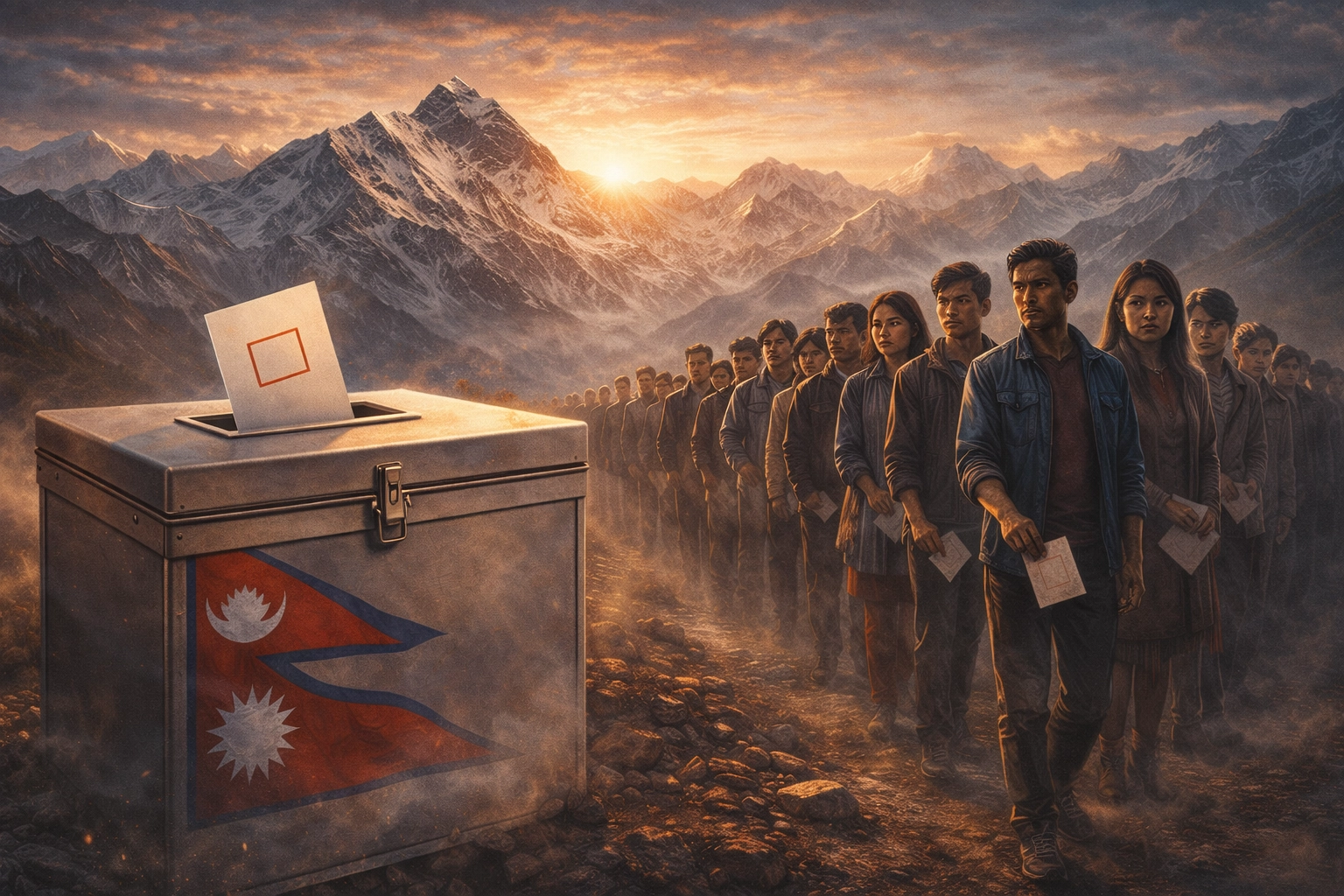
Nepal has entered a critical phase in its democratic journey as millions of citizens head to the polls in the country’s first general election since last year’s youth-led protests dramatically reshaped the political landscape. The vote is widely seen as a defining moment for the Himalayan nation, where frustration with corruption, economic stagnation and political instability has pushed a new generation of voters into the centre of the democratic process.
Nearly 18.9 million registered voters are eligible to cast their ballots to elect representatives to the 275-seat House of Representatives, the lower chamber of Nepal’s federal parliament. The election is being closely watched both domestically and internationally, as it will determine whether the country’s traditional political forces can retain their influence or whether emerging political voices will gain ground following the wave of protests led by younger citizens.
This election carries particular significance because it follows the Gen Z-led uprising that erupted in September 2025, a protest movement largely driven by young Nepalis who demanded accountability and sweeping political reform. The demonstrations spread rapidly across major cities and towns and eventually forced the resignation of the government led by former prime minister K. P. Sharma Oli. The unrest marked one of the most intense periods of political upheaval Nepal has experienced in recent years and left dozens dead, highlighting the depth of public anger toward the country’s political establishment.
The political mobilisation triggered by those protests has had a visible impact on the electorate. A substantial portion of the voter base now consists of younger citizens, many of whom registered for the first time after the demonstrations. Analysts believe this demographic shift could influence voting patterns significantly, as younger voters have been particularly vocal about issues such as corruption, unemployment, and the lack of opportunities within the country.
Nepal’s parliamentary elections follow a mixed electoral system. Of the 275 seats in the House of Representatives, 165 are elected directly through constituency-based voting, while 110 seats are allocated through proportional representation, based on the total vote share secured by political parties nationwide. Thousands of candidates from a wide spectrum of political parties and independent groups are contesting the election, making it one of the most competitive electoral contests in the country’s recent history.
For decades, Nepal’s politics have been dominated by a handful of major parties, including the Nepali Congress and the Communist Party of Nepal (Unified Marxist–Leninist). However, the political mood across the country suggests growing impatience with traditional leadership. New political figures and independent candidates are attempting to channel the energy of last year’s protest movement into electoral gains, presenting themselves as alternatives to the established political order.
One of the prominent figures representing this new political wave is Balendra “Balen” Shah, the rapper-turned-politician who rose to prominence after becoming mayor of Kathmandu. His anti-establishment messaging and focus on governance reforms have resonated strongly with younger voters and urban residents, illustrating the growing appetite for change in Nepal’s political landscape.
To ensure that the voting process remains peaceful and orderly, authorities have launched a large-scale security deployment across the country. Hundreds of thousands of security personnel, including police and temporary security forces, have been stationed around polling stations and sensitive areas. Given Nepal’s challenging geography, election logistics remain complex. Ballot boxes from remote mountainous regions often need to be transported by helicopter or carried manually across difficult terrain, meaning that counting results in some constituencies may take additional time.
The stakes in this election are particularly high because the next government will inherit a series of pressing challenges. Among the most urgent issues are tackling corruption, creating employment opportunities for young people, improving economic stability, and managing Nepal’s delicate diplomatic balance with regional powers such as India and China. Political observers note that any new administration will face strong public expectations to deliver visible reforms and restore confidence in democratic institutions.
Nepal’s democratic system has undergone a turbulent evolution since the abolition of the monarchy and the adoption of a republican constitution. The country has experienced frequent political changes and coalition governments, which have often struggled to deliver long-term policy stability. Against this backdrop, the current election represents more than a routine parliamentary contest. It is widely viewed as a test of whether Nepal’s democratic institutions can adapt to rising public expectations and generational change.
For millions of Nepalis standing in line at polling stations across the country, the vote symbolises an opportunity to shape the nation’s political direction. After a year marked by protests and political uncertainty, citizens are now turning to the ballot box in the hope that it will produce the reforms and accountability many demanded on the streets.
Subscribe Deshwale on YouTube
