



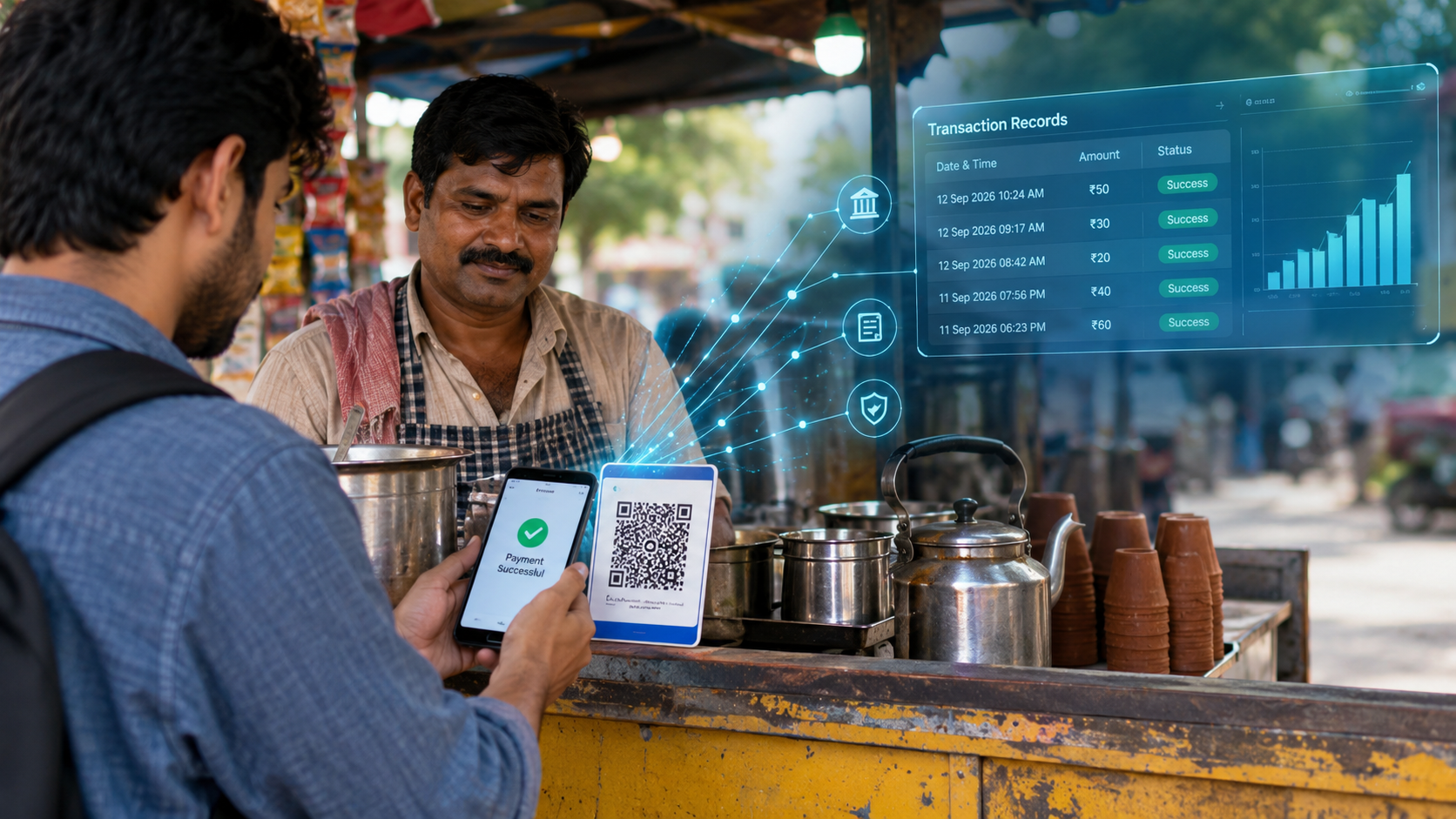
For a decade, the QR code taped to a chai stall has been India’s favourite symbol of progress. A tea seller in Ranchi, a vegetable vendor in Lucknow, a paan shop in Indore all of them now accept payments with a scan and a beep. The story we’ve been told is simple: UPI freed the small trader from the tyranny of cash, made them equal players in a digital economy, and gave them the same convenience as any city-dwelling professional with a bank app.
It’s a good story. It’s also only half of it.
What nobody tells the vendor when he puts up that QR code is that he has just done something his father never had to do. He has made his income visible.
For generations, small vendors in India ran on cash and cash, whatever its inconveniences, had one quiet advantage: it left no trail. Daily earnings were known only to the person counting them at night. Nobody could reconstruct, months later, exactly how much a roadside stall was made on any given day. That informality wasn’t just a loophole. For millions of vendors operating on wafer-thin margins, it was survival.
UPI changes that completely. Every transaction through a QR code is timestamped, recorded, and linked to a bank account. It doesn’t vanish at the end of the day the way a fistful of coins might. It sits in a ledger, visible in principle to banks, payment platforms, and tax authorities. The same feature that makes UPI powerful for the economy at large traceability is precisely what turns a vendor’s daily hustle into a permanent, searchable record.
This isn’t a hypothetical worry. It’s already happened, at scale, in Karnataka. In 2025, the state’s Commercial Taxes Department issued nearly nine thousand GST notices to small traders, built entirely on UPI transaction data collected between 2022 and 2025. The trigger was simple: anyone whose digital receipts crossed forty lakh rupees a year for goods, or twenty lakh for services, was flagged as an unregistered business, regardless of what they were actually selling.
One case became emblematic of the entire episode. A vegetable vendor in Haveri, who had been running his stall since 2021, was served a notice demanding close to twenty-nine lakh rupees in GST dues. His UPI account had received more than one and a half crore rupees over four years almost entirely from customers paying ten, twenty, or fifty rupees at a time for fruits and vegetables, goods that are legally exempt from GST altogether. He had never registered for GST because he believed, correctly, that his produce didn’t attract it. The tax department’s system didn’t know that. It only saw the total.
The fallout was immediate and visible. Handwritten signs reading “UPI Not Accepted” began appearing on stalls across Bengaluru’s markets. Traders who had spent years encouraging customers to scan and pay started asking for cash instead, not because digital payments were inconvenient, but because they were too convenient at revealing exactly how much money had moved through an account that no accountant had ever looked at.
The irony is sharp. The people celebrating UPI’s growth in policy circles are rarely the people who have to live with its consequences at street level. For a salaried professional, digital payments are a footnote one income stream among many that were already fully documented elsewhere. For a small vendor, UPI can be the first time his income becomes legible to anyone outside his own household, whether he sells anything taxable or not.
And here’s the part that rarely gets asked: did the vendor actually choose this? In most cases, no. The push toward QR codes came from banks eager to expand their user base, from platforms competing for merchant volume, and from a national narrative that treated “going cashless” as an unquestionable good. Very few vendors sat down and weighed convenience against visibility. Most adopted UPI simply because customers stopped carrying cash, and refusing to accept it meant losing sales.
None of this means UPI is bad for small businesses. It solves real problems: the risk of theft, the hassle of maintaining change, and the ability to serve customers who no longer carry wallets. A documented income trail can even help a vendor build the kind of credit history a purely cash business never could.
But convenience and consequence often arrive in the same envelope. What’s missing from the celebratory story is any acknowledgment that the vendor is bearing a cost the customer never sees. The shopper walks away having saved thirty seconds. The vendor is left holding a data trail he didn’t ask for, doesn’t fully understand, and in Karnataka’s case, had to fight to explain.
As UPI marks a decade of extraordinary scale, it’s worth asking who has been asked, and who has simply had to adjust. Digital empowerment sounds good in a headline. On the ground, for the person behind the counter, it can just as easily look like a spotlight he never requested.
Subscribe Deshwale on YouTube
