



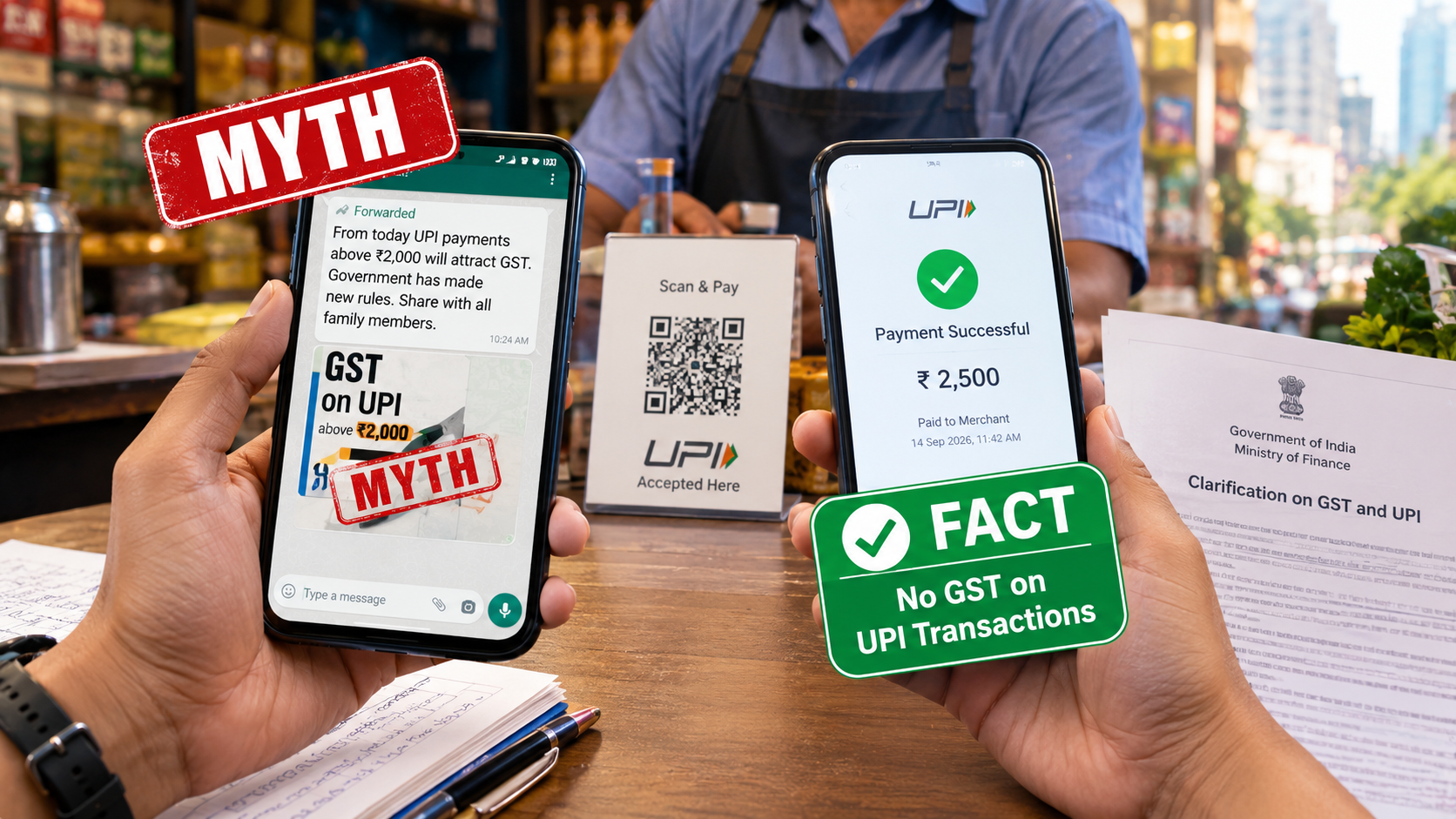
Every few months, a message starts doing the rounds on WhatsApp and social media claiming that UPI payments above a certain amount will now attract GST. People panic, screenshots get shared, and by the time it reaches your family group, it sounds like official news. Here’s the problem it isn’t true. It never has been. And this isn’t the first time this myth has come back to life.
Let’s settle this clearly. As of today, UPI transactions in India do not attract any GST, no matter how much money you send. Whether you transfer ₹50 to a friend or ₹50,000 to a shopkeeper, the payment itself is not taxed. This applies to both personal transfers between individuals and payments made to merchants.
So where does this rumor keep coming from?
The confusion traces back to a discussion that took place in September 2024, when the GST Council was reportedly looking into the idea of taxing certain service fees charged by payment aggregators, specifically for processing small UPI transactions below ₹2,000. This was never a proposal to tax the UPI transaction itself. It was about a possible fee that some payment companies might charge for handling the backend processing, and even that proposal was never finalized.
Somewhere between that discussion and the version that reached people’s phones, the message got twisted. What started as “a fee some companies might charge may attract GST” turned into “UPI payments above ₹2,000 will be taxed.” That’s how misinformation usually works: a small, technical detail gets stripped of context and turns into a scary headline.
The government has had to step in and clarify this more than once. The Finance Ministry and the Central Board of Indirect Taxes and Customs, or CBIC, have publicly stated that these claims are false. This clarification was even repeated in Parliament in 2025, where officials confirmed that there is no GST on UPI transactions, regardless of the amount involved.
There’s a practical reason this makes sense too. Since January 2020, the government has removed the Merchant Discount Rate, or MDR, on all person-to-merchant UPI payments. MDR is essentially a small fee that payment processors use to charge merchants for handling a transaction. Once that fee was scrapped for UPI, there was nothing left to apply GST on. No fee, no tax. It’s as simple as that.
Even the big GST overhaul that happened in September 2025, where the government simplified the tax structure into two main slabs instead of four, did not touch UPI payments in any way. UPI has remained completely outside the GST framework through every round of tax reform.
That said, there are situations where GST does show up near UPI, and this is likely where a lot of the confusion originates. If a payment gateway or aggregator charges a processing fee for a specific service, like handling international payments or certain business transactions, GST can apply to that fee. But even then, the tax is charged on the fee itself, not on the amount you’re actually sending. If there’s no fee, there’s no GST to apply.
There’s also a separate issue that sometimes gets mixed up with this myth income tax. If you’re a freelancer, small business owner, or someone who receives regular payments through UPI for goods or services, that money still counts as income and needs to be reported the way any other income would be. This isn’t a new UPI-specific tax. It’s simply how income tax already works, regardless of whether you’re paid in cash, bank transfer, or UPI.
So why does this myth refuse to die? Part of it comes down to how naturally believable it sounds. Taxes on digital payments exist in other contexts, so when a message claims something similar is happening with UPI, it doesn’t sound far-fetched. Add to that the speed at which financial rumours travel on WhatsApp, often faster than any official clarification can catch up, and you get a myth that resurfaces every year like clockwork.
The next time this message lands in your inbox or family group, you don’t need to panic or forward it further. UPI remains one of the simplest, most cost-free ways to move money in India, and that hasn’t changed. Before believing or sharing anything about a new tax on your daily transactions, it’s worth checking directly with a reliable source, like an official government statement, rather than trusting a forwarded message with no name attached to it.
In a country where UPI has become as routine as making a phone call, keeping the facts straight matters. And the fact is simple: your UPI payments are not being taxed, today or anytime in the near future based on any current policy.
Subscribe Deshwale on YouTube
