



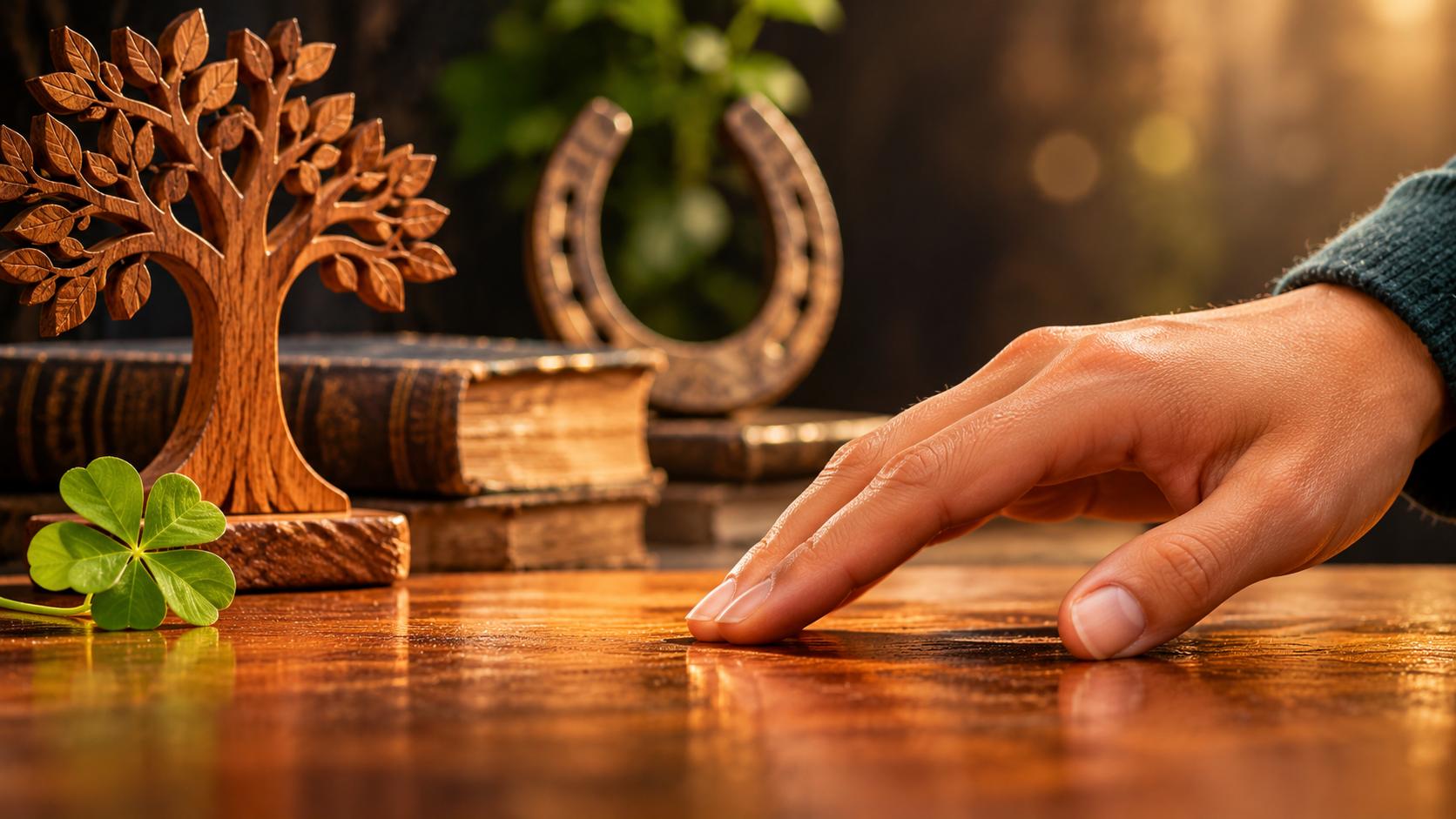
You have probably done it today without noticing. Someone asks how your year is going, and you say you have not fallen sick once. Before the sentence is even finished, your hand has found the nearest table, door or wooden chair and given it a quick tap. “Touch wood,” you add, a little embarrassed, as if the universe might have heard you.
Millions of people do this, and few can say why. It is one of those small habits we pick up as children and never question. So where did it come from? The honest answer is that nobody knows for sure. But the search for an answer is a surprisingly good story.
First, what the phrase actually means. People say “touch wood” after saying something hopeful or confident, mostly to avoid tempting fate. It is a small way of saying, “I hope this stays that way.” In the United States, people say “knock on wood” instead. The words are different, but the idea is the same. Language-history website World Wide Words describes it as a superstitious act meant to ward off bad luck or protect good fortune, and it also notes that the origin is unknown.
The most popular explanation goes back to ancient times. Many old European traditions treated certain trees, such as the oak and the ash, as special or even sacred. According to this theory, people believed spirits or gods lived in trees, so touching or knocking on one was a way of asking for protection, saying thank you for good luck or driving away harmful spirits. A related version says the knock stopped evil spirits from overhearing a person boasting about their good luck and taking it away. It is a lovely idea, but it is hard to prove, because the earliest written examples of the phrase itself are much more recent.
A second explanation brings in religion. Some people link the habit to the wooden cross of the crucifixion of Jesus Christ. In this version, touching wood means asking for divine protection and keeping bad things away. Over time, this became another way of understanding the superstition. But there is no conclusive historical evidence showing that the modern expression actually began with this Christian practice.
Then comes the third theory, and it is the one that surprises most people. British folklorist Steve Roud believes the habit may have started on a playground. In the nineteenth century, children in Britain played a game of tag called “Tiggy Touchwood.” The rule was simple. A player who touched something made of wood, like a tree or a door, was safe from being tagged. The wood gave temporary protection from the chaser. Roud suggests that this idea of protection slowly moved into everyday life and turned into the superstition we know today. He considers the game very likely to be the real starting point. Still, it remains a theory, not a proven fact.
There is a reason this last theory has gained attention. If “touch wood” came from a pagan ritual thousands of years old, some language experts argue, you would expect to find it in old records. But the written evidence is much younger than you might think. World Wide Words says the oldest example it could find of the British phrase “touch wood” is from 1899. The earliest American example of “knock on wood” it found is from 1905. So the earliest written examples are only about 120 to 125 years old, even though many people assume the habit is ancient. Other accounts point to children’s games from earlier in the nineteenth century, and sources do not agree on exact dates. That is one more reason why it is hard to say where the habit began.
It is also worth noticing that this is not only an English habit. Around the world, people have their own ways of keeping bad luck at bay. In Italy, people often say “touch iron” when they are afraid of tempting fate. In Turkey, people are known to pull one earlobe and knock on wood twice to avoid a jinx. The details change from country to country, but the feeling underneath is the same. When something is going well, we feel a small worry that saying it out loud might spoil it, and we want a little ritual to calm that worry.
There is a kind way to look at this habit. Touching wood is not really about believing that a table can control the future. There is no scientific evidence that it can. For most of us, it is more of a gentle, light-hearted gesture. It lets us share a hope without sounding too sure of ourselves. In a way, it is a tiny bit of humility. We admit that life is uncertain, and we ask luck to stay on our side.
So, the mystery stays a mystery. Was it tree spirits, a wooden cross or a game of tag in a school playground? Nobody can say for certain, and it may never be settled. What we do know is that the habit has lasted, and that people still reach for wood when they feel their luck is worth protecting.
Next time you catch yourself tapping a wooden table, you will know that you are doing something with a long, tangled and slightly mysterious history. And if there is no wood nearby, do not worry too much. As far as anyone can tell, the luck was never really in the wood.
Subscribe Deshwale on YouTube
