



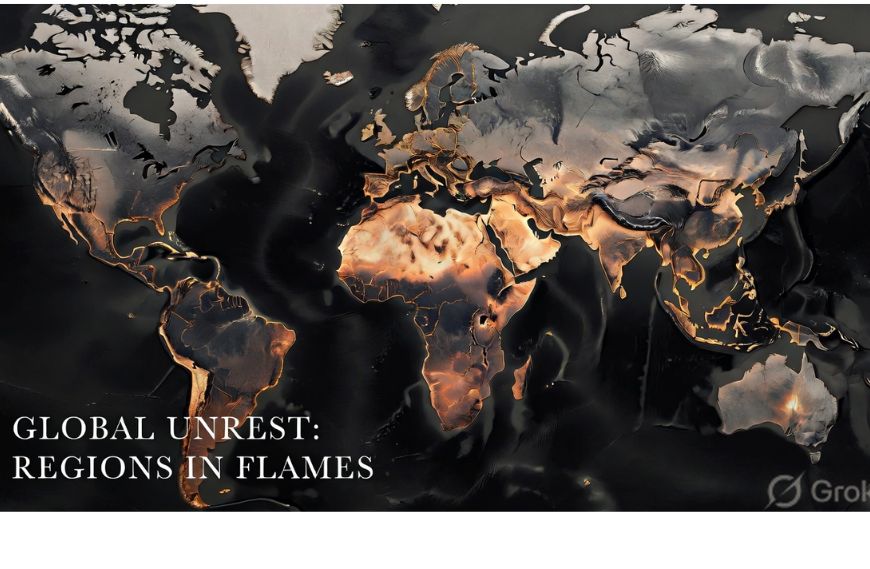
The year 2026 finds our planet not at peace, but fractured. According to data from the Armed Conflict Location and Event Data Project, the International Crisis Group, and the Council on Foreign Relations, approximately 59 ongoing armed conflicts are active across the world right now. When the scope is widened to include political instability, social unrest, economic collapse, and military insurgencies, the number of significantly affected nations rises to between 40 and 50. The World Bank classifies 39 states as fragile or conflict affected, a grim roster that includes Afghanistan, Yemen, and the Central African Republic.
These are not abstract numbers. They represent shattered cities, displaced families, and economies bled dry by war.
The Conflicts Defining This Era
The breadth of active strife spans every continent. The following are among the most significant ongoing crises:
- Sudan is locked in a brutal civil war between the Sudanese Armed Forces and the Rapid Support Forces. The country has been partitioned in effect, with over 11 million people displaced.
- Myanmar continues to see its military junta battle ethnic alliances and pro democracy forces, with no resolution in sight.
- Ethiopia faces ethnic conflicts and insurgencies in regions including Tigray and Oromia, threatening a return to full scale war.
- Syria, more than a decade into conflict, faces sectarian violence that could unravel its fragile stability.
- Yemen, though somewhat de escalated, remains in humanitarian ruins, with Houthi rebels continuing to clash with government forces.
- Iran has seen repeated flaring of protests driven by economic hardship and regime repression.
- Pakistan battles rising militancy from groups including the Tehrik i Taliban Pakistan, which spills across borders and deepens internal divisions.
- Venezuela remains gripped by economic collapse and political repression under Maduro, producing mass migration and internal clashes.
- Ecuador has escalated into a full insurgency against criminal cartels, with the government having declared war on organised crime.
- Nigeria battles Boko Haram in its north while managing nationwide economic protests.
- Haiti functions as a failed state, with gangs controlling large portions of territory amid a political vacuum.
- Lebanon teeters on the edge, its economic failure and political paralysis risking a return to open conflict.
- Bangladesh is recovering from youth led upheaval that toppled its government.
Africa and the Sahel in Crisis
Across Africa, the scale of unrest is particularly severe. In the Sahel region, Mali, Burkina Faso, and Niger are all grappling with jihadist insurgencies and military coups that have destabilised entire societies. The Democratic Republic of Congo, which alone covers 2.3 million square kilometres, endures relentless violence from armed groups in its eastern territories. South Sudan is once again on the edge of civil war, with delayed elections deepening tensions.
Latin America, Asia, and Europe
The instability is not confined to Africa or the Middle East.
- In Latin America, Colombia’s peace with FARC dissidents is fraying, while Peru and Bolivia are contending with social protests rooted in inequality.
- In Asia, the Philippines is fighting both communist insurgents and Islamist groups. India’s Kashmir region continues to simmer with separatist unrest.
- In Europe, Ukraine’s internal divisions are compounded by Russian aggression, and Bosnia Herzegovina carries the ongoing risk of ethnic flare ups.
The Land These Conflicts Consume
The Earth’s total land area is approximately 149 million square kilometres. The nations engulfed in significant internal unrest collectively account for roughly 18 million square kilometres, which is around 12 percent of the world’s land surface. This territory includes Sudan at 1.8 million square kilometres, the Democratic Republic of Congo at 2.3 million, and Iran at 1.6 million. These are not empty expanses. They encompass fertile farmland turned into battleground, ancient cities reduced to rubble, and natural resources being exploited to fund war rather than development.
The Human Cost: 1.5 Billion People
The global population in 2026 stands at approximately 8.3 billion. Of these, around 1.5 billion people, roughly 18 percent of all humanity, are living amid significant unrest. The populations of affected nations include:
- Nigeria: 224 million
- Pakistan: 241 million
- Bangladesh: 173 million
- Ethiopia: 126 million
- Philippines: 117 million
These figures encompass not combatants alone but families surviving in refugee camps, children deprived of schooling, and elderly populations without access to healthcare. In Sudan, over 11 million are displaced. In Myanmar, millions face famine risk. In Lebanon, currency collapse has pushed 80 percent of the population into poverty. In Venezuela, hyperinflation has driven millions to flee their country altogether.
The Spillover No Border Can Stop
This unrest does not stay contained within the nations where it originates. Refugees from Syria and Afghanistan are straining social systems across Europe. Economic migrants from Latin America are testing borders throughout the Americas. Social divisions, rooted in inequality, are feeding extremism and fuelling the rise of far right movements in otherwise stable nations reacting to immigration pressures. Political instability is eroding public trust in institutions, as evidenced by accountability protests across Kenya and Tanzania.
A Resource Drain the World Cannot Afford
Beyond the human suffering, these conflicts represent a staggering economic loss. Sudan’s war alone is costing billions of dollars that could otherwise fund schools, hospitals, and infrastructure. Land scarred by mines and bombardment may require generations to recover. The systemic failure to prevent or resolve these conflicts is not merely a moral failure. It is a practical one, with consequences that reach far beyond the borders of any single nation.
Why Peace Remains Elusive
The persistence of conflict in 2026, in a world more technologically connected than at any prior point in history, raises urgent questions about the role of the world’s major powers. The United States, China, Russia, and others have each, in different ways, fallen short of brokering lasting peace in these regions. The systemic failures that allow this cycle to continue are many, and understanding them is a necessary step toward any meaningful change.
Reporting draws on data from the Armed Conflict Location and Event Data Project, the International Crisis Group, the Council on Foreign Relations, and the World Bank.
Subscribe Deshwale on YouTube
