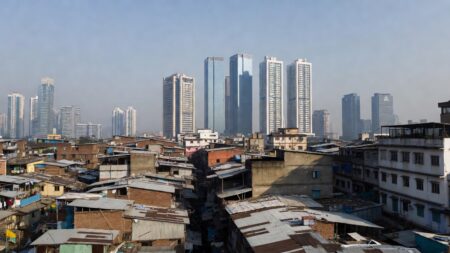







Mumbai has added another elevated pedestrian link to its growing urban network. The new 680 metre skywalk at Bandra East now connects commuters to the Bandra Kurla Complex and the Western Express Highway. The structure aims to ease foot traffic, reduce road congestion and improve safety in one of the city’s busiest corridors.
The project has been welcomed by daily commuters who navigate heavy traffic around Bandra station and the BKC business district. Office workers, students and residents are expected to benefit from faster and safer movement above chaotic roads. Elevated walkways reduce the risk of accidents and offer structured pedestrian flow. In principle, the Bandra East skywalk is a step in the right direction.
However, Mumbai’s experience with earlier skywalks raises valid concerns.
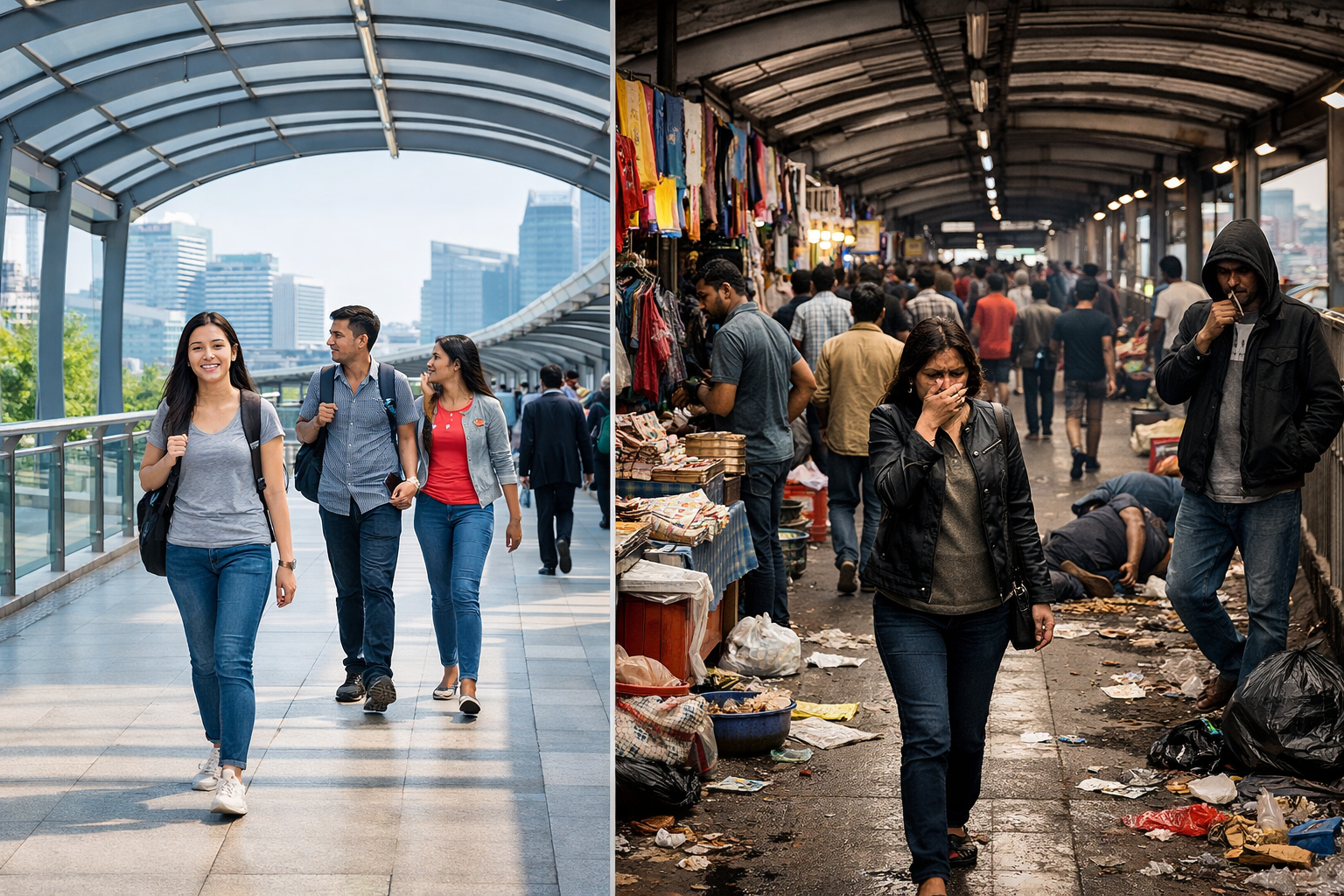
The city has more than 35 skywalks built over the past decade and a half. Several were constructed to decongest railway stations and arterial roads. While some remain functional, others have suffered neglect. In many locations, hawkers, unauthorised vendors, beggars and anti social elements have gradually occupied the space. In a few cases, sections of skywalks have become informal markets. In others, poor lighting and weak security have led to complaints about safety, including the presence of drug users and petty criminals.
For instance, stretches of the Andheri and Ghatkopar skywalks have, at different points, faced encroachments by vendors and loitering by anti social elements. Commuters have often complained that these elevated passages become crowded with stalls, leaving little room for free movement. In some areas near suburban railway stations, pedestrians have chosen to walk on the road below rather than navigate congested skywalk corridors.
This pattern has affected pedestrian confidence.
When a skywalk becomes cluttered with stalls or encroachments, its purpose is defeated. Commuters are forced to squeeze through narrow passages. Some return to using the road below, exposing themselves to traffic risks. Women and elderly citizens often feel unsafe in poorly monitored stretches. Infrastructure meant for safety and efficiency begins to create discomfort.
The Bandra East skywalk must not follow that trajectory.
Authorities need to recognise that construction is only the first step. Continuous monitoring is essential. Regular patrols, CCTV surveillance, adequate lighting and strict enforcement against encroachments should be built into the management plan from day one. A zero tolerance policy towards illegal occupation will be crucial. Maintenance contracts must ensure cleanliness and swift repairs.
A skywalk should be as beautiful and clean as a sky is. Its very name evokes openness and clarity. When maintained well, elevated walkways can aesthetically enhance a city. They offer organised design lines above busy roads. They create visual order in dense neighbourhoods. Clean and well lit skywalks also project civic discipline and administrative seriousness.
Mumbai is a city constantly battling space constraints. Elevated pedestrian corridors are practical solutions in such an environment. Yet their long term success depends on governance. Past lessons are clear. Without sustained oversight, public infrastructure can deteriorate quickly.
The Bandra East skywalk serves a high profile commercial district. That visibility may work in its favour. Business communities and local residents are likely to demand standards. Still, enforcement must remain consistent across all parts of the city, not only in premium zones.
Ultimately, the measure of success will not lie in the length of 680 metres. It will lie in whether commuters feel secure, respected and comfortable while using it. Mumbai deserves skywalks that remain safe passageways rather than informal markets or neglected corridors. The new link offers opportunity. Vigilant management will decide whether it becomes a model of urban design or another cautionary tale.
Subscribe Deshwale on YouTube