











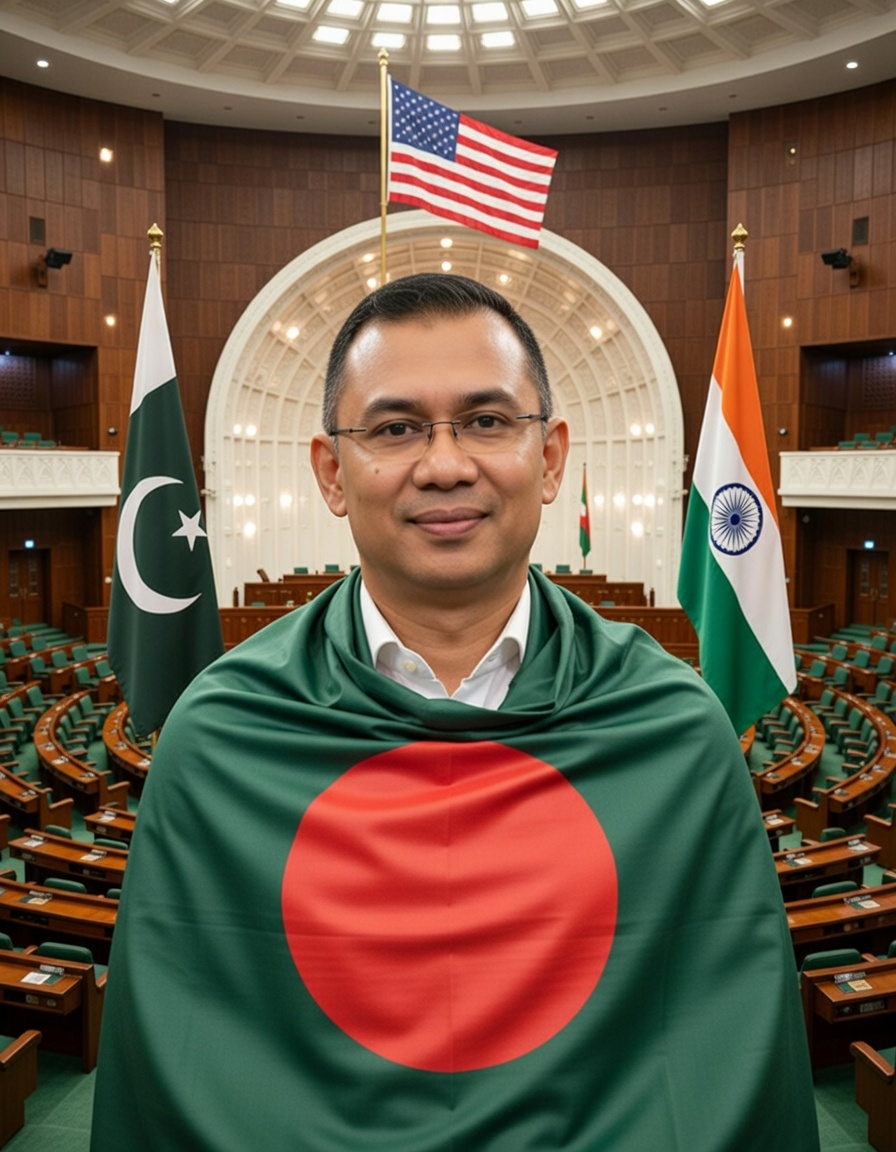
On 17 February 2026, Bangladesh witnessed a landmark political transition as lawmakers were sworn into the newly elected Parliament and Tarique Rahman prepared to take the oath as Prime Minister after a decisive election victory. The Bangladesh Nationalist Party (BNP), led by Rahman, won a sweeping majority, securing 195 of the 300 directly elected parliamentary seats, complemented by reserved seats for women, following elections held on 12 February. Hundreds gathered outside the parliamentary complex as members pledged allegiance to the nation in a ceremony marked by tight security and diplomatic attention.
Rahman’s return marks a dramatic turn in Bangladesh’s political story. He is the son of former president Ziaur Rahman and former prime minister Khaleda Zia. After spending 17 years in self-imposed exile in London and navigating legal controversies, Rahman returned to his homeland and led his party to what is widely described as a democratic renewal. His rise follows the ouster of former prime minister Sheikh Hasina in 2024, after months of nationwide student-led protests that challenged her long-standing rule.
The evolution of India-Bangladesh ties provides essential context for understanding this transition. Since Bangladesh’s independence in 1971, ties with India have ranged from deep cooperation to cautious rivalry. India played a key role in Bangladesh’s liberation struggle, and the relationship was close during the tenure of Sheikh Hasina, who became prime minister for multiple terms and developed strong links with Indian leadership. Intelligence ties, including interactions between India’s Research and Analysis Wing (R&AW) and the Awami League, were often cited as factors in security cooperation and diplomatic engagement.
Historical accounts indicate that R&AW and Indian authorities assisted Sheikh Hasina in 1975 in the immediate aftermath of the assassination of her father, Sheikh Mujibur Rahman, and many members of her family. She survived the violent coup due to timely evacuation facilitated by Indian intelligence. Reports also suggest that R&AW had earlier warned Sheikh Mujibur about an impending assassination attempt, though these warnings went unheeded. These early ties forged a complex bond between New Delhi and the Awami League, which has shaped diplomatic, security, and political interactions for decades.
Under Hasina, India and Bangladesh cooperated on regional connectivity, water sharing, and defence. However, there were points of friction, such as disagreements over border incidents, trade disputes, and management of shared river systems. The rivalry between the Awami League and BNP has historically been intense, often polarising Bangladeshi politics and influencing bilateral ties with India. While the Awami League maintained close alignment with New Delhi, the BNP emphasised Bangladeshi nationalism and a cautious approach toward Indian influence. Rahman’s public comments have reflected this duality, signalling openness to engagement while underscoring sovereignty.
The student uprisings of 2024, which contributed to Hasina’s ouster, emerged from deep frustrations among young Bangladeshis. Many protesters voiced demands for reforms, accountability, and relief from economic stagnation. While there were claims in some quarters about foreign involvement, including speculation about intelligence services, there is no substantiated evidence of a deliberate effort by external agencies such as the CIA or the Pakistani intelligence service to drive the protests or deliberately weaken India-Bangladesh ties. The protests were largely driven by internal socio-political grievances, economic challenges, and frustration with governance.
Relations between New Delhi and Dhaka have cooled since August 2024. Incidents involving border security, trade disruptions, and political discourse have introduced tensions. The controversy surrounding the exit of Bangladeshi cricketer Mustafizur Rahman from the Indian Premier League recently became a focal point for debate about national pride and bilateral sentiment. While sports controversies rarely indicate official policy, they can reflect broader public perceptions.
Minority representation in the new parliament has drawn attention. In the newly sworn-in parliament, there are two Hindu MPs representing Hindu-majority constituencies—Feni-3 and Comilla-5—both affiliated with Tarique Rahman’s BNP, along with one Buddhist MP representing Rangamati-1. By comparison, in Sheikh Hasina’s last parliament till August 2024, there were four Hindu MPs and two Buddhist MPs, most aligned with the Awami League. Some members of the Hindu community continue to face suspicion and social pressure, being looked upon as secret agents of India or as allies of the Awami League, reflecting the delicate position of minorities in Bangladesh’s politics.
Sheikh Hasina, now living in India post-ousting, faces legal challenges in her home country. Her political future is uncertain, and while speculation sometimes circulates about extreme scenarios, there is no credible indication that India would entertain anything that would jeopardise her life or safety. Democratic norms and diplomatic conventions guide India’s approach to all foreign political refugees and past leaders.
India has maintained diplomatic engagement throughout these changes. Lok Sabha Speaker Om Birla is set to represent India at the swearing-in of Rahman’s government, reinforcing a commitment to sustained bilateral ties despite political shifts in Dhaka. New Delhi has stressed the importance of peace, stability, and cooperation with Bangladesh, consistent with the shared historical bond between the two nations.
The election itself, described by observers as a potential test for democratic norms, recorded broad participation and ushered in a new government after years of political turbulence. The BNP’s victory was complemented by increased participation from younger voters and a parallel referendum on governance reforms, illustrating the country’s complex democratic pulse.
As Bangladesh enters this new chapter under Tarique Rahman, the trajectory of India-Bangladesh relations will be pivotal. Both democracies face internal pressures and external challenges. Their proximity, shared history, and the scale of cross-border ties make cooperation beneficial. Yet the political narratives in Dhaka and Delhi will shape the future of this relationship — whether it moves back toward strong collaboration or navigates periods of cautious independence.
In this shifting landscape, the decisions made in Dhaka and New Delhi will resonate across South Asia, influencing regional security, economic integration, and the lived experiences of millions on both sides of the border.
Subscribe Deshwale on YouTube


