 Deshwale
Before Wristwatches, How Did Indians Know the Time?
In brief · AI summary Before wristwatches, people in India tracked the day using the sun and shadows, along with water clocks such as the ghati yantra, in which a copper bowl sank after about 24 minutes. Ghariyalis struck a heavy brass disc to announce each passing period, while temple bells and drums signalled key moments of the day. A few kings also built enormous stone instruments to measure time more precisely.
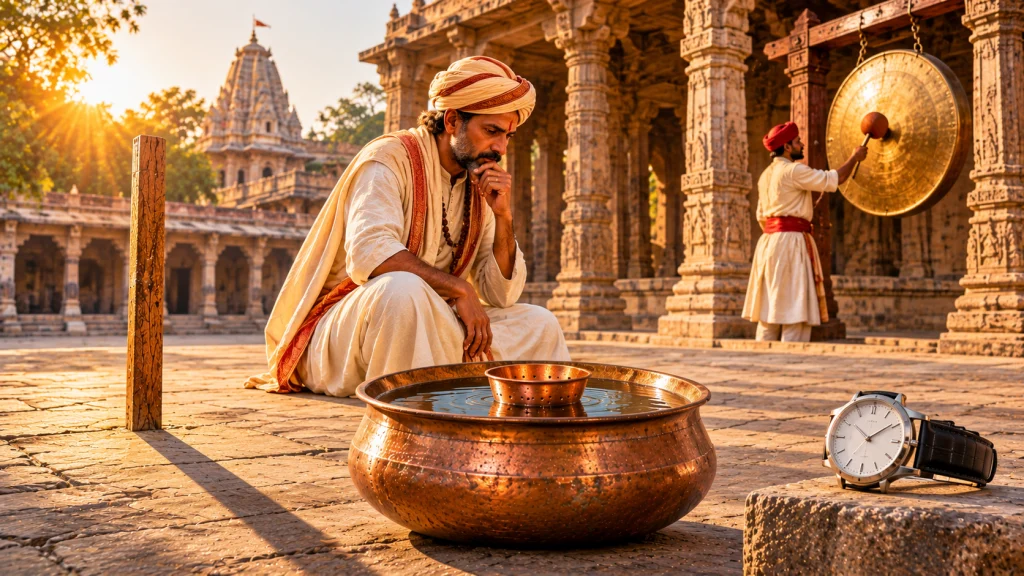
Ask anyone around you what time it is, and they will glance at a phone and answer in half a second, down to the exact minute. We hardly notice how remarkable that is. For most of India’s history there was no phone, no wall clock and no wristwatch. And yet farmers reached their fields on time, priests began prayers at the right hour, and kings held court when they were supposed to. So how did a whole country keep time without a single clock in its pocket?
The answer is that people looked up, listened, and trusted what they could see and hear. Different tools served different needs. The sun and shadows took care of everyday life. Water clocks counted time more carefully. Gongs, bells and drums spread the hour across the town. And a few kings, who were not satisfied with any of this, built enormous stone instruments to chase time down to the second. Let me take you through them one by one.
Start with the day itself. In traditional India, the day did not begin at midnight, when most people are fast asleep. It began at sunrise. The daylight was cut into four parts and the night into four more, and each part was called a prahar. These were not fixed slices of the clock. They stretched and shrank with the seasons, because they were shares of the light and the dark. On a day when both are equal, a prahar comes to roughly three hours. If you speak Hindi, you have used the word without thinking. Dopahar, the word for afternoon, simply means two prahars, the point you reach two prahars after sunrise.
Smaller moments had their own names too, and some of them are lovely. A muhurta lasted 48 minutes, and families turned to it when they wanted to pick a good moment for a wedding or a journey. The quiet time before dawn was thought to be the best hour for study and prayer. And in the evening came godhuli, the hour of cow dust, when cattle walked home and their hooves lifted a golden haze over the village road. Nobody needed a dial to tell them it was godhuli. They were standing right inside it.
Of course, a sky only helps you when the sun is out, and for that there is the oldest clock of all: a stick in the ground. Its shadow stretches long to the west in the morning, shrinks as the sun climbs, becomes shortest at noon, and then stretches out again towards the east. Indian scholars called this stick a shanku, and they took it seriously. The Arthashastra, the old Indian book on running a kingdom, already speaks of telling time from shadows. Around the sixth century, the astronomer Varahamihira worked out a method to find the hour from a shadow’s length. Most people never needed his method, though. A shadow creeping across a wall or across your own feet told you how much of the day was left, and it cost nothing. The trouble came with cloudy skies and with night.
That is where water came in. The Indian water clock, called the ghati yantra, was a beautifully simple idea. Take a small copper bowl with a tiny hole at the bottom and float it on a larger vessel of water. Water seeps in through the hole, slowly, and after a set time the bowl fills and sinks. That set time was one ghati, about 24 minutes, which is one sixtieth of a full day. Break a ghati into 60 palas, and each pala comes to about 24 seconds. For quicker moments, people counted breaths, each about four seconds long.
You might ask why they did not simply let water drain out of a pot. The reason is that a draining pot slows down as the water level falls, so its timing slips. A bowl filling through a small hole keeps a steadier pace. The right size of hole was found by trial and error, again and again, until the bowl sank in exactly one ghati, and it was checked against the shadow at noon. This was no folk trick either. Aryabhata, Varahamihira, Brahmagupta and Lalla all wrote about water clocks, and so does the Surya Siddhanta. A Jain text from around the year 100 CE speaks of measuring time with water. A Chinese traveller who came to Nalanda in the seventh century wrote about how the water clock worked there. And in the Government Museum in Chennai, you can still see an old coconut-shell version.
A clock, though, is only useful if people can read it, and a bowl sinking in a courtyard is not much use to a town. So towns hired people for the job. They were called ghariyalis, and their whole work was to watch the clock on behalf of everyone else. Each time the bowl sank, the ghariyali struck a heavy brass disc, the ghariyal, with a mallet. The disc hung high so the sound could roll over the rooftops and into the market. Then he emptied the bowl, set it afloat again, and waited. This went on through the day and the night, in sun and in rain. If you heard the gong, you knew how far the day had travelled. Our languages still remember him. In Hindi, ghadi means a clock or watch and also a moment, and ghanta means a bell and also an hour. When we say something will take an hour, we are quietly speaking the language of the brass disc.
The gong was only one voice in a town full of them. In a Hindu temple, the bell is rung at key moments of worship, when the lamp is waved before the deity, for example, or when food is offered. Because temples ran on a fixed daily routine, anyone who lived nearby could tell from the sounds which part of the day had arrived. To be fair, a temple bell was never meant to be a clock, and calling it one would be wrong. But it worked as a public signal all the same. In royal forts like the Red Fort in Delhi, a drum house at the gateway played music at fixed hours. In towns with mosques, the call to prayer rose five times a day at moments set by the sun. Put together, these sounds made a timetable that nobody had to print. A wall clock shows you the time whether you care or not. A bell only works if you are listening.
Now imagine you are a king who loves astronomy and you want more than “roughly”. That was Sawai Jai Singh II, the ruler of Amber, who founded Jaipur. In the early 1700s he built a series of huge stone observatories called Jantar Mantar. The first came up in Delhi in 1724, and others followed in Jaipur, Ujjain and Varanasi. The one in Jaipur was finished in the 1730s, and UNESCO named it a World Heritage Site in 2010.
Its star is the Samrat Yantra, the Supreme Instrument, a giant sundial about 27 metres tall. A tall triangular wall throws its shadow on curved stone scales marked in hours and minutes and finer divisions. The shadow moves about a millimetre every second, so if you stand there, you can actually watch time crawl across the stone. It is often said to tell local time to within about two seconds, although the blurry edge of the sun’s shadow makes such a claim hard to prove. Right next to it, a smaller sundial, the Laghu Samrat Yantra, is accurate to about twenty seconds. But notice something about these instruments. They tell you the time of that exact place, by that place’s own sun. That sounds like a small detail. It was about to become a very big problem.
Here is why. The sun does not reach its highest point everywhere at once. For every degree you go east, noon arrives about four minutes earlier. India is nearly thirty degrees wide, which means noon in the far east comes almost two hours before noon in the far west. For centuries nobody cared. Each town ran by its own sun, and people did not travel fast enough to notice the gap.
Then came the railways, and a timetable only works if everyone agrees on the time. In the early 1800s an observatory in Madras fixed a reference time, now called Madras Time, and by the 1850s the railways used it. It ran about five hours and twenty-one minutes ahead of Greenwich. Meanwhile, Bombay and Calcutta each had their own official time from 1884, and Calcutta’s clocks ran more than an hour ahead of Bombay’s. A traveller crossing the country might have had to reset his watch several times. Clock towers, the ghanta ghars, also began to rise in Indian cities after 1858, when the British Crown took over from the East India Company. In places like Jaipur, the rulers welcomed them, as the court already cared a great deal about time.
The knot was finally cut on 1 January 1906, when Indian Standard Time came into force. It is based on the line of longitude at 82 degrees 30 minutes east, which passes near Mirzapur in Uttar Pradesh. After Independence, on 1 September 1947, the government declared it the official time for the entire country. Even then, old habits died slowly. Calcutta kept its own time until 1948 and Bombay until 1955.
So what did all this mean for an ordinary person in an ordinary day? Mostly, it meant that time belonged to everyone. It was not something you wore. It was something you heard and saw, along with all your neighbours. A farmer rose before sunrise and read the sky and his own shadow. A shopkeeper opened up when the morning sounds began in town. A student woke in the quiet hours before dawn to learn his verses by heart. A family waited for the right muhurta before a wedding, and checked it in the panchang, the traditional almanac. Priests, soldiers and court officials all kept pace with the ghariyali’s gong.
That system had a real strength, because anyone could use it. You did not need to read numbers or buy anything. Your eyes and ears were enough. It had a weakness too. The time was only right where you stood, and a bell in one town could not tell you the hour in the next.
When standard time and wristwatches arrived, they fixed that problem, and we are better off for it. But something got quietly lost along the way. Most of us today could not guess the hour from a shadow, and few of us have watched godhuli with the eyes of someone who needs it to know the day is ending. Still, the old way never fully left us. We still say ghadi for a watch and ghanta for an hour. Temple bells still ring at the same moments of worship. And in a stone courtyard in Jaipur, a shadow still crawls across a scale at about a millimetre a second, ready to tell the time to anyone patient enough to stand and watch.
Subscribe Deshwale on YouTube