



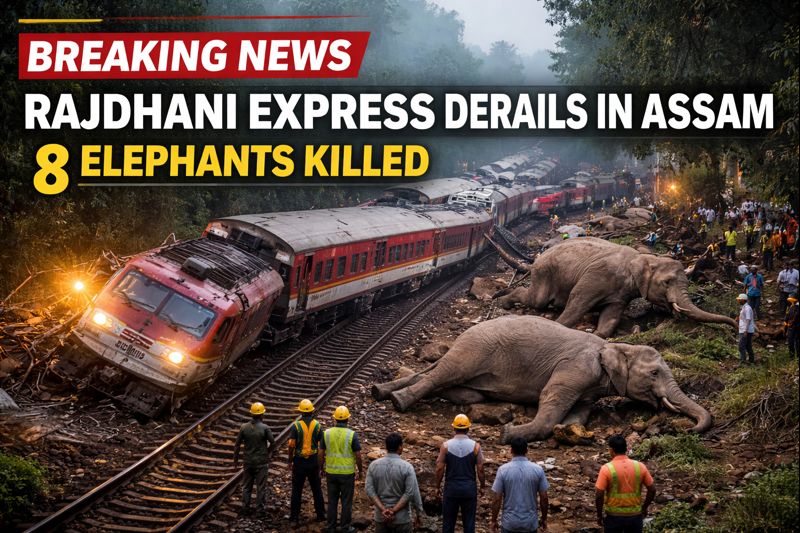
A major railway accident occurred in Assam early Saturday when the Sairang–New Delhi Rajdhani Express collided with a herd of wild elephants, leading to the death of eight elephants and the derailment of the train’s engine and five passenger coaches.
The incident took place around 2:17 am on the Jamunamukh–Kampur section in Assam’s Hojai district, triggering emergency response operations by railway and forest authorities.
What Happened
The high-speed Rajdhani Express was travelling through a forested stretch when a group of elephants reportedly crossed the railway track. Despite the locomotive pilot applying emergency brakes, the train could not be stopped in time, resulting in a devastating collision.
The impact caused the locomotive and five coaches to derail, forcing an immediate halt to train movement on the section.
Passenger Safety
Railway officials confirmed that no passengers or railway staff were injured in the derailment. Passengers were safely evacuated from affected coaches and shifted to secure compartments. Alternative travel arrangements were made to minimise inconvenience.
The train was later moved toward Guwahati, where damaged coaches were detached and replacement coaches attached before resuming its onward journey.
Wildlife Casualties Confirmed
Forest officials at the site confirmed that eight elephants died in the collision, including younger members of the herd. One elephant was injured and placed under veterinary care.
The bodies of the elephants were removed from the tracks to allow restoration work, while post-mortem examinations were initiated to document the impact.
Rail Services Affected
Train movement on the Jamunamukh–Kampur section was disrupted for several hours following the derailment. Multiple trains were diverted through alternative routes as railway engineers and accident relief teams worked to restore the affected tracks.
Senior railway officials were present at the site to oversee repair operations and assess infrastructural damage.
Recurring Safety Concern
The incident has once again highlighted the growing risk of train–wildlife collisions in Assam, a state with a large elephant population and several rail lines passing through forest and semi-forest zones.
Despite previous safety advisories, collisions involving elephants continue to occur, raising serious questions about speed regulation, animal movement monitoring, and preventive infrastructure in sensitive regions.
Calls for Immediate Action
Following the tragedy, wildlife experts and conservation groups have renewed calls for urgent safety measures, including:
- Speed limits in wildlife-sensitive zones
- Real-time animal detection and alert systems
- Better coordination between railway and forest departments
- Identification and protection of elephant movement paths
Experts warn that without immediate intervention, similar incidents could recur, posing risks to both wildlife and passengers.
While no human casualties were reported, the death of eight elephants marks one of the most serious wildlife-related railway accidents in the region in recent times. The incident underscores the urgent need to balance infrastructure expansion with environmental protection.
Investigations are underway to determine whether additional safety protocols could have prevented the collision.
Subscribe Deshwale on YouTube
