






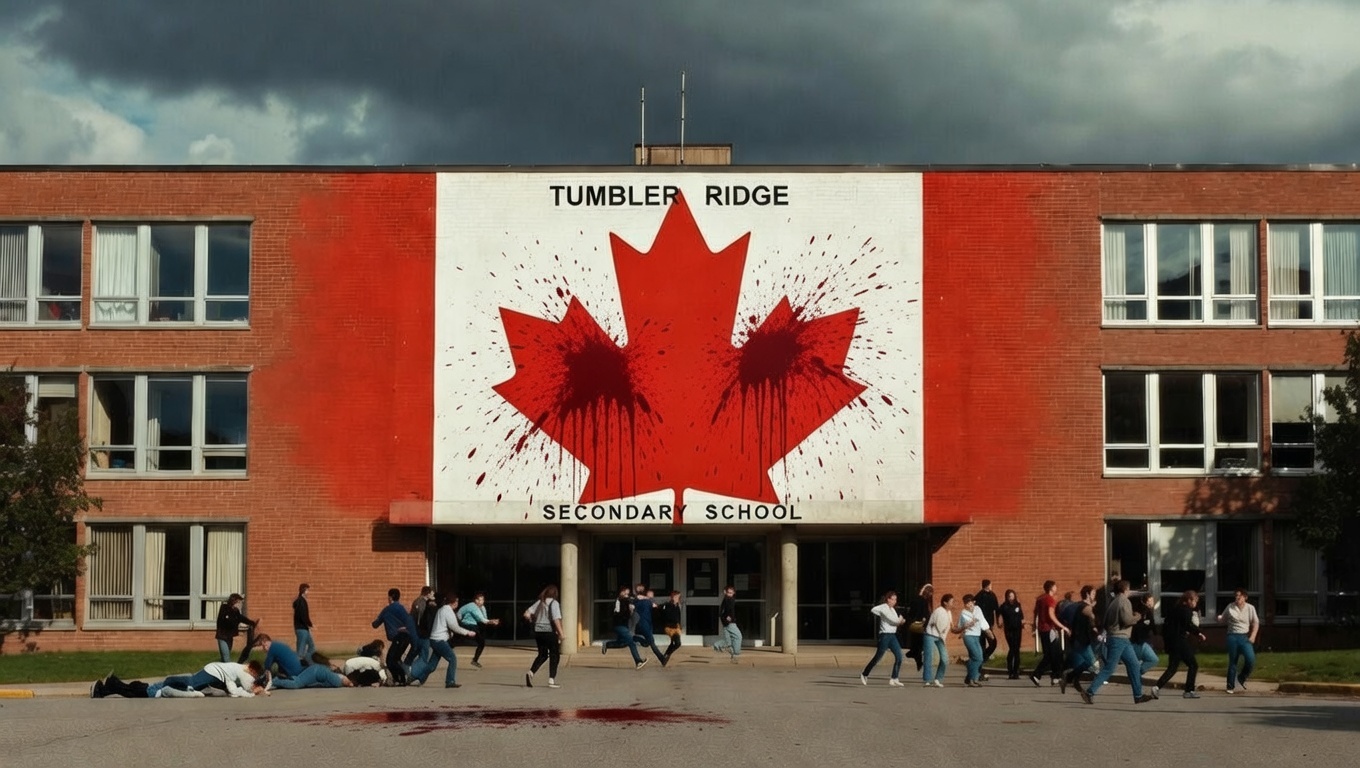
A mass shooting at Tumbler Ridge Secondary School in northeastern British Columbia, Canada, has left the country reeling. On February 10, 2026, an assailant opened fire at the small school and a nearby residence, killing ten people, including the suspect, and injuring around 27 others, according to the Royal Canadian Mounted Police (RCMP).
The tragic incident occurred in Tumbler Ridge, a town of about 2,400 people located more than 1,000 kilometres northeast of Vancouver. Local officials described the shooting as one of the deadliest in Canadian history, leaving families, students and first responders grief‑stricken and in shock.
Victims were found inside the school and at a local residence believed to be linked to the event. Six were found dead inside the school, a seventh died en route to hospital, and two more were discovered at the residence. The suspect was found dead at the scene from what appeared to be a self‑inflicted wound.
The shooting has drawn international attention. Leaders around the world condemned the violence and expressed solidarity with Canadians. French President Emmanuel Macron, Australian Prime Minister Anthony Albanese, German Chancellor Olaf Scholz and Ukrainian President Volodymyr Zelensky offered condolences to the victims’ families and support for the people of Tumbler Ridge. Prime Minister Narendra Modi of India also condemned the attack and said India stands in solidarity with Canadians at this difficult time.
Tumbler Ridge Secondary School serves around 160 students in grades seven through twelve. In a town this small, a mass shooting like this strikes at the heart of the community. Many students and teachers know one another intimately, and such a violent event can have lasting psychological effects on people who once felt safe in their classrooms and neighbourhoods. Counselling and mental health support have been made available locally, and the school will remain closed for days as the community begins to process its loss.
Canada’s strict gun laws, which include mandatory safety training, criminal background checks and licensing requirements for firearm ownership, have long kept gun violence far below levels seen in the United States. Even so, mass shootings do occur in Canada, though they are rare. The last events of similar scale include the 1989 École Polytechnique massacre in Montreal and other isolated shootings.
By contrast, the United States experiences far more mass shootings. In 2025 alone, independent tracking sources reported around 480 mass shootings, including more than 90 in schools, underscoring the stark difference in frequency compared to Canada. Definitions vary, but mass shootings in the US occur much more often, even after adjusting for population differences.
Canadian gun laws generally require certified safety courses, background checks and periodic licence renewals. Regulations on types of firearms and storage rules are also more rigorous.
In the United States, gun laws vary by state, and a higher proportion of the population owns firearms, including semi‑automatic weapons. Opponents of strict regulation argue that responsible owners should not be penalised for the actions of a few, while supporters maintain that stronger laws reduce the risk of mass violence. The Second Amendment to the U.S. Constitution shields the right of the people to keep and bear arms, stating, “A well-regulated Militia, being necessary to the security of a free State, the right of the people to keep and bear Arms, shall not be infringed’. Ratified in 1791 as part of the Bill of Rights, it establishes an individual right to have firearms.
The causes of mass shootings are complex and often multifaceted. Psychological distress, social isolation, access to weapons, personal crises and ideological motives can all play roles. Experts also caution against focusing solely on gun laws without addressing broader mental health support and early intervention systems.
In small, close‑knit towns like Tumbler Ridge, the mental impact of such violence can be profound. Residents who once felt safe may now struggle with anxiety, fear and grief. Children may fear returning to school, and families may worry about the future. Recovery will require compassion, dedicated mental health resources and sustained community support.
As Canadians mourn, the contrast with the United States remains stark. Both nations grapple with preventing mass shootings, but differing legal frameworks and cultural attitudes shape their experiences. For now, the focus in Tumbler Ridge is on healing, remembering the victims and reaffirming support for a community forever changed.
Subscribe Deshwale on YouTube