










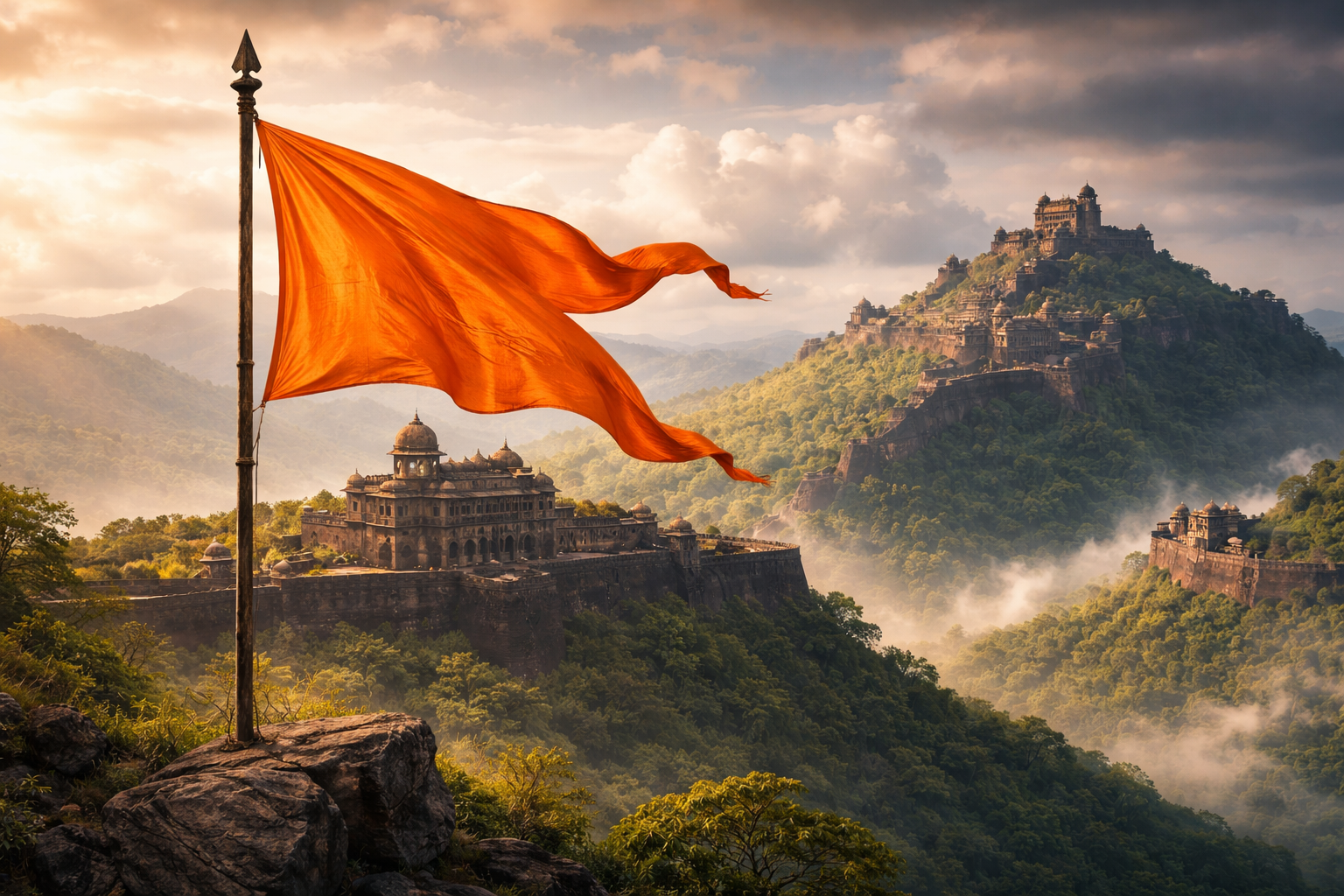
Chhatrapati Shivaji Maharaj, born on February 19, 1630, in the hill-fort of Shivneri near present-day Junnar, Maharashtra, remains one of the most celebrated figures in Indian history. He emerged as a symbol of courage, strategic brilliance, and statesmanship at a time when the Deccan region was fragmented by competing powers. His life was marked not just by conquests, but by a vision that blended military acumen with administrative foresight and diplomacy.
Shivaji Maharaj’s early life shaped his understanding of governance and warfare. Trained in the arts of swordsmanship, guerrilla tactics, and fort architecture, he imbibed lessons from his mother, Jijabai, who instilled in him a sense of justice, self-respect, and devotion to his people. These formative experiences laid the foundation for his future as a leader who valued both courage and compassion. One vivid example from his early life is the encounter with Afzal Khan in 1659. Afzal Khan, a general of the Bijapur Sultanate, invited Shivaji for a supposed negotiation but allegedly planned to kill him. Shivaji, anticipating treachery, carried concealed weapons and personally confronted and killed Afzal Khan, demonstrating his foresight and tactical calculation.
Shivaji Maharaj’s military campaigns are often remembered for their ingenuity. He pioneered guerrilla warfare in the Western Ghats, using the terrain to his advantage. His capture of key forts like Torna, Rajgad, and Raigad allowed him to consolidate territories and protect his people from external threats. Another example is the daring escape from Aurangzeb’s Agra captivity in 1666. Despite being placed under supervision, Shivaji managed to evade Mughal control and return to the Deccan, an episode that enhanced his reputation for resourcefulness. His naval initiatives were equally significant. Understanding the importance of maritime security, he built a navy to defend the Konkan coast and challenge Portuguese and Siddhi fleets. The construction of Sindhudurg fort in the Arabian Sea reflected his strategic vision to secure trade routes and protect his coastline. These efforts were not mere acts of conquest but structured attempts to safeguard the Maratha state against multiple pressures.
Beyond the battlefield, Shivaji Maharaj was a shrewd diplomat. He negotiated with the Mughals, the Deccan Sultanates, and regional powers to preserve autonomy and safeguard his realm. His treaties were pragmatic and often temporary, reflecting a flexible approach to survival in a volatile political environment. Critics argue that his expansionist campaigns and emphasis on fortification intensified regional rivalries. Some historians observe that repeated confrontations with Mughal authority led to prolonged cycles of warfare that shaped Deccan politics for decades.
Renowned historian Jadunath Sarkar regarded Shivaji as a figure of exceptional military genius and administrative clarity. Sarkar highlighted his disciplined governance and ability to combine mobility with fortified defence. In contrast, Mughal chroniclers such as Khafi Khan in Muntakhab-ul-Lubab and Saqi Mustaid Khan in Maasir-i-Alamgiri portrayed Shivaji as a disruptive rebel who challenged imperial order. These texts criticised his raids and questioned the legitimacy of his coronation, reflecting the imperial viewpoint of the time. Such divergent accounts illustrate how political allegiance shaped historical writing in the seventeenth century.
Shivaji Maharaj’s vision extended to governance and administration. He established a system based on merit and efficiency, appointing capable ministers and commanders irrespective of lineage. Revenue reforms, judicial oversight, and a structured civil administration reflected his belief that a stable state required institutional strength. The Chauth and Sardeshmukhi revenue arrangements helped consolidate influence in surrounding territories. Later, the Marathas established Gingee Fort in present-day Tamil Nadu as a strategic southern capital during the reign of his successor Rajaram, extending Maratha authority deep into the peninsula and reinforcing the durability of Shivaji’s statecraft.
After Shivaji’s death in 1680, the Maratha polity endured severe Mughal pressure but eventually evolved into a powerful empire under the leadership of the Peshwas, who initially served as prime ministers to the Chhatrapati. Figures such as Balaji Vishwanath, Baji Rao I, and Madhavrao I expanded Maratha influence across large parts of the Indian subcontinent. Under Baji Rao I, Maratha armies advanced into Malwa, Bundelkhand, and even the outskirts of Delhi, transforming what began as a regional kingdom into a confederacy with pan-Indian ambitions. The administrative and military foundations laid by Shivaji enabled this expansion. Although the empire later suffered setbacks, including the defeat at the Third Battle of Panipat in 1761, the Maratha Confederacy remained a decisive force in eighteenth-century Indian politics.
The reverence for Shivaji Maharaj extends far beyond historical narratives. Among Marathis, his memory occupies a central place in public life. Portraits adorn homes, schools, and community spaces. His forts, including Raigad and Gingee, attract thousands who view them as symbols of resilience. Hindus from other linguistic regions also revere him as an exemplar of courage and self-rule. In many Maharashtrian, Gujarati, Kannada, and Tamil households, stories of his life are shared across generations. His familial and political legacy also influenced the rise of the Thanjavur Marathis in southern India. This Marathi community established itself in Tamil Nadu, gradually integrating with local Tamil society while retaining aspects of Maratha cultural identity, thereby extending his historical footprint into southern India.
In modern India, interpretations of Shivaji’s legacy vary. Right-leaning historians often present him as a champion of Hindu sovereignty and resistance against Mughal imperial domination. Left-leaning scholars tend to situate him within the broader socio-economic and regional politics of the Deccan, emphasising administrative innovation over religious framing. These differing interpretations have occasionally sparked debates on academic campuses and in public discourse, reflecting the continuing relevance of his life in contemporary political imagination.
Chhatrapati Shivaji Maharaj’s legacy is enduring. He inspired generations with his emphasis on honour, courage, and disciplined governance. His life demonstrated that leadership required both strategic foresight and institutional development. The forts he built, the naval foundations he laid, and the administrative systems he shaped influenced Indian political history long after his death in 1680.
Chhatrapati Shivaji Maharaj’s birth anniversary is not merely a commemoration of a warrior king. It is a reflection on the complexities of power, legitimacy, and state-building in early modern India. His life continues to inspire admiration, debate, and scholarship, ensuring that his legacy remains both vibrant and contested in equal measure.
Subscribe Deshwale on YouTube


