



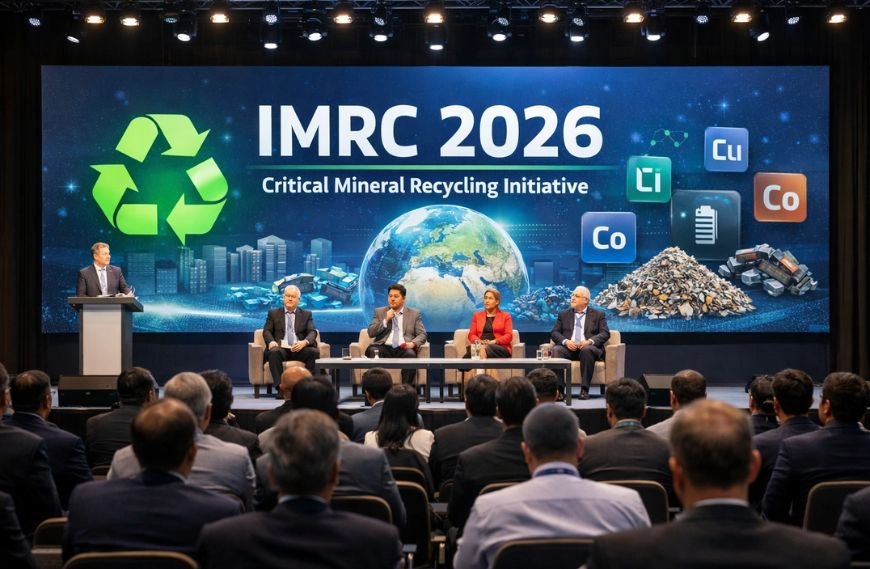
India’s Rs 1,500-crore Critical Mineral Recycling Incentive Scheme is gaining strong traction from the recycling industry, with more than 70 companies already registered and over 10 receiving formal approvals. The update was shared by Dr Anupam Agnihotri, Director of the Jawaharlal Nehru Aluminium Research Development and Design Centre (JNARDDC), during the International Material Recycling Conference (IMRC) 2026 organised by the Material Recycling Association of India (MRAI) in Jaipur.
Dr Agnihotri said the scheme, launched last October and operationalised under the National Critical Mineral Mission, aims to create 270,000 metric tonnes of recycling capacity across the country. It offers targeted incentives to two categories of recyclers. Group A companies with an annual turnover above Rs 200 crore are eligible for incentives of up to Rs 50 crore or 20 percent of plant and machinery investment, whichever is lower. Group B companies with turnover below Rs 200 crore can receive incentives of up to Rs 25 crore or 20 percent of equipment costs.
Highlighting India’s strategic urgency, Dr Agnihotri said the country has identified 24 critical minerals, many of which remain heavily dependent on imports. He warned that rising global resource nationalism could soon restrict exports of both raw materials and scrap. According to him, India has a narrow window of five to six years to build strong domestic recycling and recovery infrastructure.
The scheme prioritises quality-driven recycling over volume expansion. Only advanced R3 and R4 category recyclers are eligible. Group A recyclers must process at least 10,000 tonnes annually, while Group B recyclers must handle a minimum of 5,000 tonnes, along with meeting defined purity standards. Incentives are linked to capital investment and phased operational support over five to six years, offering long-term stability for technology-driven recycling projects.
JNARDDC has been designated as the nodal agency for aluminium, copper, lead and zinc recycling. Dr Agnihotri said the centre will also support pilot plants and startups through nine Centres of Excellence, with financial backing of up to Rs 20 crore.
Adding a global perspective, Dr Rachana Arora, Director – Climate Change and Circular Economy at GIZ India, said India’s recycling-led approach aligns with international supply chain strategies. She highlighted growing cooperation between India and the European Union in battery recycling, renewable energy materials and urban mining.
On the technology front, Dr Alok Ranjan Paital, Principal Scientist at CSIR–CSMCRI, said advanced recycling methods such as cathode-to-cathode regeneration could significantly reduce energy consumption and material loss in battery recycling.
Representing the industry, Vijay Pareek, Executive Director of Gravita India Ltd., said the scheme brings long-awaited regulatory clarity, boosting investor confidence and accelerating capacity creation in the recycling sector.
IMRC 2026 is being held from January 20 to 22 at the Novotel Jaipur and Convention Centre, bringing together policymakers, recyclers, manufacturers and global stakeholders. During the event, the MRAI Battery Recycling Excellence Awards 2026 were presented, with Ardee Industries Limited winning Recycler of the Year in the MSME category and Gravita India Limited receiving the Large-Scale Recycler of the Year award.
Subscribe Deshwale on YouTube
