




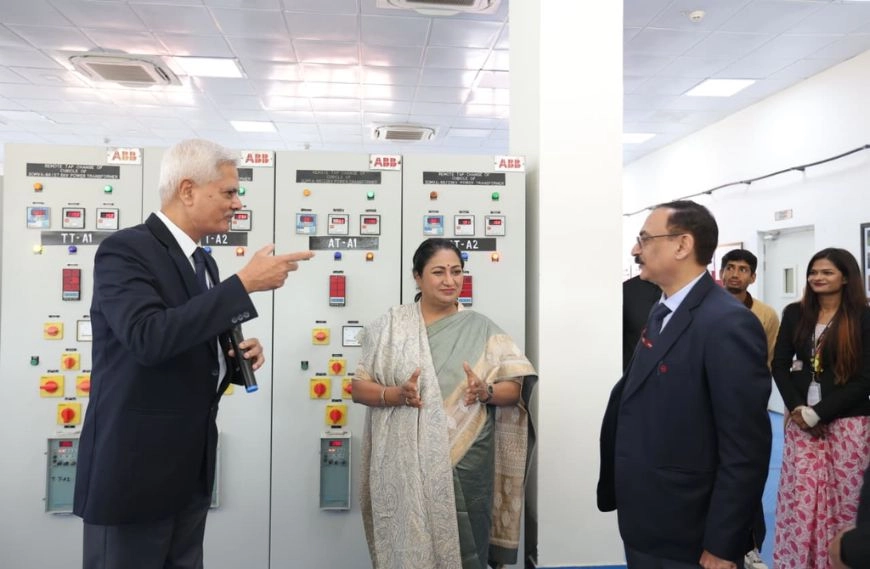
Delhi’s public transport landscape is set to receive a significant boost as Chief Minister Rekha Gupta reaffirmed the city government’s commitment to expanding the Metro network. Speaking at the inauguration of a state-of-the-art Electric Receiving Sub-Station (RSS) near the Central Vista Project on Park Street, the Chief Minister highlighted the strategic importance of investing in Metro infrastructure as a key component of urban mobility.
The newly inaugurated sub-station, completed in just 18 months, will play a pivotal role in ensuring uninterrupted power supply to critical Metro routes. By providing stable and reliable electricity, the facility is expected to support the city’s rapidly expanding Metro network, which currently spans nearly 500 kilometres and serves over 3.5 million passengers daily. “The Delhi Metro has become a lifeline for the capital, and we are committed to maintaining its efficiency and reliability as we move forward with expansion plans,” Gupta said.
Officials briefed the Chief Minister on the technical aspects of the sub-station, demonstrating how its advanced systems protect Metro operations against power disruptions. The project employs modern smart-grid technology and energy management protocols, reinforcing Delhi’s broader vision of becoming a smart, sustainable, and environmentally responsible city. The sub-station not only secures seamless Metro functioning but also reflects the government’s commitment to adopting innovative infrastructure solutions that support long-term urban development.
The Chief Minister confirmed that construction on new Metro corridors will commence shortly, further extending connectivity across the city and easing the burden on roads congested with vehicular traffic. These new lines are expected to enhance accessibility for commuters, improve travel efficiency, and reduce the city’s carbon footprint by encouraging the use of mass transit over private vehicles.
Gupta also emphasised that the Metro expansion initiative is part of a larger urban mobility strategy aimed at making public transport safer, more reliable, and environmentally sustainable. The government is not only focusing on physical infrastructure but also on integrating modern technologies, smart operations, and sustainable practices into every aspect of the Metro network. “This is more than just an expansion of rail lines; it is an investment in Delhi’s future as a modern, connected, and accessible city,” she stated.
As Delhi continues to grow, the Metro remains central to the city’s transport ecosystem, linking residential areas, business districts, and key public spaces. The combination of new corridors, enhanced power infrastructure, and cutting-edge technology positions the Delhi Metro as a model for sustainable urban transport in India and beyond.
By prioritising efficiency, reliability, and sustainability, the city government aims to ensure that the Metro remains a safe, convenient, and environmentally friendly option for millions of daily commuters. With these initiatives, Delhi moves closer to realising a vision of seamless, smart, and future-ready public transportation.
Subscribe Deshwale on YouTube
