



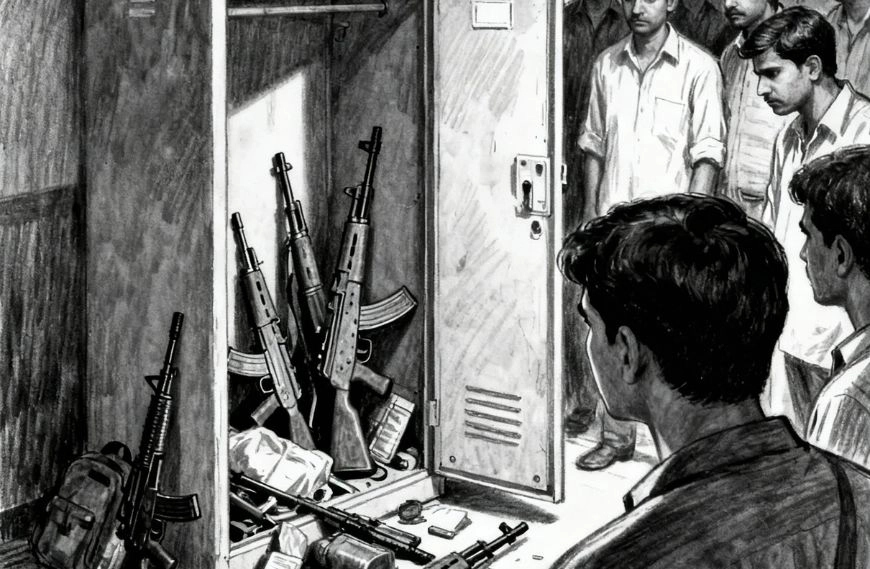
A shocking discovery in Haryana’s Faridabad has exposed a major security breach near the national capital. The Jammu and Kashmir Police, in coordination with local authorities, recovered approximately 350 kilograms of suspected ammonium nitrate (initially reported as RDX), an AK-47 rifle, a pistol, three magazines, 20 detonator timers, and a walkie-talkie set from a residential house in Dhauj village, just a few kilometres from Delhi.
The operation began after the arrest of Dr Adil Ahmad Rather, a resident of Anantnag district, who was detained in Saharanpur (UP) last week. He was accused of putting up posters supporting a banned terror outfit. During interrogation, the police reportedly extracted information that led them to a house in Faridabad.
When the police team reached the location, they found a shocking stockpile of explosives and weapons hidden inside. The property is believed to have been owned or rented by Adil Ahmad and another doctor from Jammu and Kashmir, both of whom had been living in the area.
The recovery has raised serious questions about how such a large quantity of explosives and arms entered the Delhi-NCR region undetected. The material was enough to cause massive destruction if used in a planned attack.
Officials said the find indicates the possible presence of organised networks attempting to expand their activities beyond Jammu and Kashmir. The incident has also alarmed central security agencies, given its proximity to the national capital.
The forensic team is currently testing the seized material to confirm if it is indeed ammonium nitrate or a similar high-intensity explosive. The National Investigation Agency (NIA) and Intelligence Bureau (IB) have been informed, and further questioning of the suspects is underway to trace the origin and intended use of the cache.
Police sources said the initial clues suggest that the arms and explosives were being stored for a possible terror operation or to be supplied to other individuals. However, investigators have not yet confirmed whether the accused had direct links with any active terror organisation.
What makes this case more concerning is that the suspects are educated professionals. The involvement of doctors in a suspected terror-linked operation challenges stereotypes about the kind of individuals who engage in such activities. Authorities are now looking into whether the accused used their professional status to avoid suspicion and transport the material safely.
The Faridabad explosives haul has prompted heightened security measures across Delhi and neighbouring states. Police forces have been instructed to verify new tenants, inspect rented properties, and tighten surveillance on suspicious movements.
While officials continue to analyse the seized material, the incident serves as a reminder of the evolving nature of security threats where terror and crime networks are increasingly exploiting unsuspected profiles and urban areas.
As one senior officer remarked, “The recovery of such a large quantity of explosives near Delhi is not just alarming, it is a wake-up call. We must stay ahead of those who try to exploit our openness and mobility.”
The investigation continues, but the Faridabad cache has already sent ripples through India’s security circles highlighting the urgent need for stronger intelligence sharing and community vigilance.
Subscribe Deshwale on YouTube
