











Pros and Cons
By: Prathamesh Amrute
For aspiring restaurateurs, one of the earliest and most consequential decisions is whether to open a franchise or launch an independent restaurant. Both paths offer unique opportunities and challenges, and the choice often reflects an entrepreneur’s appetite for risk, desire for creative freedom, and long-term vision. In a highly competitive industry where margins are tight and customer expectations are high, understanding the pros and cons of each model is essential.
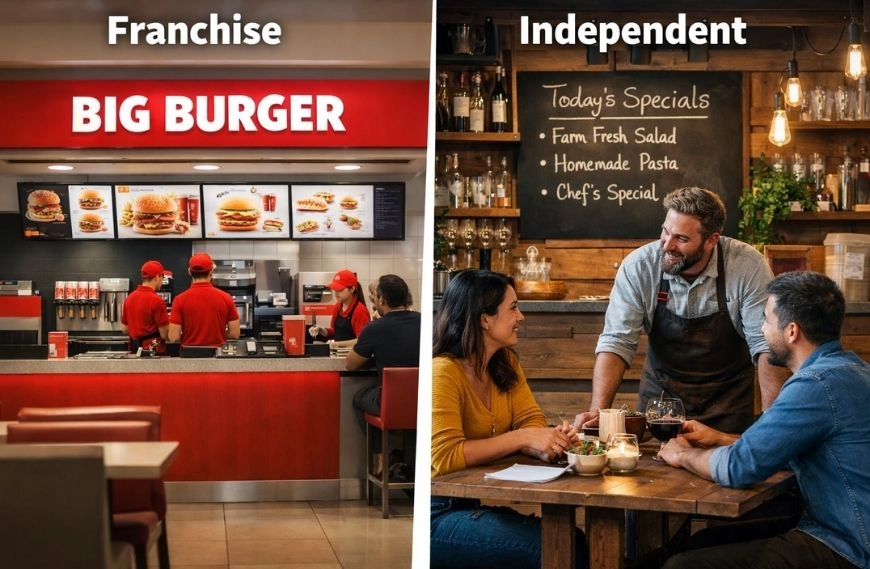
Franchises provide a ready-made business model. With established branding, proven systems, and operational playbooks, they offer a level of predictability that appeals to risk-averse investors. Franchisees benefit from:
- Brand recognition: Customers are more likely to trust and patronize a familiar name.
- Operational support: Training programs, supplier networks, and standardized processes reduce the learning curve.
- Marketing power: National or regional campaigns amplify visibility, often at a scale independent restaurants cannot afford.
However, this structure comes at a cost. Franchisees must pay upfront fees, ongoing royalties, and adhere to strict corporate guidelines. Creative freedom is limited—menus, décor, and promotions are often dictated by the franchisor. For entrepreneurs seeking autonomy, this can feel restrictive.
Independent restaurants offer complete control over concept, menu, and branding. Owners can innovate, experiment, and build a unique identity that reflects their vision. This freedom allows for:
- Creative differentiation: From signature dishes to immersive ambiance, independents can stand out in ways franchises cannot.
- Full profit retention: Without royalty payments, owners keep all earnings.
- Agility: Independent operators can pivot quickly in response to customer feedback or market trends.
Yet, independence comes with higher risk. Without the backing of a parent company, owners must build brand awareness from scratch, manage all operations, and shoulder the full financial burden. Marketing expenses are often higher, and profitability may take longer to achieve.
Franchises typically require significant upfront investment, including franchise fees, equipment, and adherence to corporate standards. While these costs are substantial, they are offset by the potential for quicker returns due to brand recognition and operational efficiency.
Independent restaurants may have lower initial costs, especially if launched on a smaller scale. However, they often face higher marketing expenses and slower growth as they work to establish a customer base. Access to financing can also be more challenging, as lenders may view independents as riskier ventures compared to established franchise models.
Franchises offer a more predictable path with proven success metrics, making them attractive to investors seeking stability. The trade-off is limited control and ongoing royalty payments. Independent restaurants, by contrast, carry higher risk but also higher potential rewards. Owners retain full profits and can create a brand that is truly their own.
The decision often comes down to personality and vision. Entrepreneurs who value structure, scalability, and reduced risk may gravitate toward franchises. Those driven by creativity, passion, and a desire to build something unique may prefer independence.
Choosing between a franchise and an independent restaurant is about long-term goals. Franchises are ideal for those seeking scalability and structured growth, while independent restaurants appeal to those who want authenticity and creative control. Both models can succeed with the right strategy. The key lies in aligning the choice with personal strengths, financial resources, and market opportunities. By weighing the pros and cons carefully, aspiring restaurateurs can chart a path that not only suits their ambitions but also sets the stage for lasting success.
Author Bio: (With a postgraduate degree in Hospitality Management from a leading Toronto based institution, Prathamesh Amrute has cultivated deep expertise in the industry, earning recognition for his ability to blend academic rigor with real world service excellence.)
Subscribe Deshwale on YouTube


