









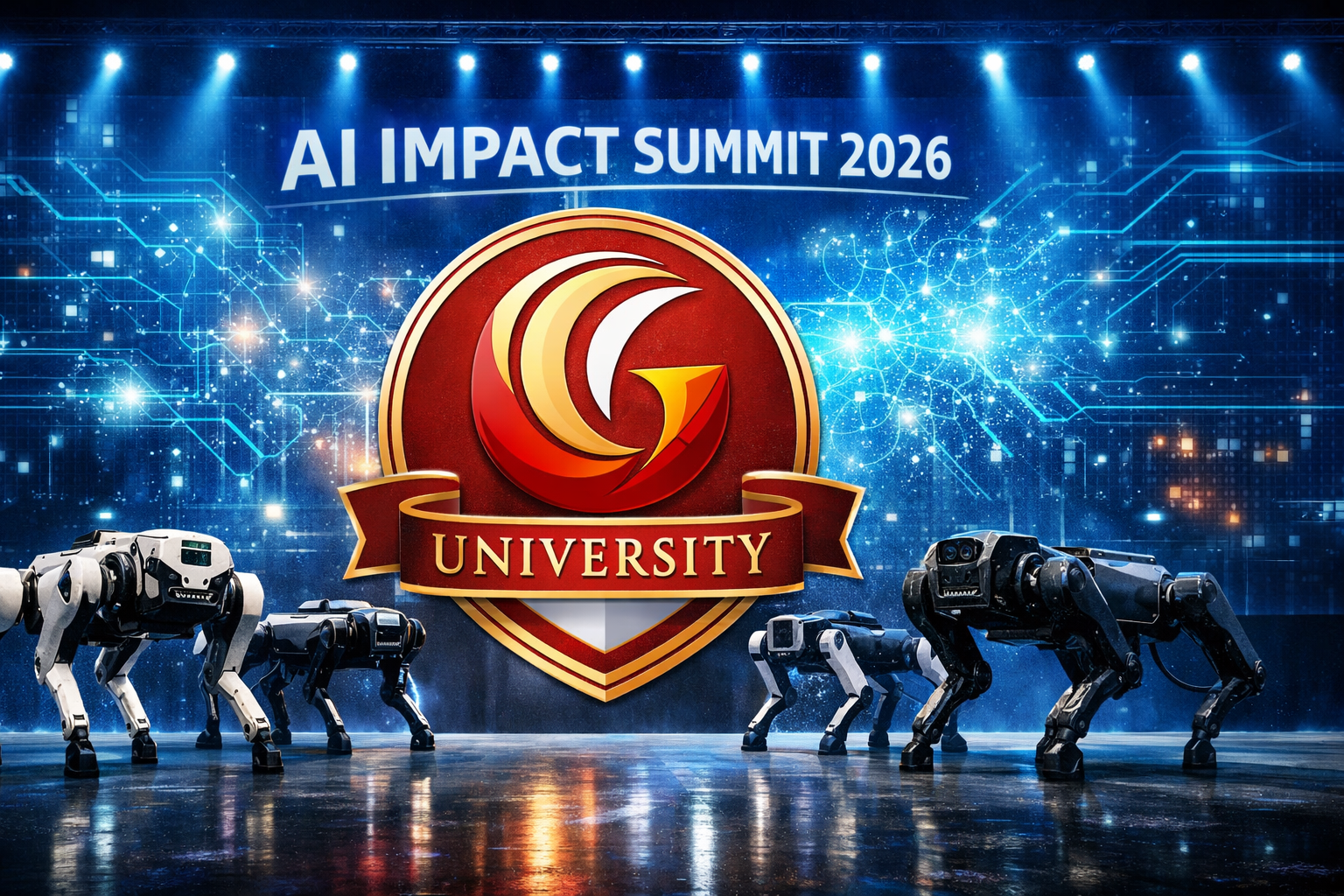
India’s push to become a global force in artificial intelligence has placed universities under growing scrutiny. Institutions are announcing major investments, unveiling new laboratories and hosting technology showcases. In that charged environment, claims made on public platforms carry weight. The recent controversy involving Galgotias University at the India AI Impact Summit 2026 has therefore sparked wider debate about ambition, transparency and the credibility of India’s AI ecosystem.
At the summit in New Delhi, Galgotias University presented its artificial intelligence initiatives and highlighted a robotic dog named “Orion” at its pavilion. Shortly after videos from the event circulated online, observers identified the machine as a Unitree Go2 quadruped robot manufactured by a Chinese company. Questions emerged about whether the robot had been displayed as an in-house innovation. The issue quickly shifted from a campus-level showcase to a national conversation about authenticity in technology exhibitions.
In response to the uproar, sources within the government said that event organisers asked Galgotias University to vacate its stall at the summit expo following the controversy. The request reflected official sensitivity around accuracy at a high-profile event attended by policymakers, industry leaders and foreign delegates. In a public clarification, the university stated that it had not claimed to have built the robot. It described the device as a teaching and demonstration tool intended to expose students to advanced robotics platforms rather than a product of its own research.
The episode has unfolded against a backdrop of aggressive investment announcements. Galgotias University recently committed more than Rs 350 crore towards building an AI ecosystem that includes research infrastructure, laboratories and industry collaboration. Such commitments mirror a broader national trend. Indian universities, both public and private, are racing to establish centres of excellence in artificial intelligence, machine learning and data science. Government policy has emphasised digital transformation, and institutions are keen to align with that agenda.
Yet investment size and global impact are not always equivalent. When compared with leading research systems in the United States, China and Europe, India’s university-driven AI output remains modest. European universities such as the University of Oxford, ETH Zurich and the Technical University of Munich are investing heavily in AI research, supported by substantial regional funding initiatives. For example, the European Union has committed more than €20 billion to artificial intelligence research and innovation under its Horizon Europe programme, with a significant share flowing into university research, cross-institution partnerships and industry collaborations. These institutions combine long-standing academic strength with public and private funding, and they often collaborate closely with industry clusters in cities like Zurich, Munich and London. They contribute extensively to research publications, foundational theory and ethical frameworks for AI, even as they participate in hardware and software innovation.
Chinese universities such as Tsinghua University and Peking University benefit from sustained state funding, integrated research parks and deep links with technology giants. They contribute heavily to peer-reviewed publications, patents and hardware development in areas such as robotics, computer vision and large language models. Chinese campuses are not only users of advanced machines but also designers of proprietary systems.
Indian institutions have made meaningful strides, particularly in software development and start-up incubation. Several Indian Institutes of Technology and prominent private universities run AI research labs and interdisciplinary programmes. Indian researchers contribute to global conferences and open-source projects. However, large-scale indigenous hardware breakthroughs and globally dominant AI platforms are still rare. Much of the country’s strength lies in applied innovation and talent production rather than frontier laboratory manufacturing.
The controversy at the summit therefore touches a deeper nerve. It raises questions about how universities frame their capabilities and how ambition is communicated to the public. In a sector where credibility is currency, even perception matters. As India invests billions in digital infrastructure and seeks a larger role in the global AI order, universities will face sharper scrutiny from regulators, industry and society.
The real test will not be the size of an investment pledge or the visibility of a summit display. It will be measurable research output, transparent collaboration and innovations that stand up to international comparison. For Indian higher education, credibility in artificial intelligence will depend less on spectacle and more on sustained, verifiable achievement.
Subscribe Deshwale on YouTube


