



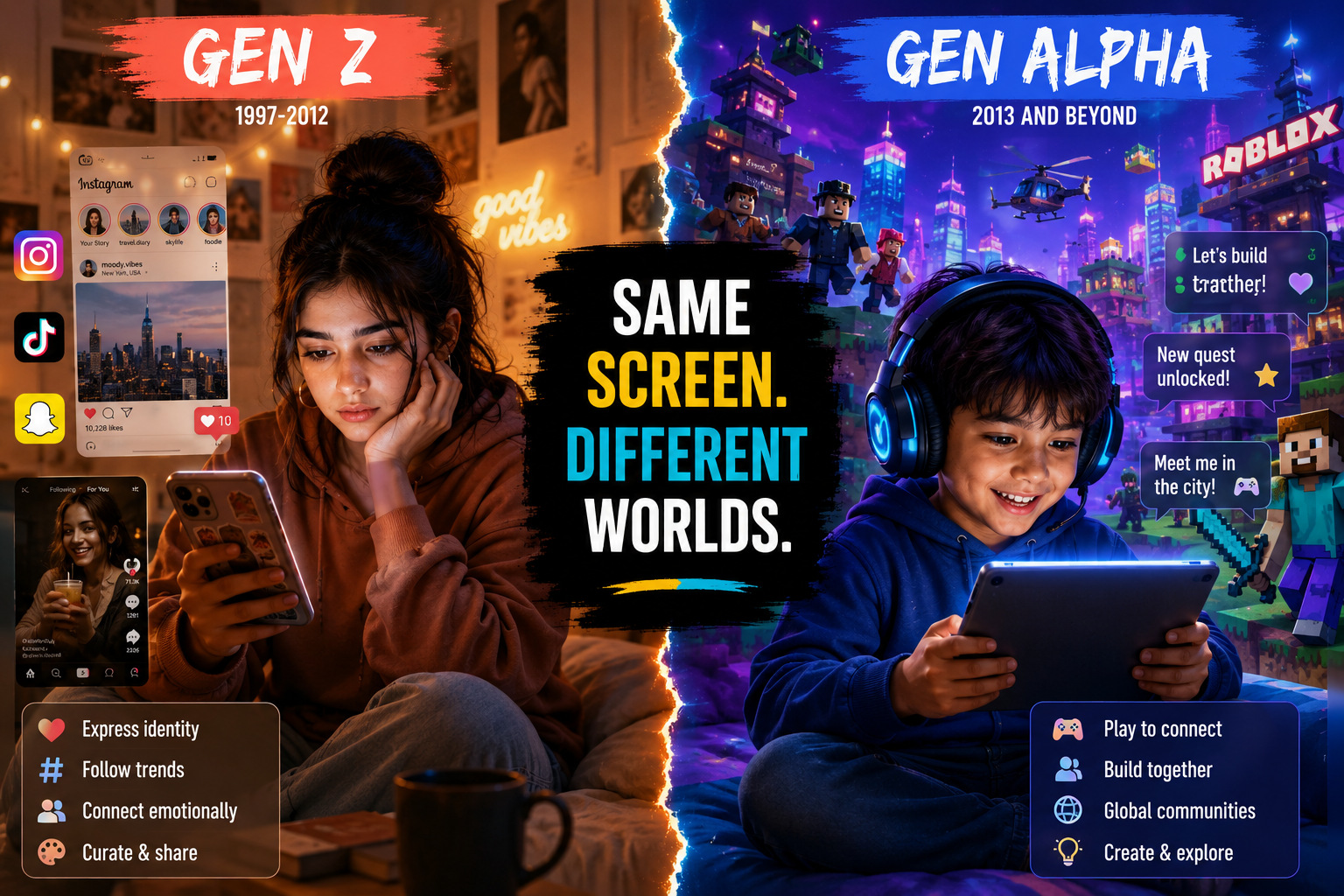
They both grew up with smartphones and Wi-Fi. So why does it feel like they come from completely different planets?
Walk into any home with a teenager and a ten-year-old, and you will notice something strange. Both of them are online. Both of them are staring at screens. But what they are doing, how they are feeling, and what they want from the world could not be more different. One is scrolling TikTok looking for something real. The other is deep inside a Roblox game, building a virtual city with friends from three different countries. Same internet. A completely different universe.
This is the Gen Z and Gen Alpha divide and it is more fascinating than most people realise. Gen Z, born roughly between 1997 and 2012, grew up watching the internet arrive and take over their lives. Gen Alpha, born from 2013 onwards, never knew a world without it. That single difference sounds small. It is actually everything.
Gen Z watched the internet arrive. Gen Alpha was born inside it. That is not a small gap it is a completely different starting point.
Gen Z had a “before.” They remember a childhood where weekends meant going outside, where phones were not yet glued to every hand, where social media was something you discovered in your teens rather than something your parents set up for you before you could read. That memory of a simpler time is a huge part of who they are. It is why Gen Z tends to crave authenticity so deeply they have seen what the internet can do to people, and they are suspicious of anything that feels fake or performed.
Gen Alpha has no such reference point. For them, a voice assistant answering their questions is as ordinary as asking a parent. Tablets arrived before textbooks. YouTube was a babysitter, teacher, and best friend all at once. They did not adapt to technology; they simply grew inside it, the way a fish grows inside water, never questioning whether the water is there.
How they use social media
Gen Z
Uses Instagram, TikTok, and Snapchat to express identity, follow trends, and connect emotionally. Social media is a stage they perform, curate, and share.
Gen Alpha
Uses social media more to stay in touch, less to perform. Gaming worlds like Roblox and Minecraft are their real social spaces they build and play together.
The social media story is where the two generations split most visibly. Gen Z built TikTok. They figured out the algorithm, mastered the 15-second hook, and turned authenticity into an art form. Their entire digital language is built around emotional connection. A good video does not just entertain, it makes you feel seen. For Gen Z, social media is deeply personal.
Gen Alpha is growing up with a completely different relationship to all of it. They are less interested in posting and more interested in doing. Gaming is their social life. Roblox and Minecraft are not just games to Gen Alpha, they are the playgrounds, the malls, the hangout spots that Gen Z had in the physical world. Socialising for Gen Alpha often means building something together inside a virtual world, not curating a profile for strangers to admire.
Then there is the question of AI. For Gen Z, artificial intelligence is a tool that arrived during their lifetime, impressive, sometimes unsettling, something to figure out. For Gen Alpha, AI is just… there. Nearly half of Gen Alpha teens already use AI as a search engine. They ask questions the way older generations asked Google, and before that, the way their grandparents asked a librarian. It is not a novelty. It is infrastructure. This is the generation that will grow up treating AI the way we treat electricity, invisible, expected, and completely essential.
For Gen Z, AI is a tool to figure out. For Gen Alpha, it is simply part of the air they breathe.
Their values are shifting too quietly but clearly. Gen Z came of age during climate marches, the Black Lives Matter movement, and a mental health crisis that hit their generation particularly hard. They are vocal, politically aware, and driven by a strong sense of what is wrong with the world. Gen Alpha is growing up in a world where many of those conversations are already happening. Inclusion and fairness feel less like causes to fight for and more like basic expectations. They are not less caring. They are just starting from a different baseline.
The mental health piece is worth paying attention to. Gen Z opened up the conversation around anxiety, depression, and burnout in a way no generation had before. They made it okay to say “I am not okay.” Gen Alpha inherits that more open world, but they also inherit the same algorithms, the same comparison culture, and the same pressures just at an earlier age, with smaller hands holding the phone.
Here is the thing that often gets missed in these generational comparisons: neither generation is better or worse. Gen Z brought emotional intelligence, social awareness, and a hunger for authenticity to the digital age. Gen Alpha is bringing something different an instinct to build, to create, and to treat technology not as something to be amazed by, but as a natural extension of thought. The screen is the same. What they see through it could not be more different. And that, more than anything, is what makes this moment so worth paying attention to.
Subscribe Deshwale on YouTube
