



India’s growth story often celebrates billion-dollar conglomerates, unicorn startups, and record-breaking stock markets. But beneath this glossy narrative lies the real backbone of the economy: 6.82 crore micro, small and medium enterprises (MSMEs). These businesses contribute around 30% to India’s GDP, generate over 45% of exports, and employ nearly 30 crore people.
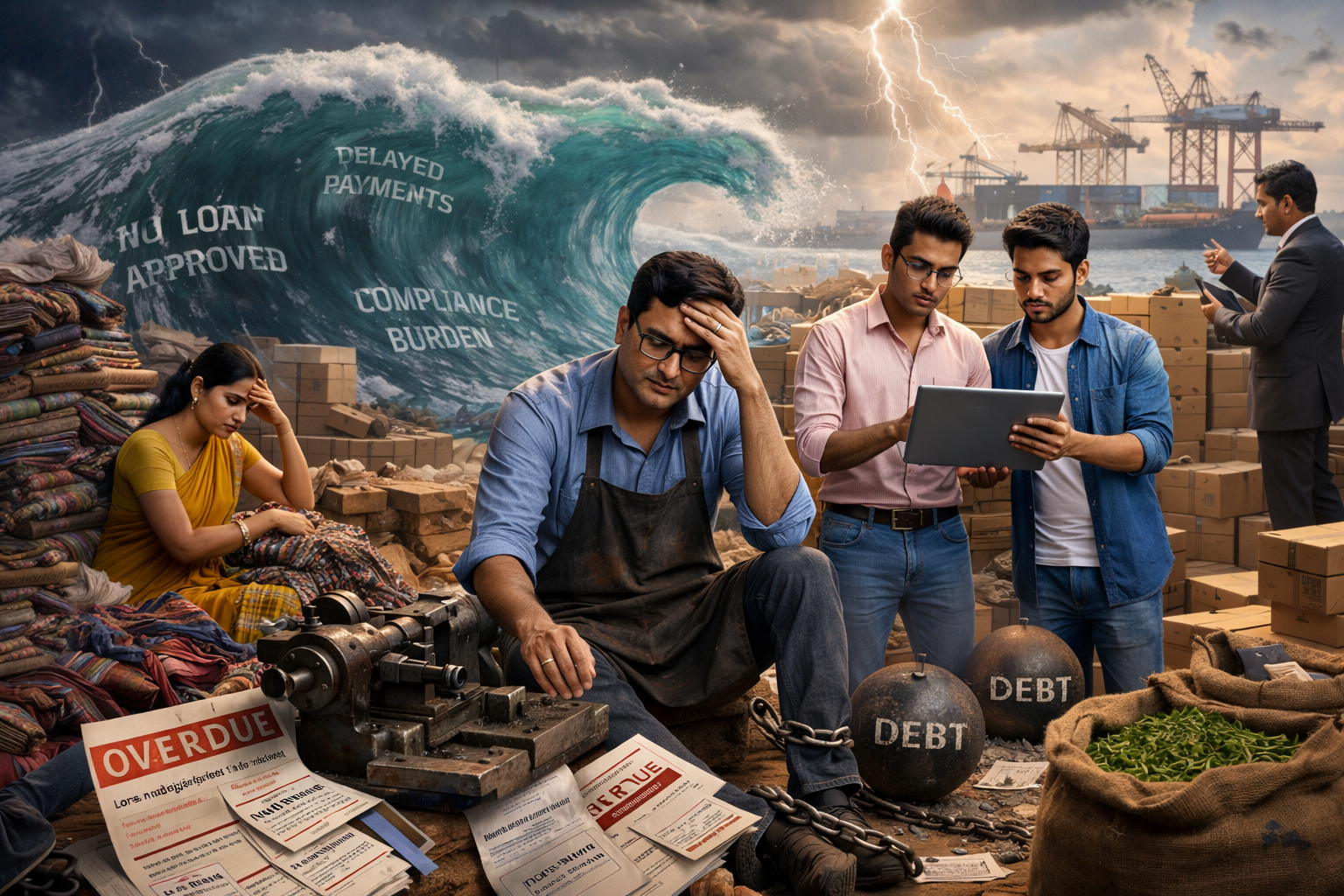
Despite their scale and importance, India’s MSMEs, particularly micro enterprises, are operating under intense pressure. Rising compliance costs, delayed payments, limited access to credit, and increasing market concentration are turning entrepreneurship into a daily survival test.
As India aims to become a five trillion dollar economy, the uncomfortable question is clear: are MSMEs growing with the economy, or being left behind by it?
India’s MSME Reality: Strength in Numbers, Weakness in Structure
India’s MSME ecosystem is heavily skewed towards micro enterprises. Nearly 97% of firms employ fewer than 10 people, which limits productivity, technology adoption, and bargaining power. While collectively large, most units remain small, informal, and under-capitalised.
Three issues dominate MSME distress today:
- A credit gap exceeding 500 billion dollars
- Delayed payments stretching up to 90 to 120 days
- A compliance-heavy regulatory framework designed more for large firms than small businesses
This combination has slowed expansion, discouraged formalisation, and pushed many enterprises into informal or high-cost borrowing.
Credit: The Biggest Constraint for Indian MSMEs
Access to affordable credit remains the single biggest bottleneck. Less than 15% of micro enterprises receive formal bank credit, forcing many to depend on informal lenders charging extremely high interest rates.
While government schemes exist, their reach is limited, and risk-averse banking practices continue to restrict flow of funds. In contrast, global economies treat SME credit as essential infrastructure, using fintech platforms, guaranteed lending, and invoice financing to ensure liquidity.
For India, strengthening trade receivables platforms, expanding digital lending, and improving risk assessment for small borrowers is no longer optional.
Delayed Payments: The Silent Killer of Small Businesses
Delayed payments remain one of the most damaging issues for Indian MSMEs. Small suppliers often end up financing large buyers due to weak enforcement of payment timelines. Locked working capital reduces capacity utilisation, delays wages, and increases dependence on short-term debt.
Other economies strictly enforce payment deadlines through penalties and automated systems. In India, despite existing laws, enforcement remains inconsistent, making delayed payments a systemic risk rather than an exception.
Compliance Burden: Growth Barrier for Micro Enterprises
India’s push towards formalisation has improved transparency, but it has also increased the compliance burden on micro enterprises. Multiple filings, technical errors, and automated notices consume time and resources that small firms simply do not have.
Globally, countries are moving towards simplified, single-window compliance systems and regulatory sandboxes. India’s challenge is not regulation itself, but over-regulation without scale sensitivity.
A lighter compliance framework for micro firms could significantly improve productivity and ease of doing business at the grassroots level.
Exports and Market Access: Uneven Playing Field
Indian MSMEs play a crucial role in exports, but face high logistics costs, limited branding, platform fees, and intense competition from larger players. Unlike global peers that operate within well-supported industrial clusters, many Indian MSMEs operate in isolation.
Export growth requires more than incentives. It needs cluster-based infrastructure, technology upgradation, predictable logistics, and stable policy support.
What Needs to Change
For MSMEs to move from survival to scale, India must focus on execution rather than announcements:
- Expand access to low-cost, patient credit
- Strictly enforce payment timelines
- Simplify compliance for micro enterprises
- Promote export-oriented industrial clusters
- Use fintech and digital platforms at scale
Without structural reform, MSMEs will remain large in number but limited in influence.
India’s MSMEs are not inefficient or unambitious. They are structurally constrained. Global experience shows that when small businesses receive consistent policy support, affordable finance, and fair market access, they become engines of sustainable growth.
If India wants inclusive economic expansion, MSMEs must move from policy footnotes to policy priorities.
Subscribe Deshwale on YouTube
