




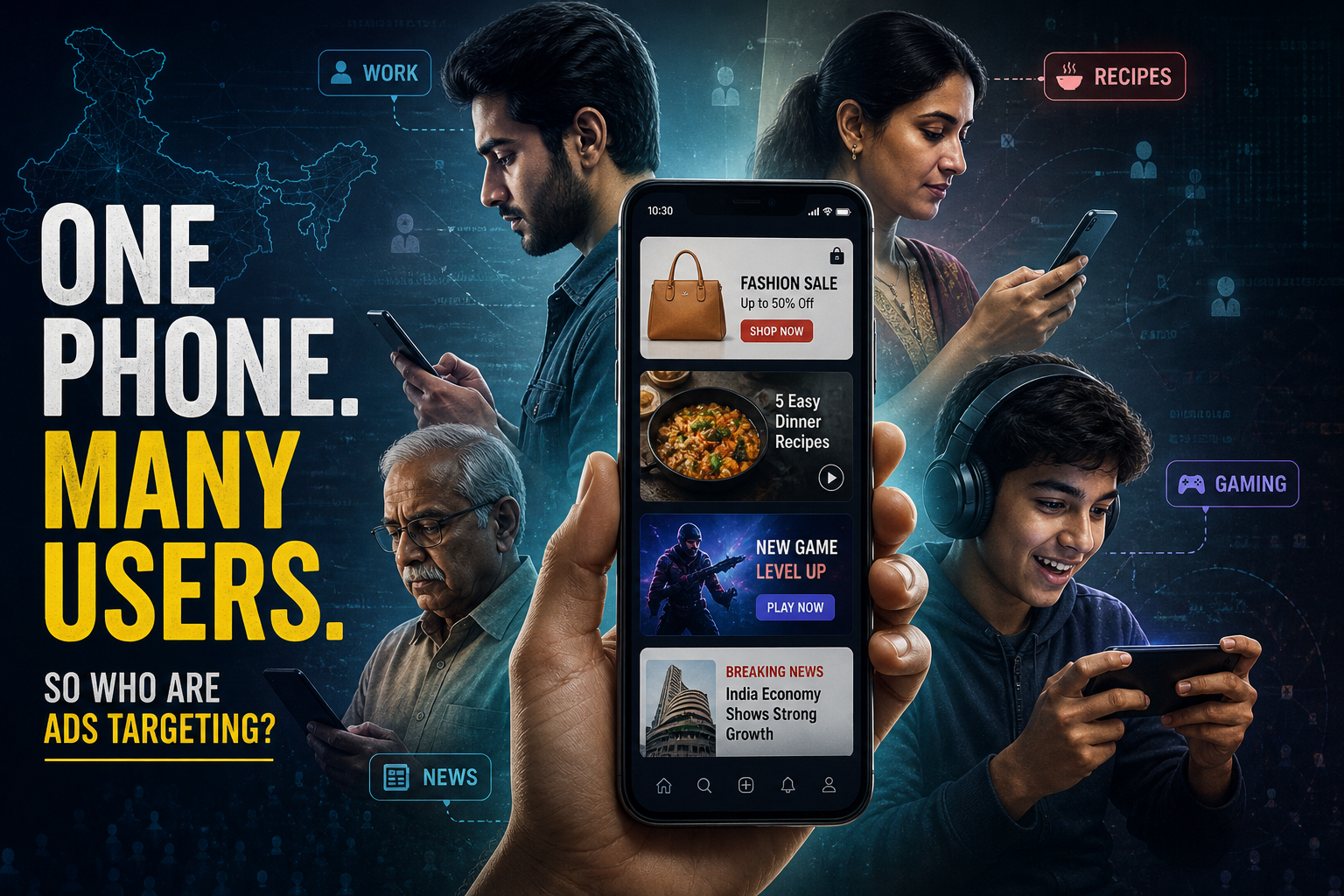
The number sounds like a triumph. It is. But buried inside it is a problem that nobody in digital advertising wants to talk about.
India’s internet story has never been short on big numbers. According to Nielsen’s India Internet Report 2025, the country now has over 915 million active internet users. Nearly 94% of them access the internet through mobile data. And at the heart of all of this sits a single device, the smartphone owned by over 622 million Indians.
That is a staggering figure. For brands, for platforms, for anyone trying to sell something to someone in this country, 622 million smartphones sounds like 622 million open doors.
Here is the problem. More than a third of those smartphone users share their devices.
Do the rough math. That means somewhere upward of 200 million smartphones in India are being passed between two or more people, family members, spouses, siblings, parents and children often on a daily basis. The phone that the algorithm thinks belongs to a 28-year-old man in Pune could, at different points in the same day, be in the hands of his mother looking up recipes, his teenage sister watching videos, and his father checking news.
But the algorithm does not know that. And that is where things get interesting.
The invisible user
The entire architecture of digital advertising in India is built on one silent assumption: one phone, one person. Every ad you see, every product recommendation that appears on your screen, every “personalized” notification all of it is generated by systems that treat your device as a window into a single individual’s preferences and behaviour.
India’s digital advertising market reached ₹49,000 crore in FY2025, commanding 44% of the total advertising pie overtaking television and is projected to grow a further 15% to ₹56,400 crore in FY2026. That is a colossal amount of money being spent on the assumption that digital advertising is precise. That it reaches the right person, with the right message, at the right time.
But if over 200 million devices are shared, a significant chunk of that targeting is not precise at all. It is a guess. A well-funded, algorithmically sophisticated guess but a guess nonetheless.
Think about what that means in practice. A mother uses a family smartphone to search for a school bag for her child. The next person to pick up that phone is her husband, who now starts seeing school bag ads for the next two weeks. A woman watches cooking videos on her husband’s phone. His feed quietly shifts. A grandfather borrows his grandson’s device to make a call and stumbles into an app he has never used before. That one interaction registers as user behaviour. Somewhere, a data point is born that does not reflect a real person.
Why this matters beyond advertising
The shared device reality is not just an advertising problem. It has implications for how we understand India’s internet at a basic level.
When we say 78% of India’s internet users watch video online, a finding from the same Nielsen report we are drawing conclusions about individual behaviour. But how many of those video views are happening on a shared screen, in a shared sitting, with a shared account? When we say 74% of users engage with social networking, whose social network are we actually talking about?
Device sharing is also a privacy issue that rarely gets discussed. When two people share a phone, they often share everything on it: messages, browsing history, financial apps, health information. In a country where 62.5% of the population still lives in rural areas, where a single smartphone is often the most expensive piece of technology a household owns, sharing is not an exception. It is the norm.
What the industry pretends not to notice
Here is the uncomfortable part. The digital industry knows about device sharing. It has been known for years. But the business model runs on the idea of individual reach and individual targeting, so there is little incentive to loudly announce that a significant share of the audience data is muddied.
Challenges such as ad fatigue, tracking ROI, and consumer privacy concerns remain key considerations for India’s digital marketing industry but device sharing rarely makes the list. It should be near the top.
India’s internet story is genuinely extraordinary. The growth is real, the numbers are real, and the opportunity is real. But 622 million smartphones does not mean 622 million distinct digital identities. Until the industry reckons honestly with that gap, the most sophisticated ad systems in the world will keep confidently talking to the wrong person.
Subscribe Deshwale on YouTube
