



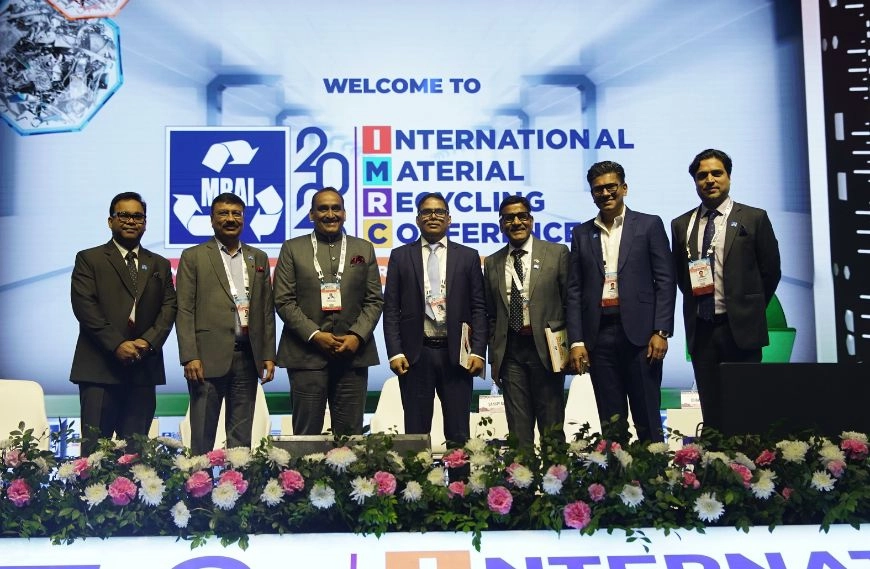
India’s demand for steel scrap is expected to rise sharply as the country expands its steelmaking capacity, according to Shri Daya Nidhan Pandey, Joint Secretary, Ministry of Steel, who was speaking at the inauguration of the 13th International Material Recycling Conference and Exposition (IMRC 2026) in Jaipur.
Pandey noted that scrap currently contributes around 21 per cent of India’s crude steel output, compared with a global average of nearly one-third. With scrap availability projected to reach approximately 36 million tonnes, he said the sector is poised for significant growth. As India works towards 300 million tonnes of steel capacity by 2030 and 500 million tonnes by 2047, the role of recycled scrap will become increasingly central to sustainable production.
Highlighting government initiatives, Pandey outlined policy measures such as the Steel Scrap Recycling Policy 2019, the Vehicle Scrappage Policy, and the rollout of Registered Vehicle Scrapping Facilities. He added that the newly notified Extended Producer Responsibility (EPR) framework for end-of-life vehicles and construction and demolition waste is expected to accelerate formal scrap recycling while supporting India’s net-zero target for 2070.
Industry leaders also raised concerns about regulatory and tax challenges. Sanjay Mehta, President of the Material Recycling Association of India (MRAI), urged the government to reduce GST on scrap to five per cent, stating that high tax rates were discouraging compliance and slowing industry growth. He also called for the removal of import duties on aluminium scrap and stronger enforcement of EPR norms across e-waste, tyres, and plastics.
Mehta highlighted the social impact of recycling, noting that nearly one-third of India’s scrap supply originates from informal workers such as ragpickers and small workshops. He emphasised that digital payment systems and reduced taxation could help integrate these workers into the formal economy.
Addressing the evolving industry landscape, Dhawal Shah, Senior Vice President of MRAI, said recycling in India has transitioned from a CSR-led activity to a core business sector. With over 1,400 sustainability-focused start-ups operating nationwide, he predicted that recycling could surpass traditional mining in scale before 2050.
The three-day IMRC 2026, organised by MRAI and held at the Novotel Jaipur and Convention Centre from January 20 to 22, has brought together policymakers, investors, and global stakeholders to discuss sustainability, climate action, and circular economy strategies.
During the inaugural session, Lifetime Achievement Awards were presented to industry veterans Jinesh Shah, Purshottam Parolia, and Hitesh Shah, while Anshul Gupta received the Global Recycler of the Year Award.
Subscribe Deshwale on YouTube
