








By: Pratyush Bardoliwala
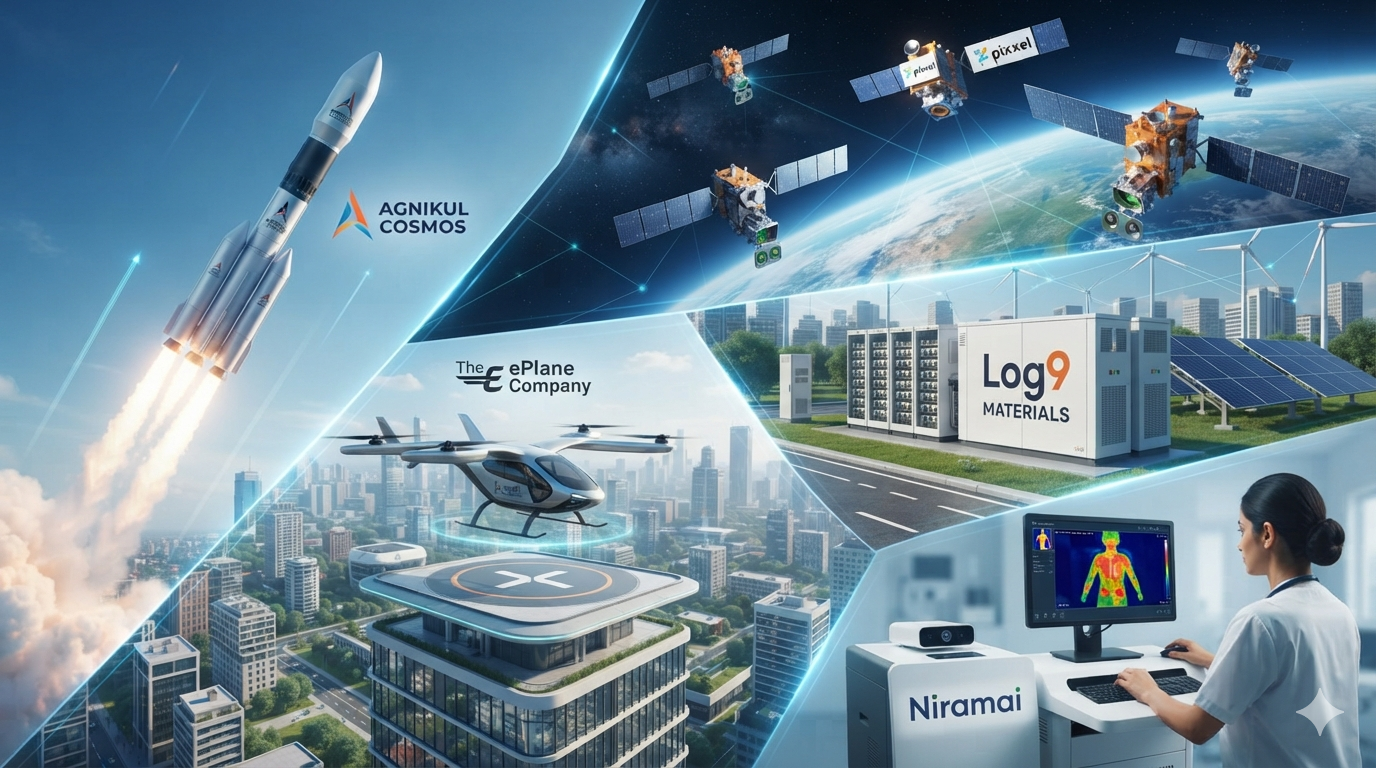
India is no longer just a market for global technologies. From space exploration and electric aviation to healthcare and clean energy, Indian companies are developing advanced solutions that have the potential to solve real-world problems and compete globally. Here are five Indian technology companies building products that could shape the future.
1. Agnikul Cosmos
Founded in 2017 and incubated at IIT Madras, Agnikul Cosmos is an Indian space technology company focused on developing small satellite launch vehicles. The company is known for developing Agnibaan, a customisable launch vehicle designed to carry small satellites into low Earth orbit. One of its key technological achievements is the development of the Agnilet engine, a single-piece 3D-printed semi-cryogenic rocket engine that showcases the potential of advanced manufacturing techniques in space technology.
Why Agnikul Cosmos Is Revolutionary
Agnikul’s use of 3D printing in rocket engine manufacturing is a major innovation because it simplifies production by reducing the number of individual components required. This approach can help reduce manufacturing time, improve design flexibility and potentially lower production costs. The company aims to make satellite launches more accessible by offering dedicated launch solutions for small satellite operators.
With its focus on indigenous rocket technology and private space capabilities, Agnikul could play an important role in strengthening India’s position in the global space sector. Its developments may help create more affordable access to space for startups, researchers and businesses.
2. Pixxel
Founded in 2019, Pixxel is an Indian space technology company developing advanced Earth-observation satellites. Based in Bengaluru, the company is building a constellation of hyperspectral satellites designed to capture highly detailed data about the Earth’s surface. Unlike traditional satellites that collect information through a limited number of spectral bands, hyperspectral satellites analyse hundreds of wavelengths, allowing them to identify patterns and changes that are difficult to detect through conventional imaging.
Why Pixxel Is Revolutionary
Pixxel’s hyperspectral technology can detect details that remain invisible to ordinary satellite cameras. Its applications include monitoring crop health, studying environmental changes, analysing forests, tracking pollution and supporting industries such as agriculture and mining. By developing advanced satellite imaging technology in India, Pixxel is entering a specialised segment of the global space industry focused on high-resolution Earth intelligence.
In the future, Pixxel’s technology could help India make better decisions in areas such as agriculture, climate monitoring, disaster management and resource planning. Its satellites could provide valuable data for addressing some of the country’s biggest environmental and economic challenges.
3. The ePlane Company
Founded in 2017 and based in Chennai, The ePlane Company is an Indian aerospace technology company developing electric aircraft designed for urban transportation. The company is working on electric vertical take-off and landing (eVTOL) aircraft, commonly known as air taxis, which are designed to take off and land vertically without requiring traditional runways. Its goal is to develop compact, efficient and sustainable aircraft solutions for short-distance urban travel.
Why The ePlane Company Is Revolutionary
The ePlane Company’s eVTOL technology aims to address challenges faced by modern cities, including traffic congestion and long travel times. Electric air taxis could offer a faster alternative for short urban journeys while producing fewer operational emissions compared to conventional helicopters. By using electric propulsion and a compact aircraft design, the technology has the potential to reduce operating costs and make urban air mobility more practical in the future.
With the development of electric aircraft in India, The ePlane Company could contribute to the future of transportation by introducing new mobility options for crowded cities. If successfully commercialised, its technology could change how people travel within urban areas and place India among countries developing next-generation aviation solutions.
4. Log9 Materials
Founded in 2015 and based in Bengaluru, Log9 Materials is an Indian deep-tech company working on advanced battery technologies and energy storage solutions. The company develops innovations in areas such as electric vehicle batteries, aluminium fuel cells and energy storage systems. Its focus is on creating cleaner and more efficient energy solutions that can support India’s growing demand for electric mobility and renewable energy.
Why Log9 Materials Is Revolutionary
Log9 Materials is developing battery technologies aimed at improving the performance and reliability of energy storage systems. Its aluminium fuel cell technology and battery solutions focus on challenges such as energy efficiency, charging performance and sustainable mobility. These innovations could support the wider adoption of electric vehicles by addressing some limitations of conventional battery technologies.
With India’s transition towards electric mobility and clean energy, Log9 Materials could play an important role in building domestic energy technology capabilities. Its work in advanced batteries and energy storage could help strengthen India’s EV ecosystem and contribute to a more sustainable transportation future.
5. Niramai
Founded in 2016 and based in Bengaluru, Niramai is an Indian health technology company developing solutions for early cancer detection. The company has developed Thermalytix, a non-invasive breast cancer screening technology that uses thermal imaging and artificial intelligence to identify abnormalities associated with breast cancer. Unlike traditional screening methods, the technology focuses on making early detection more accessible and comfortable for patients.
Why Niramai Is Revolutionary
Niramai’s thermal imaging-based screening technology does not use radiation and does not require painful breast compression, making the process less invasive compared to conventional screening methods. Its AI-powered approach can analyse thermal patterns and help healthcare professionals identify potential signs that may require further evaluation. The technology is designed to support wider screening access, especially in areas where traditional healthcare infrastructure may be limited.
By combining artificial intelligence with healthcare, Niramai could help improve early cancer detection in India and make screening services more available across urban and rural regions. Its innovation represents how Indian health-tech companies are using technology to address critical healthcare challenges and improve patient outcomes.
From space technology and electric aviation to healthcare and clean energy, Indian companies are creating solutions that could shape the future across industries. These innovations highlight India’s growing ability to develop advanced technologies and build products that can address challenges not just within the country, but around the world.
Subscribe Deshwale on YouTube


