



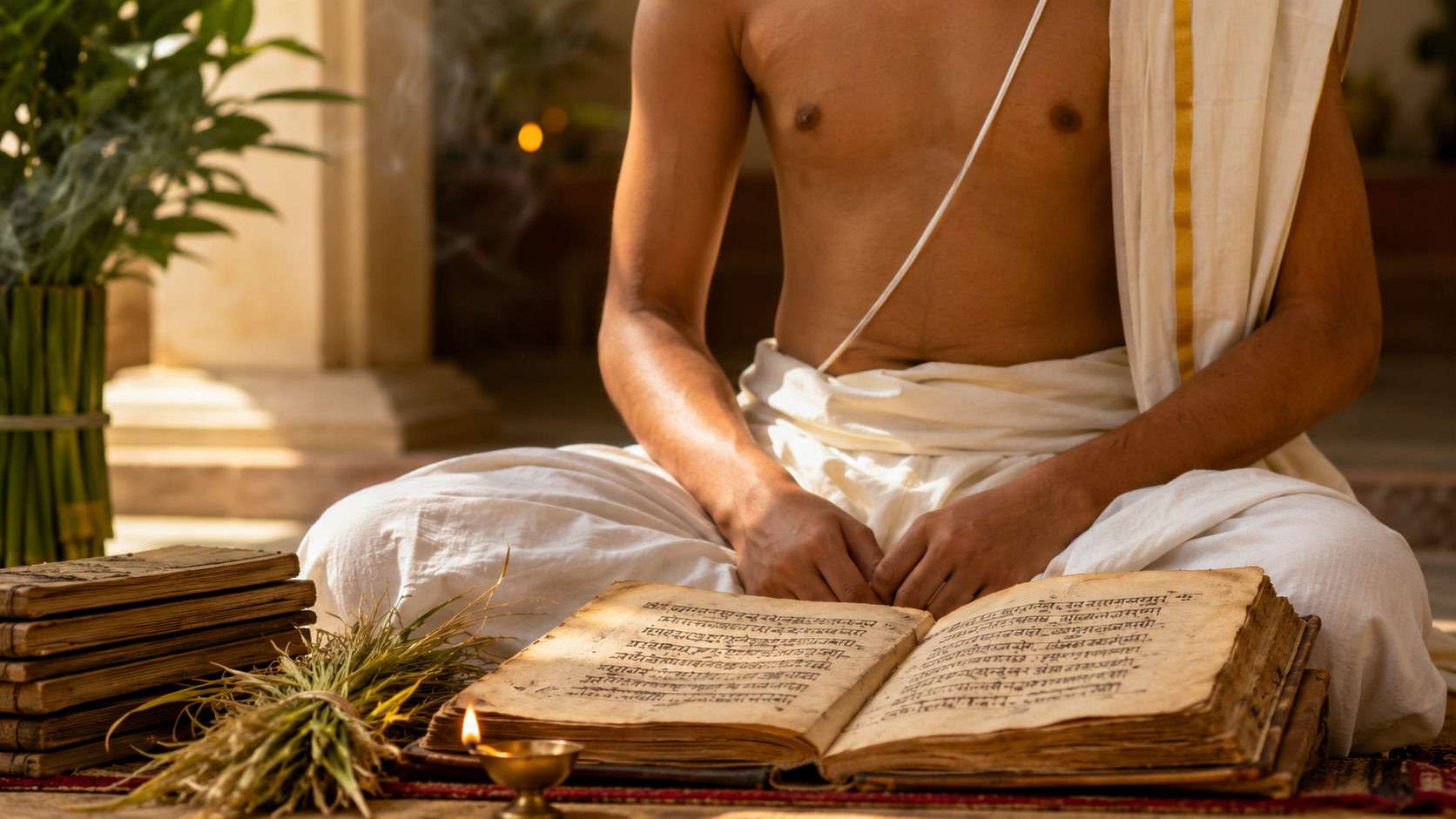
It’s thin, white, and weighs next to nothing. Worn under a shirt, it can go unnoticed by everyone except the man wearing it. And yet for centuries, this small cotton thread has carried an unusual weight of meaning. To some, it’s a reminder of a disciplined religious life. To others, historically, it meant access to Vedic learning and ritual privilege. To critics of the caste order, it became a visible symbol of exclusion. The object itself is simple. Its history is not.
In Sanskrit, it’s called the yajnopavita, worn over the left shoulder and under the right arm, and it’s tied to a rite called upanayana. The wearer is described as dvija, “twice-born.” The first birth is physical. The second, symbolic one comes through initiation into a life of learning and discipline.
Most people today associate janeu almost entirely with Brahmins, and in current practice, that’s largely accurate. Historically, though, the picture is more layered. In its classical form, upanayana was meant for the three dvija varnas Brahmins, Kshatriyas and Vaishyas and a boy who underwent it became a brahmacharin, a student living under a teacher’s discipline. The ceremony was as much educational as religious.
There’s an older layer that complicates this further. Some early texts, including the Baudhayana Grihyasutra, appear to have encouraged a wider section of society, including Shudras, to undergo upanayana, before later medieval texts narrowed the rite to the three upper varnas. That suggests the restriction wasn’t built in from the start it hardened gradually, as India’s broader social order hardened. Even more strikingly, the earliest Vedic-era evidence for the initiation itself doesn’t mention the thread at all, which hints that the yajnopavita as a physical object came later.
The word itself is instructive too. The Gobhila Grihya Sutra describes the upavita in connection with a cord, a garment, or even a rope of kusha grass not one fixed material. What mattered was the position and function of the object, not its exact physical form, which evolved considerably over time.
Perhaps the most interesting part of upanayana is its link to education. The ceremony marked entry into formal Vedic study a student learning under a guru, expected to practise restraint and take on daily religious duties. Seen this way, janeu worked almost like an ancient educational badge, not a certificate but a constant physical reminder that learning had begun, and that learning came bundled with responsibility.
Over time, the meaning of the thread became entangled with caste not overnight, but gradually, as access to sacred learning and ritual authority came to be distributed unequally across society. This is where janeu picks up its harder, more social dimension, one that can’t honestly be separated from its religious meaning.
Women’s relationship to this history is also more complicated than the modern picture suggests. The Gobhila Grihya Sutra uses the term yajnopavitini for a woman wearing the ritual cord in a wedding context, and tradition preserves the category of brahmavadini women associated with Vedic study who underwent a form of upanayana for that purpose. This doesn’t mean women broadly had the same access to initiation that men did; they clearly didn’t. But it does mean the actual history was more varied across regions and periods than the flattened, present-day rule implies.
Ask why the thread has three strands, and you’ll get several different answers: three debts owed to gods, sages and ancestors, the three gunas, or the three Vedas. That variation isn’t a sign that someone’s wrong. Hindu ritual symbols tend to gather meaning across centuries rather than settle on one fixed origin.
One thing worth a note of caution: several popular claims suggest janeu triggers specific nerves, or that looping it around the ear during certain acts produces measurable medical benefits. These claims circulate as settled fact, but there’s no solid evidence behind the specific biological mechanisms often cited. A ritual object having genuine psychological or behavioural value is entirely plausible that’s different from claiming modern physiology has proven a precise mechanism.
Many traditions periodically renew the thread, often around occasions like Upakarma. The point isn’t really the new cotton it’s the recurring chance to remember what the thread was meant to represent in the first place, since commitments made once tend to fade without reinforcement.
Janeu was also never confined to Brahmins alone. Communities across India maintain their own versions under regional names poonal, poita, jandhyam, janivaara, bratabandha each shaped by local custom.
What makes Janeu genuinely striking is how it holds two opposing truths at once. It began as a symbol of entry into knowledge, and that knowledge became socially restricted. It represented duty, and it also became, over time, a marker of privilege. Both are real, and neither erases the other.
What it means today depends entirely on the person wearing it daily ritual for some, a distant childhood ceremony for others. What has survived, through every shift in material and meaning, is a very old human instinct: carrying a visible, physical reminder of an invisible obligation, on the body, every single day.
Subscribe Deshwale on YouTube
