



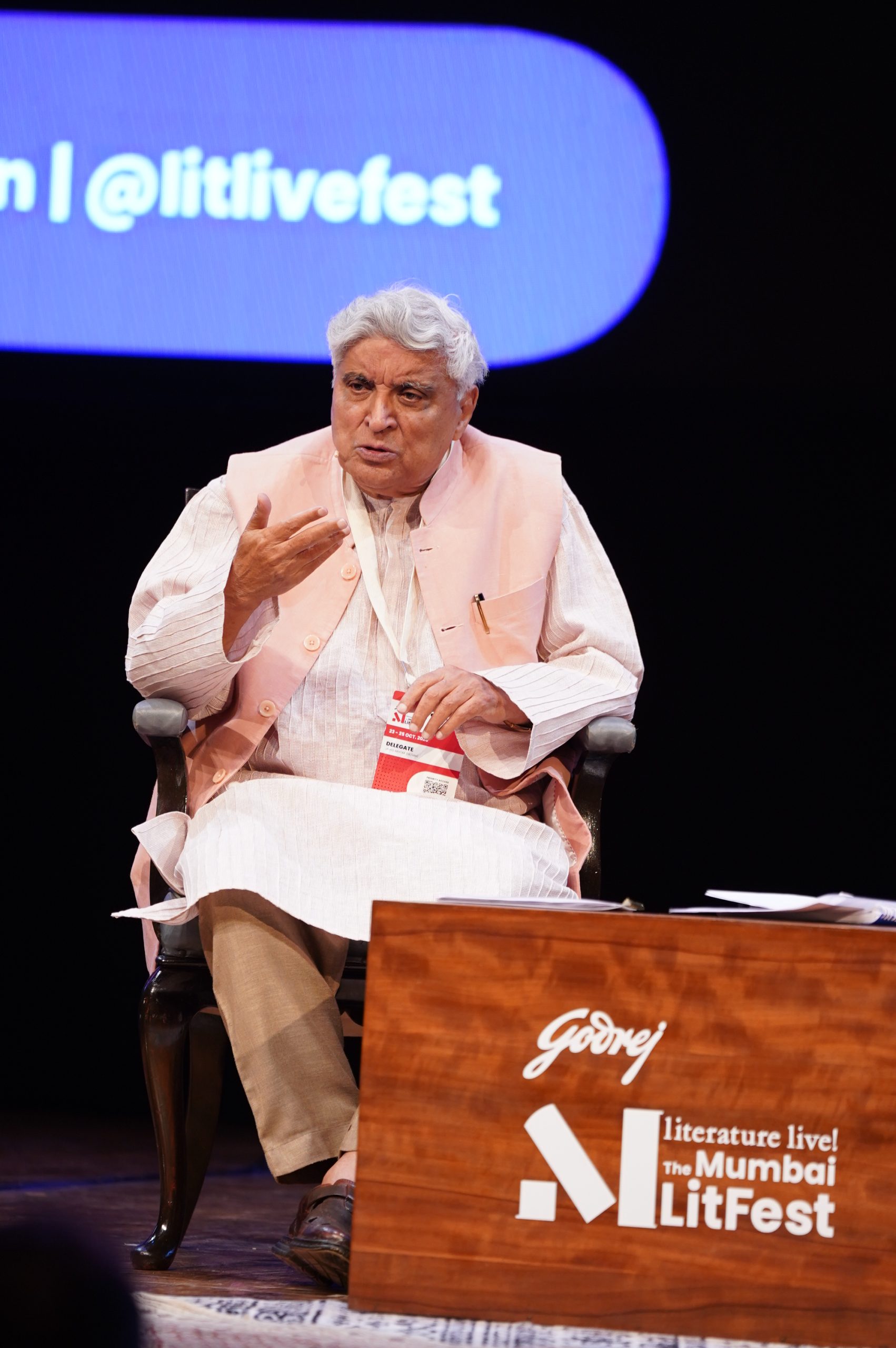
Artificial Intelligence may be transforming industries around the world, but celebrated lyricist and screenwriter Javed Akhtar believes that when it comes to creative expression, technology still has a long way to go. Speaking at the inaugural session of the 17th edition of Godrej Literature Live! The Mumbai LitFest 2026, Akhtar said that AI cannot replicate the emotional depth and subconscious thought that define human creativity.
The literary festival began on October 23 at its long-time venue, the National Centre for Performing Arts (NCPA), Mumbai, with the traditional opening session titled “For The Love of the Word – The Anil Dharker Session.” The event also marked the launch of Akhtar’s latest book, Three Masters, a collection of timeless dohas by legendary philosopher-poets Kabir, Rahim and Vrind, translated into English by Sumantra Ghosal.
Kabir’s timeless lesson on true greatness
During the session, Akhtar reflected on the enduring relevance of Kabir’s teachings by reading one of the poet’s most celebrated dohas:
“बड़ा हुआ तो क्या हुआ, जैसे पेड़ खजूर। पंथी को छाया नहीं, फल लागे अति दूर ॥”
Explaining its meaning, Akhtar said that a person’s greatness is measured not by status or position but by the contribution they make to society.
According to him, life is only a brief journey between “nothingness and nothingness,” and what truly matters is what an individual gives back to humanity. Drawing from Kabir’s metaphor of the date tree, he noted that despite its height, the tree offers little shade to travellers and its fruit remains difficult to reach. Likewise, people who fail to help others may achieve success but leave behind little lasting impact, while those who provide “shade and fruit” through their actions are remembered for generations.
“AI doesn’t have a subconscious mind”
Responding to an audience question about whether Artificial Intelligence poses a threat to poetry and creative writing, Akhtar dismissed the idea that AI could replace human imagination.
He described AI as a useful assistant capable of handling practical tasks such as writing formal complaints or performing administrative work. However, he argued that creativity is rooted in experiences, emotions and the subconscious mind—qualities that machines cannot genuinely possess.
According to Akhtar, while AI can imitate patterns and process information, it cannot understand personal grief, love, loss or the emotional experiences that have inspired art throughout human history. He added that painting, music and poetry emerge from deeply personal emotions and subconscious reflection, making them fundamentally human forms of expression.
His remarks highlighted the distinction between intelligence based on data and creativity shaped by lived experiences, suggesting that technology can support artists but cannot replace the emotional depth that defines great literature and art.
The discussion resonated with the audience as debates around AI-generated content continue to grow worldwide. Akhtar’s perspective served as a reminder that while technology is evolving rapidly, storytelling, poetry and artistic expression remain closely tied to human emotion and consciousness.
The opening session of Godrej Literature Live! 2026 set the tone for the festival by celebrating literature, philosophy and meaningful conversations, reinforcing the enduring relevance of classical poetry and the irreplaceable value of human creativity in an increasingly AI-driven world.
Subscribe Deshwale on YouTube
