









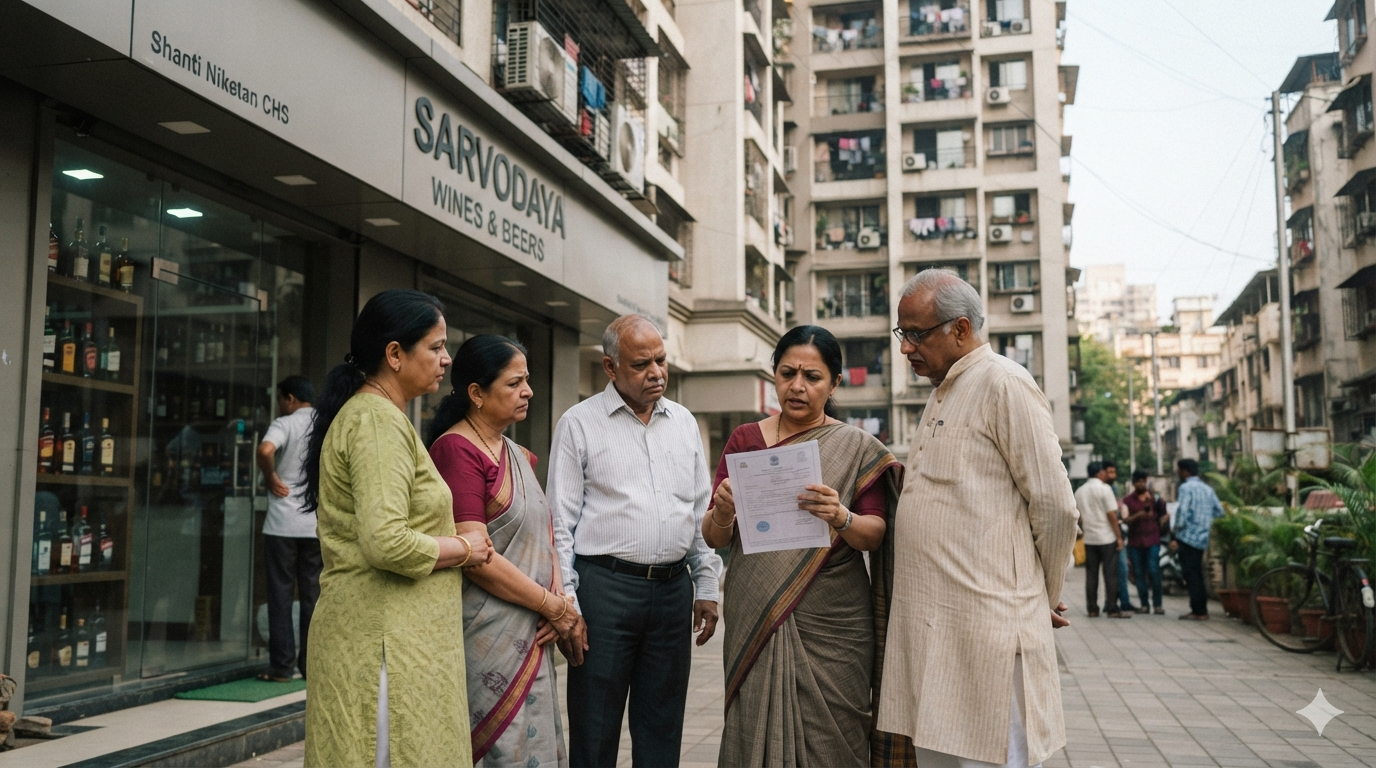
The Maharashtra government has introduced a new rule requiring liquor licence holders to obtain a No Objection Certificate (NOC) from the registered housing society when seeking to relocate their outlets to residential or residential-cum-commercial complexes.
The Home Department issued the notification on 6 August 2026, and the amendment came into force immediately.
The new provision applies specifically to FL-2 licences for foreign liquor sold for off-consumption and CL-3 licences for retail sale of country liquor. It requires an NOC from the concerned registered housing society when such outlets are relocated to residential or residential-cum-commercial complexes.
The move gives housing societies a formal role in the process and addresses concerns raised by residents about liquor shops operating within residential complexes.
Under the amended rules, liquor licence holders seeking to relocate FL-2 or CL-3 outlets to residential or residential-cum-commercial complexes must obtain an NOC from the registered housing society. This means the existing excise approval process is now supplemented by a society NOC for such relocations.
The amendment does not amount to a blanket ban on liquor shops across residential areas. Its reported scope is specifically linked to the relevant liquor licences and their relocation into residential or mixed-use residential complexes.
A housing society, generally a registered co-operative housing society, manages the common affairs of a residential building or housing complex. Its responsibilities can include maintenance, security, repairs, financial administration and management of common areas. Under the new amendment, a registered housing society can also play a formal role when covered liquor outlets are proposed for relocation into its residential or residential-cum-commercial complex.
The change follows concerns raised by residents and housing societies over liquor shops operating within residential complexes. Reported complaints have included crowding, noise, illegal parking and disturbance around buildings where liquor outlets operate. The issue has been particularly relevant in urban areas such as Mumbai, Thane and Pune.
The amendment addresses a procedural gap by requiring the society’s NOC for covered liquor-shop relocations into such complexes.
The NOC requirement also applies where a complex has received only a Partial Occupancy Certificate (POC). This is significant for buildings where some portions have become occupied while construction continues elsewhere.
The provision means a liquor outlet covered by the amended rules cannot avoid the society-NOC requirement simply because the complex has not yet received a final Occupancy Certificate.
At the same time, the amendment provides relief to licence holders after the required NOC has been obtained. Once the outlet has been relocated with the required NOC, the licence holder does not have to obtain a fresh society NOC every year solely for subsequent licence renewals.
This separates the initial relocation approval from subsequent annual licence renewals.
The move has been welcomed by housing society representatives, who argue that residents should have a say when liquor outlets are proposed within their residential complexes. Liquor traders, meanwhile, have raised concerns that the additional NOC requirement could make relocation more difficult, particularly for businesses affected by redevelopment or other changes to their existing premises.
For residents, the amendment means their registered housing society must provide an NOC before a covered liquor outlet can be relocated into the complex. For liquor licence holders, it introduces an additional requirement at the relocation stage while avoiding the need for a fresh society NOC for subsequent licence renewals.
The amendment therefore gives housing societies greater control over covered liquor-shop relocations within their residential complexes, without creating a blanket prohibition on liquor shops across Maharashtra.
Subscribe Deshwale on YouTube


