



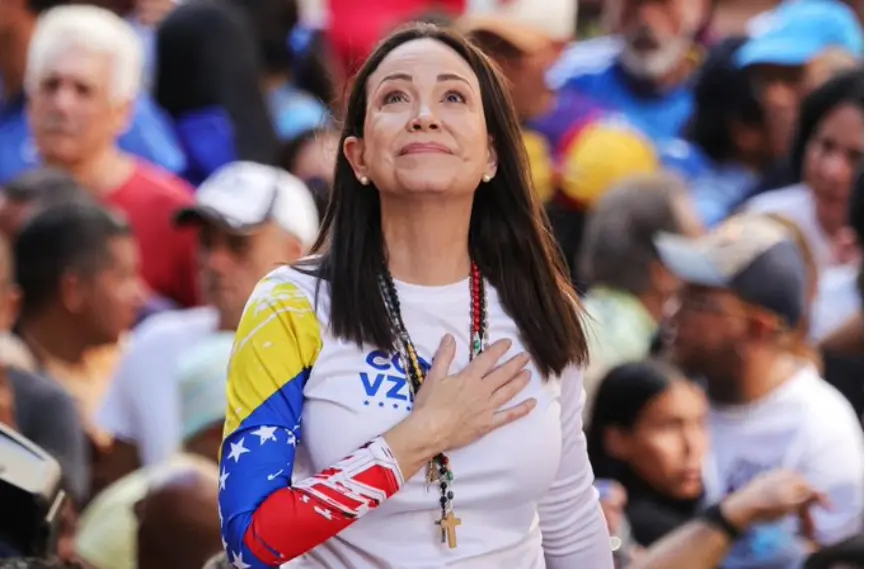
María Corina Machado, a Venezuelan opposition leader, has been awarded the 2025 Nobel Peace Prize for her unwavering commitment to promoting democracy and human rights in Venezuela. Despite facing significant personal and political challenges, Machado has remained a steadfast advocate for democratic values.
Early life and education
Born in Caracas in 1967, Machado pursued industrial engineering and finance, equipping her with analytical skills that would later aid her in political endeavors. Her academic background, combined with her family’s prominence, provided her with a platform to influence Venezuela’s political landscape.
Political activism and challenges
In 2001, Machado co-founded Súmate, a non-governmental organization aimed at promoting electoral transparency. Her efforts brought her into the national spotlight, especially during the 2004 referendum against then-President Hugo Chávez. In 2010, she was elected to the National Assembly, garnering the highest number of votes in the country’s history. However, her tenure was short-lived; in 2014, she was expelled from the assembly by the ruling government, citing her active opposition to the regime.
Formation of Vente Venezuela
Undeterred by political setbacks, Machado established the political party Vente Venezuela in 2013. The party advocates for liberal economic reforms, including the privatization of state-owned enterprises like PDVSA, Venezuela’s oil company, and the implementation of welfare programs to support the country’s impoverished population. Her leadership in Vente Venezuela positioned her as a formidable figure in the opposition, uniting various factions under a common cause: the restoration of democracy in Venezuela.
The 2024 presidential election and subsequent challenges
In 2023, Machado won the opposition’s primary election with overwhelming support, positioning her as the unity candidate for the 2024 presidential election. However, the government barred her from running, accusing her of administrative irregularities. In response, she endorsed historian Corina Yoris as a symbolic stand-in candidate. Despite claims of electoral fraud and widespread protests, Nicolás Maduro was declared the winner. Following the disputed election, Machado went into hiding due to safety concerns, continuing her advocacy for democratic reforms from the shadows.
International recognition and the Nobel Peace Prize
Machado’s relentless pursuit of democratic ideals did not go unnoticed. In 2024, she received the Václav Havel Human Rights Prize and the Sakharov Prize, shared with Edmundo González, for their collective efforts in representing Venezuelans fighting for democracy. In 2025, the Norwegian Nobel Committee awarded her the Nobel Peace Prize, recognizing her tireless work promoting democratic rights and striving for a peaceful transition from dictatorship to democracy in Venezuela. The committee lauded her as a symbol of resistance and democratic resilience.
María Corina Machado’s evolution from an industrial engineer to a political icon underscores the profound impact one individual can have on a nation’s democratic journey. Her story inspires countless others, especially women in STEM fields, to leverage their expertise and platforms to advocate for justice and democratic values. Her dedication serves as a beacon for those committed to the principles of democracy, human rights, and the relentless pursuit of a just society.
