









By: Hiren Gandhi
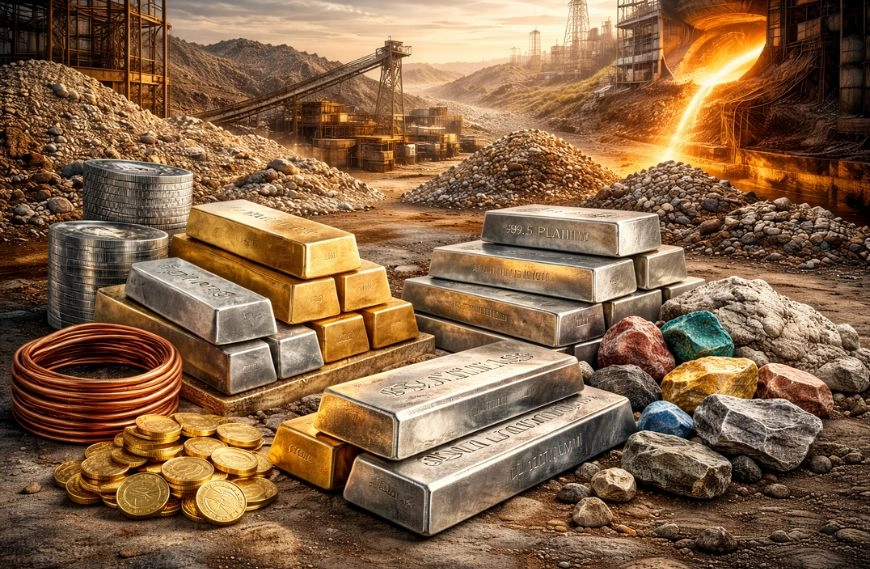
In today’s global economy, the metal sector has once again taken centre stage. Commodities such as gold, silver, copper, platinum, and rare earth metals are no longer limited to industrial usage alone; they have become crucial pillars of global finance, instruments for inflation hedging, and important elements of geopolitical strategy.
Status of the Metal Market as of December 2025
- Gold: Approximately $4,532 per ounce
- Silver: Around $79 per ounce (high volatility)
- Copper: $5.77 per pound
- Platinum: At historical high levels
These figures indicate that metals have moved beyond being safe-haven assets and have become a central component of the global supply–demand ecosystem.
Why Is the Metal Market So Volatile?
Several key factors are driving heightened volatility in the metals market:
- Global economic uncertainty
- Inflation and U.S. Federal Reserve interest rate decisions
- Geopolitical tensions, including wars, sanctions, and trade restrictions
- Supply chain disruptions
- Rising demand from both industrial and investment sectors
Metals such as silver experience especially sharp movements because they serve both industrial and investment purposes.
Key Metal Trends (2024–2025)
The following trends have become particularly prominent:
- Rising demand for transition metals such as copper, lithium, and nickel
- Rapid growth in electric vehicles, battery technology, solar power, and green energy
- Reshoring of manufacturing and restructuring of global supply chains
- High volatility, yet a strong long-term upward trend
Why Has Silver Emerged as a Superstar?
By 2025, silver surged nearly 170%, reaching around $79 per ounce. Key reasons include:
- Expectations of U.S. interest rate cuts
- Massive use in AI data centres
- Rising jewellery and industrial demand in India
- Limited new supply entering the market
Global and Indian Production Statistics
Gold
- Global production: 3,673 tonnes (2024)
- Global demand: 4,974 tonnes
- India’s production: 1.4 tonnes
- India’s demand: 802.8 tonnes
Silver
- Global industrial demand: 680.5 million ounces
- India’s imports: 2,580 tonnes (first eight months of 2025)
Platinum
- Global production: 170 tonnes (2025)
Copper
- Global production: 22.9 million tonnes (2024)
- Global demand: 27 million tonnes
- India’s future demand: 3.24 million tonnes
Rare Earth Metals
- China dominates global production
- India’s production: approximately 2,900 metric tonnes
MCX – India’s Commodity Exchange
The Multi Commodity Exchange (MCX), established in 2003, is India’s leading platform for trading metals, energy products, and agricultural commodities.
Relationship Between Metals and the U.S. Dollar
Metals typically share an inverse relationship with the U.S. dollar:
- Strong dollar → Metal prices decline
- Weak dollar → Metal prices rise
Future Outlook (Up to 2026)
- Gold: Potential to reach $5,000 per ounce
- Silver: May cross $100 per ounce
- Copper & Platinum: Expected to remain strong due to structural demand
- Global GDP growth and possible interest rate cuts could further support metal prices
Who Holds the World’s Largest Gold Reserves?
- 🇺🇸 United States: 8,133 tonnes
- 🇩🇪 Germany: 3,351 tonnes
- 🇮🇹 Italy: 2,451 tonnes
- 🇮🇳 India (households): Estimated 25,000–30,000 tonnes, the highest in the world
The metal sector is no longer just a commodity market—it has become a strategic backbone of the global economy. In the years ahead, technology, energy transitions, and geopolitical developments will increasingly shape the direction of metal markets.


Secretary — InGlobal Business Foundation (IBF)
Director — ReNis Agro International LLP, Ahmedabad, India
Subscribe Deshwale on YouTube


