



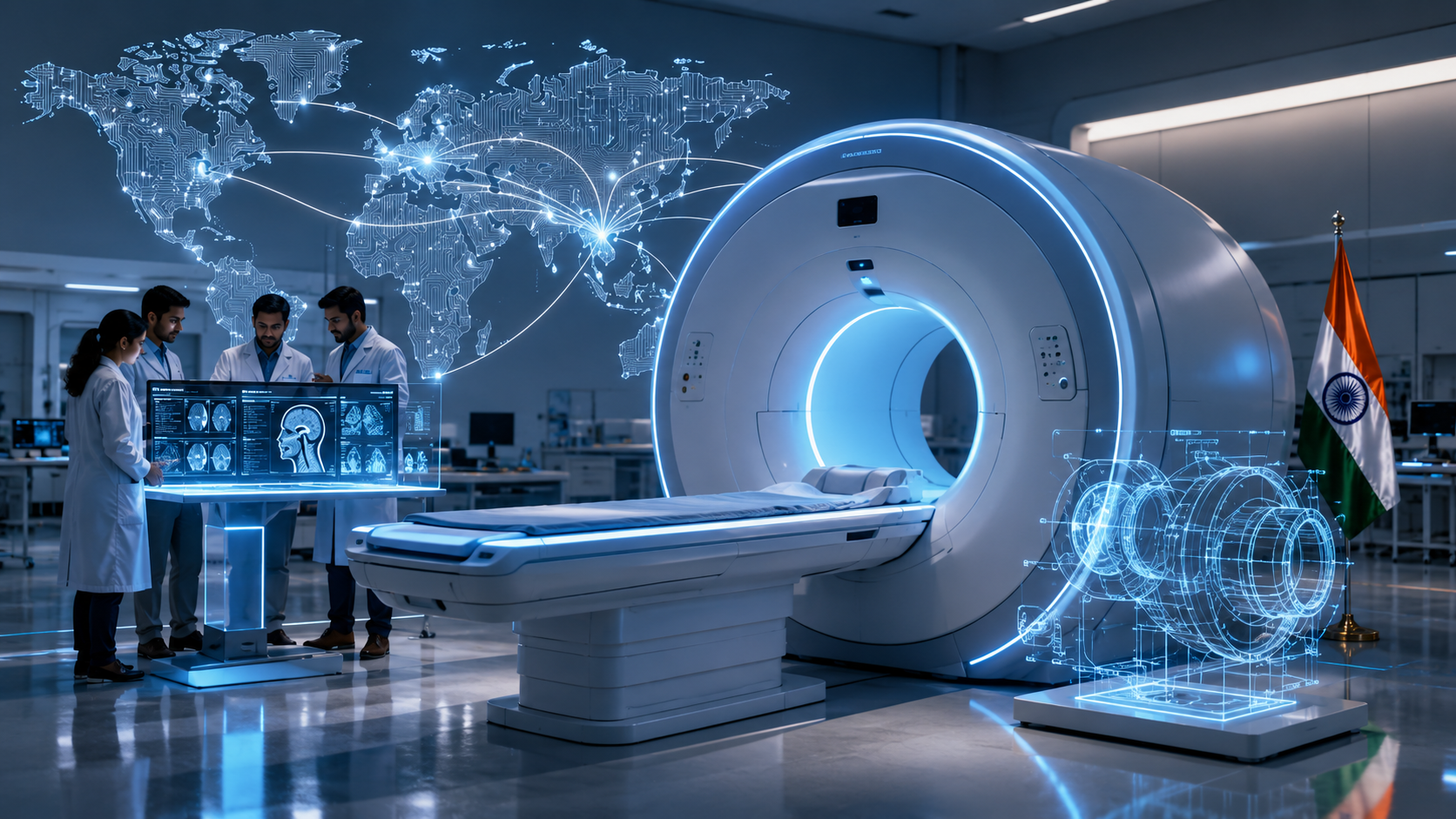
Every MRI machine in every Indian hospital was built somewhere else. Not assembled elsewhere and shipped here designed, engineered and manufactured entirely outside the country. That’s a big part of why a single MRI scan in India still costs close to Rs 10,000, out of reach for a large share of families who need one.
The reasons trace back decades. Since MRI technology first became commercially viable, the machines have come out of the same small set of countries: the US, Germany, Japan, China, Italy and the Netherlands. Three companies, Siemens Healthineers, GE HealthCare and Philips, control roughly two-thirds of the global market between them. Canon Medical and China’s United Imaging split most of what’s left. The overall market runs into several billion dollars a year, and it’s only getting bigger as hospitals everywhere push for sharper, faster imaging.
There’s a reason so few players dominate. People in the industry compare building an MRI scanner to building a jet engine. It demands years of research, serious capital, and engineers who understand physics, electronics, software and precision manufacturing all at once. Very few companies have pulled that combination off, so the same handful of names ends up in hospital after hospital, country after country.
Geography plays into it too. North America alone buys close to 40 percent of the world’s MRI machines, and richer countries tend to get the newest models first, replacing them every few years. Everyone else waits buying older, cheaper versions once they’ve filtered down. Access to good imaging, in other words, has as much to do with a country’s buying power as with the technology itself.
India sits firmly on the wrong side of that gap. It imports every MRI machine it uses, spending roughly Rs 3,500 crore a year to do so, and that bill eventually gets passed down to the patient. It’s also why Indian hospitals have nearly three CT scanners for every MRI machine. CT equipment is cheaper to buy and run, so that’s what gets bought, even when MRI would give doctors a clearer picture.
Global manufacturers haven’t had much incentive to change any of this. Most are guarded about letting outsiders near their systems, worried about losing control of proprietary technology. Arjun Arunachalam ran into that wall directly. An electrical engineer who studied MRI physics at the University of Wisconsin-Madison and later worked at GE HealthCare’s research centre in the US, he came back to teach at IIT Bombay hoping to do MRI research of his own and found that manufacturers simply weren’t interested in working with Indian institutions. India, in their eyes, wasn’t a serious enough market to bother with.
That’s what led him to start Voxelgrids in Bengaluru, setting out to do something no Indian company had managed before: build an MRI machine from the ground up, without licensing anyone else’s designs. His team, which has since grown from four engineers to 33, built the magnet architecture, the electronics and the software entirely in-house, rather than adapting an existing system.
The machine that came out of it looks genuinely different from what’s already on the market. It runs on roughly a third of the cabling found in conventional systems, draws far less power, and can operate on nitrogen instead of helium, a gas that’s grown scarce and expensive, and one every other major MRI maker still depends on. Arunachalam says those changes could eventually cut the cost of a scan by around 70 percent.
Getting there wasn’t just a technical fight, though. It was a financial one too. MRI startups routinely run out of money before they finish a working product, and the big manufacturers know it which is exactly why a multinational giant showed up mid-pandemic with an acquisition offer, at a moment when Voxelgrids was genuinely struggling to keep the lights on. Arunachalam turned it down. He believed a buyout would have meant handing over control of the very technology he’d spent years building.
What kept the company alive instead came from closer to home. Tata Trusts, under Ratan Tata, backed Voxelgrids early effectively placing an order for a machine that didn’t exist yet. Years later, after Tata’s passing, Zoho founder Sridhar Vembu stepped in. An electrical engineer himself, Vembu understood exactly what Arunachalam was attempting and backed it anyway, uncertainty and all.
None of this guarantees Voxelgrids succeeds where it matters most in actual hospitals, at scale, at a price that changes anything. But it’s already proof that the MRI industry’s decades-long lock isn’t unbreakable. China’s United Imaging has been chipping at the same monopoly through aggressive pricing; Voxelgrids is trying to do it through design. If the machine does reach India’s smaller towns and diagnostic centres the way Arunachalam hopes, the story stops being about one startup and starts being about who gets to afford a scan at all.
Subscribe Deshwale on YouTube
