











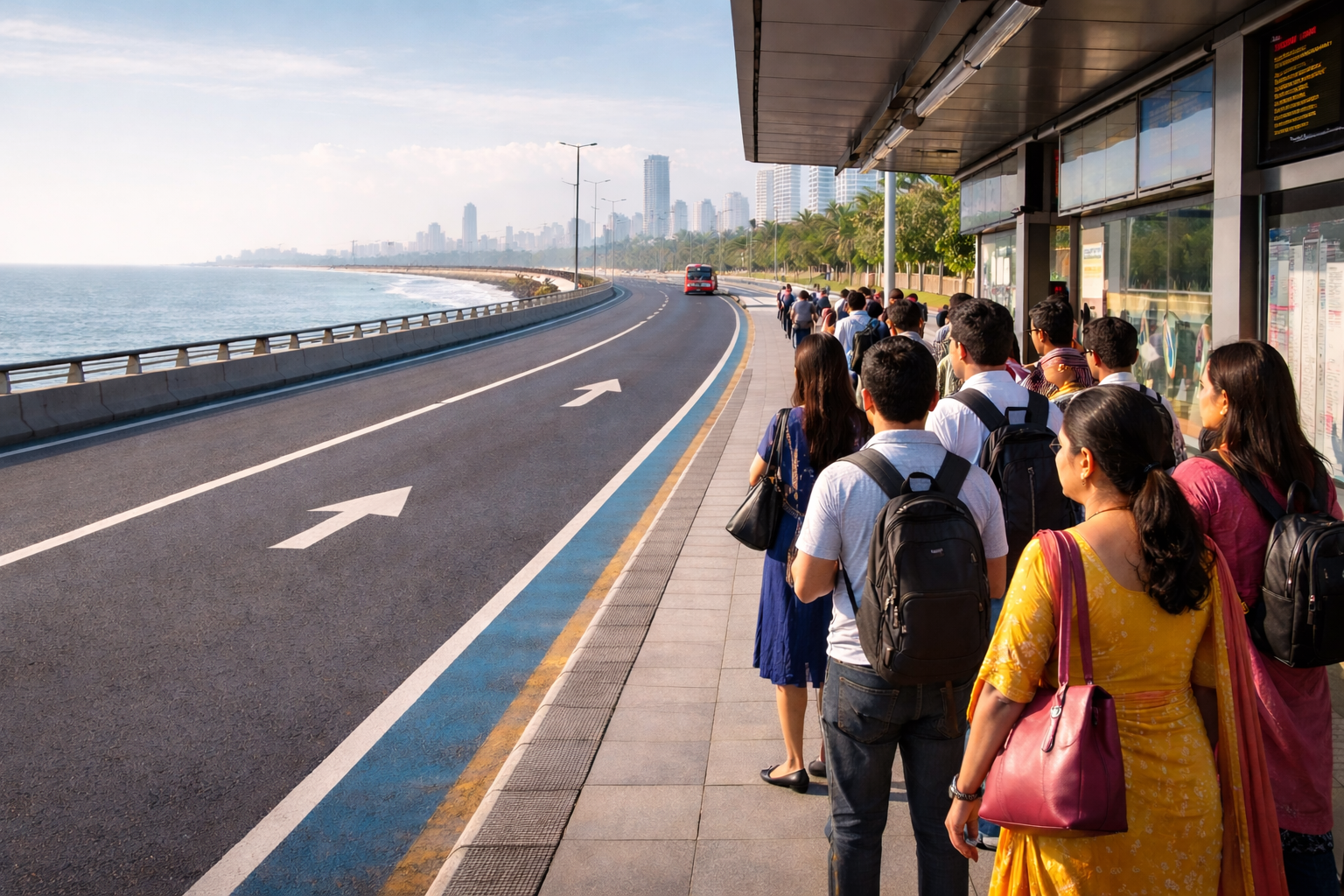
Mumbai’s Coastal Road was envisioned as a high-speed urban corridor along the city’s western shoreline. Phase 1 of the project, the 10.58 km stretch between Marine Drive and Worli, was opened to traffic in March 2024. The route runs largely on reclaimed land and is designed to ease pressure on key arterial roads in south Mumbai.
Early traffic observations have indicated some decongestion on parallel routes such as Pedder Road and Worli Sea Face, particularly during evening rush hours. Supporters say the corridor offers a faster alternative to congested inner-city roads and improves overall connectivity in south Mumbai.
The Coastal Road also includes a dedicated bus lane. The idea is straightforward. Public transport must benefit alongside private vehicles. However, commuters have expressed frustration that only two BEST routes currently operate on the reserved corridor.
The project is planned to extend northwards towards Bandra, and eventually further to Kandivali, creating a continuous western corridor linking south Mumbai with the suburbs. Proponents argue that once fully operational, the expanded route will streamline traffic movement and modernise the city’s transport grid.
Critics question whether the benefits are evenly distributed. Environmental concerns were raised during construction. Others argue that unless public transport is strengthened, the corridor may primarily serve private car users.
The debate cannot be separated from the condition of BEST. As of 2024, BEST’s operational fleet stands at roughly 3,000 buses, down from over 4,000 a decade ago. Cumulative losses reported in recent civic budgets exceed ₹9,000 crore. Financial stress has constrained expansion and fleet renewal.
This strain is visible on the ground. Passengers on routes such as A-204 and 262 frequently report long waiting times, especially in the evenings. Gaps of 25 to 35 to 60 minutes are common during peak hours, as per some commuters. Irregular frequency pushes commuters towards autos and app-based cabs. That weakens confidence in the bus network.
Dedicated bus corridors can work, but only with adequate fleet strength and disciplined scheduling. Bogotá’s TransMilenio system is often cited as a successful example. Its exclusive busways carry over two million passengers daily and significantly cut travel time on major corridors. Curitiba in Brazil pioneered integrated bus rapid transit decades ago. Reliable frequency and strong route planning made buses the backbone of urban mobility there.
These examples show that infrastructure alone does not guarantee success. Service levels determine impact.
Mumbai’s Coastal Road offers an opportunity. If BEST increases frequency and strategically deploys buses on the corridor, the dedicated lane could attract ridership. Efficient bus operations would also improve air quality and reduce congestion by encouraging a shift away from private cars.
The Coastal Road has already altered the city’s skyline and traffic pattern. Its next test lies in whether it can strengthen public transport. For that to happen, financial reform and operational stability at BEST are essential.
Urban infrastructure must serve the many, not the few. The Coastal Road can become a model corridor. However, its promise will be fulfilled only when buses move as efficiently as cars, and commuters experience consistent, reliable service across the network.
Subscribe Deshwale on YouTube


