








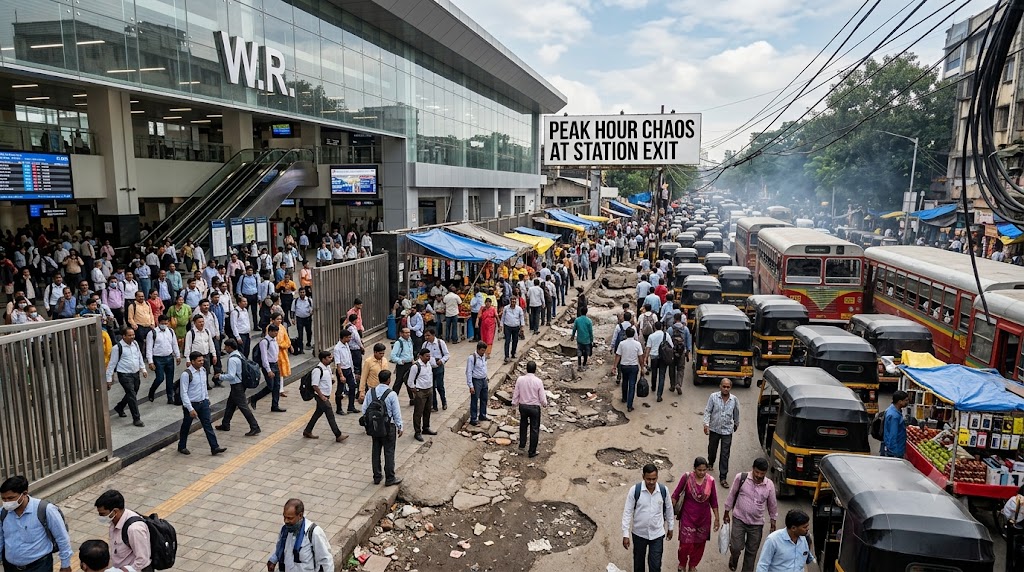
At Ram Mandir station on the Western line, thousands of commuters step off a smooth, air-conditioned local every day and walk straight into chaos. The station itself works fine. What happens the moment they exit the gate does not.
This isn’t a one-off complaint. It’s the pattern across Mumbai’s suburban network right now, and the irony is that the city has never spent more money trying to fix it.
Across successive phases of the Mumbai Urban Transport Project and the national Amrit Bharat Station Scheme, investments have crossed ₹52,724 crore. CSMT alone is mid-redevelopment, with its old Platform 18 entrance already demolished to make way for a new concourse, all while preserving the terminus’s UNESCO heritage status. Fifteen suburban stations under Central Railway, including Parel, Vikhroli, Kanjurmarg, Byculla and Kurla, have been marked for similar upgrades.
Inside these stations, the transformation is real. Lifts, escalators, better lighting, digital displays, cleaner platforms. None of that is in dispute.
The problem is what the money doesn’t touch. A recent policy analysis of Mumbai’s transit system put it plainly: station redevelopment is still treated as an engineering exercise confined to railway premises, not as one leg of a journey that includes the footpath, the bus stop and the auto stand outside. The stations get budgets. The 200 metres beyond the gate does not.
Bandra Terminus is the clearest warning sign. In October 2024, overcrowding on its platform during the festive rush led to a crowd crush that injured nine people, two critically. The Railways responded with safety audits and crowd restrictions at high-density stations, including CSMT and Dadar. But the audits looked inward, at platforms and boarding gates. They didn’t touch the roads and footpaths outside, where the same overcrowding often begins.
That’s the deeper issue: last-mile connectivity isn’t really a “last mile” problem. It’s a jurisdiction problem.
Railway stations fall under the Railways. Roads fall under the municipal corporation. Traffic falls under the police. Bus stops fall under BEST. Metro integration falls under yet another authority. Each of these bodies can point to its own budget, its own project, its own inauguration. None of them owns the 200 metres where a commuter actually struggles the most.
This is why a redeveloped station can sit inside a completely undeveloped neighbourhood. Bandra station’s own building underwent a major renovation in 2023, yet the crowd crush a year later happened not because the building failed, but because everything feeding into and out of it wasn’t designed to move that many people safely at once.
For commuters, none of this is abstract. It’s the difference between a five-minute walk and a fifteen-minute one. It’s whether an elderly parent can get from the platform to an auto without crossing four lanes of unregulated traffic. It’s whether “last-mile” transport options shared autos, BEST buses, app-based cabs are organised enough to use quickly, or scattered enough that people just wade into traffic instead.
The fix isn’t complicated to describe, even if it’s hard to execute: treat the station and its surrounding half-kilometre as one project, not two. Coordinate the redevelopment authority with the municipal corporation and traffic police from day one, not after the building is finished. Fund footpaths and organised transport stands with the same seriousness as escalators and digital boards.
Some of this thinking already exists on paper planners increasingly talk about integrating transport modes and public spaces around stations. What’s missing is execution that matches the scale of the money already spent on the buildings themselves.
Mumbai didn’t get here by under-investing. It got here by investing narrowly. ₹52,724 crore has bought the city gleaming platforms and heritage-sensitive restorations. It hasn’t yet bought a five-minute walk that doesn’t involve dodging traffic.
A commuter’s journey doesn’t end at the ticket gate, and it doesn’t begin there either. Until Mumbai’s planning treats the road outside the station with the same urgency as the station itself, the city will keep building world-class terminals surrounded by the same broken footpaths they always had.
Subscribe Deshwale on YouTube


