








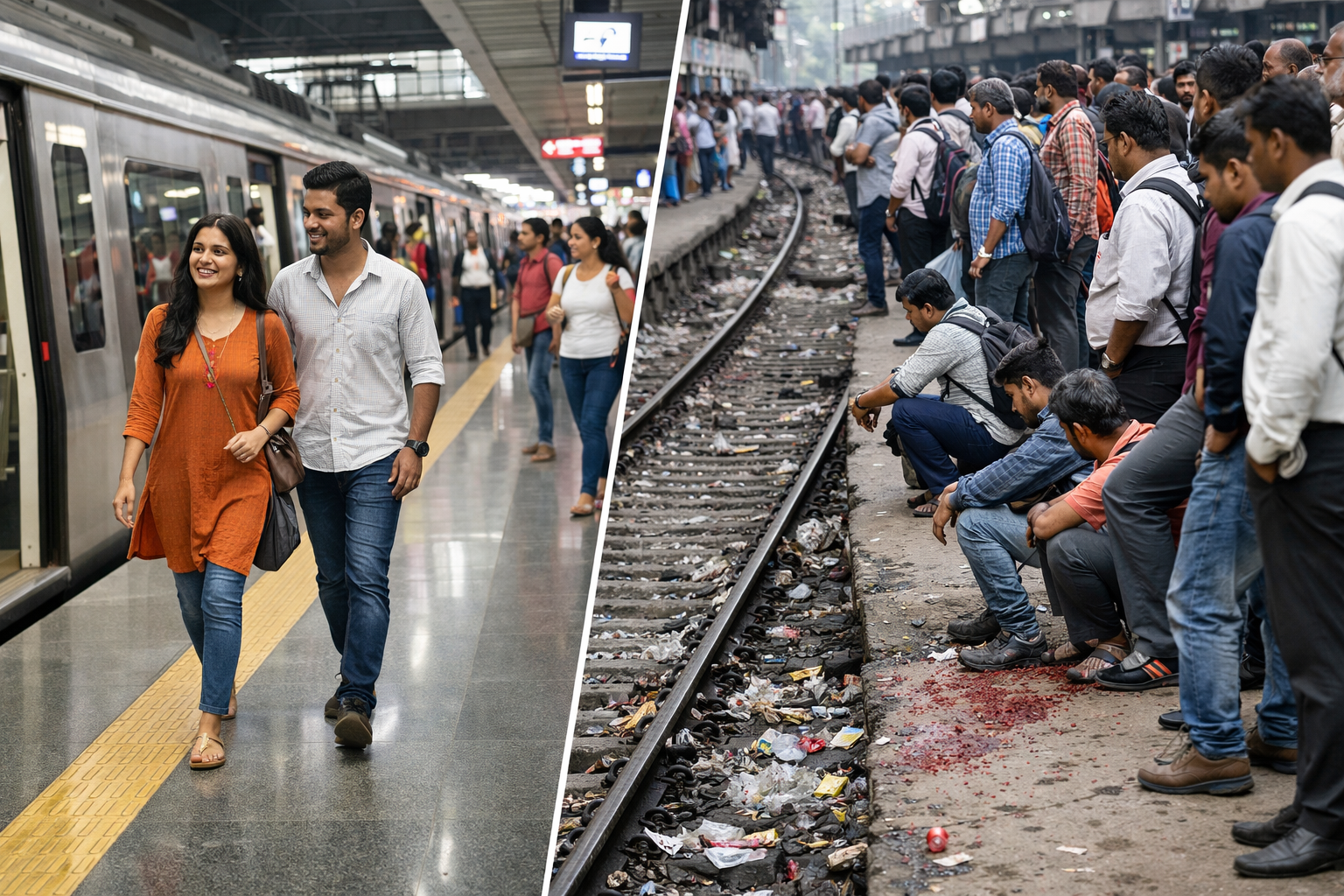
Mumbai’s public transport network reflects two contrasting realities. The suburban railway system, operated by Western Railway and Central Railway under Indian Railways, carries more than 7 million passengers daily. It is one of the busiest commuter networks in the world. By comparison, the Mumbai Metro network, overseen by the Mumbai Metropolitan Region Development Authority and private concessionaires on certain lines, serves a far smaller ridership base, estimated in the range of several lakh passengers per day across operational corridors.
The difference in footfall is visible. So is the difference in cleanliness.
At many suburban railway stations, platforms often show litter in the form of food wrappers, plastic cups, biscuit packets and gutkha sachets. The tracks themselves frequently bear red stains from paan and gutkha spitting. Despite periodic cleaning drives and visible sanitation workers, the scale of waste generation remains overwhelming. In high traffic stations such as Dadar, Thane and Andheri, constant passenger flow leaves little breathing space for sustained cleaning.
Metro stations, in contrast, present a markedly cleaner environment. Floors are usually spotless. Walls are free from spit stains. Waste bins are not overflowing. Housekeeping personnel are visible throughout the day. Access is regulated through ticket gates, which creates a more controlled environment.
Part of the explanation lies in scale. Mumbai’s suburban network handles crowd densities that few global cities experience. Open platforms, multiple entry points and continuous train frequency create enormous maintenance challenges. Metro stations are smaller, enclosed and easier to supervise.
Yet crowd size alone does not fully explain the gap.
Civic behaviour plays a significant role. Littering and spitting remain persistent problems at suburban stations despite fines under railway regulations. Public announcements requesting passengers to maintain cleanliness are made regularly. However, in the noise and rush of peak hours, these messages often fade into the background.
The Metro environment appears to encourage better compliance. Some observers argue that Metro commuters tend to belong to a more middle class and professional demographic. While it may be tempting to describe the Metro crowd as more “elite”, behaviour cannot be reduced to class alone. Infrastructure design, surveillance systems, visible enforcement and social signalling all influence conduct.
Administrative structures also differ. Indian Railways allocates substantial funds annually towards station cleanliness under its Swachh Bharat commitments. In recent railway budget documents, thousands of crores have been earmarked nationwide for sanitation, mechanised cleaning and waste management. In the Mumbai suburban division, mechanised floor scrubbers, jet cleaning machines and garbage compactors are deployed at major stations. Cleaning contracts are outsourced, and platforms are swept daily.
However, daily sweeping may not be sufficient in stations that handle lakhs of commuters every few hours. A single round of cleaning can be undone quickly during peak rush. The question arises whether suburban stations are cleaned multiple times a day at all locations or only at select high priority hubs.
Metro operators typically follow stricter facility management protocols. Housekeeping teams operate in shifts. Platforms and concourses are cleaned several times during operating hours. Closed circuit cameras, regulated entry and dedicated staff presence make monitoring easier. Because passenger numbers are lower, cleanliness standards are easier to maintain consistently.
It is also worth examining whether technology is being fully leveraged in the suburban network. While mechanised equipment exists, tracks remain difficult to clean manually due to operational constraints. Advanced vacuum based track cleaning systems, automated waste segregation units and stronger anti spitting enforcement mechanisms could reduce the burden on human sanitation workers.
Expecting sanitation workers alone to manage sprawling railway premises that stretch across kilometres may not be realistic. Human effort must be complemented by technological intervention and behavioural change.
Stronger messaging may also be necessary. Louder and firmer announcements against littering and spitting, coupled with visible penalties, could have greater impact than polite reminders. Behavioural reform reduces costs. If littering declines, official expenditure on repeated cleaning cycles would fall. Savings could then be redirected towards infrastructure upgrades, safety enhancements and broader human development priorities.
The cleanliness gap between Mumbai’s suburban railway stations and its Metro stations is therefore not merely aesthetic. It reflects differences in scale, governance, enforcement capacity and public behaviour. As the Metro network expands and suburban stations undergo redevelopment under national modernisation schemes, bridging this gap should be a priority.
Clean transport spaces are not a luxury reserved for premium corridors. In a city where millions depend on public mobility each day, they are essential to dignity, health and civic pride.
Subscribe Deshwale on YouTube


