




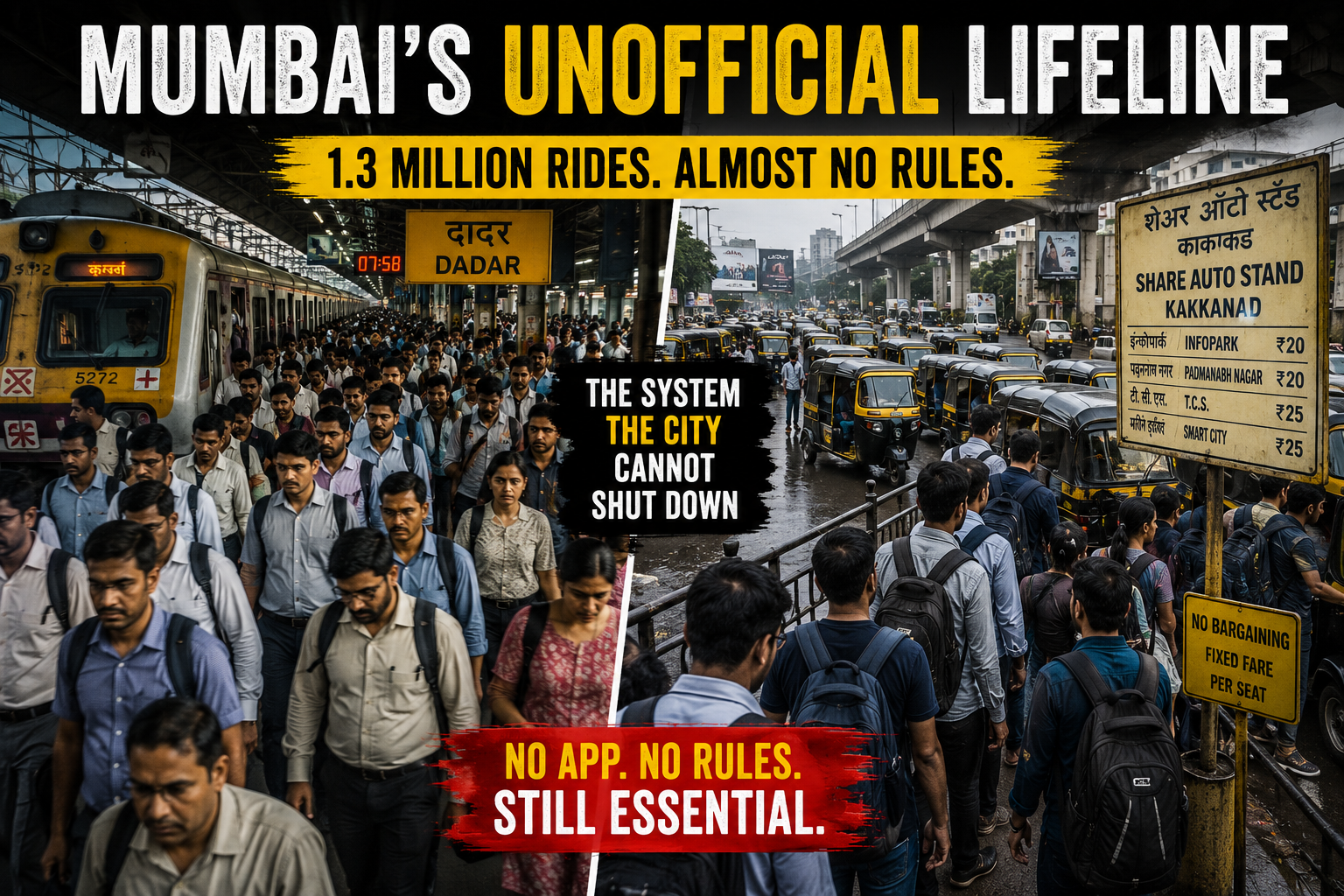
Every morning, millions of Mumbaikars step off a local train and face the same problem: the station is close, but their destination is not. The bus is too slow, a cab is too expensive, and walking in the heat is not an option. So they do what generations before them have done. They spot a shared auto, squeeze in with three strangers, and get moving.
No app. No booking. No receipt. Just a hand gesture, a fixed route, and an unspoken agreement that somehow works every single day.
Mumbai’s shared auto network carries 1.3 million rides every day. That makes it one of the largest informal transport systems in any city in the world. And yet, it runs almost entirely without official rules, regulated fares, or government planning.
A city that outgrew its own blueprint
Mumbai is home to over 1.2 crore people packed into just 603 square kilometres, one of the most densely populated urban areas on the planet. The city’s official transport backbone is the suburban railway, which carries approximately 93 lakh commuters every single day across the Western and Central Railway lines combined. The BEST bus service adds millions more.
But here is what the planners missed: trains take you to stations, not to your doorstep. And for the vast majority of Mumbaikars living deep inside crowded suburbs far from main roads, far from bus stops the last kilometre is the hardest one.
That gap is what the shared auto fills. It is not glamorous. It is not comfortable. But it works.
How it actually works
The shared auto system is simple in practice. A fixed-route auto park near a railway station exit. Passengers heading in the same direction pile in officially, a maximum of three. The driver charges a fixed per-seat fare, picks up and drops off along the route, and keeps moving.
For the commuter, it is faster than a bus and far cheaper than a metered auto or cab. For the driver, filling seats means better earnings than hunting for individual fares. On paper, it is a perfect solution.
The problem is, most of it exists outside the law.
The illegal network nobody talks about
Auto rickshaws are banned from South Mumbai entirely; they cannot go below Bandra on the western side or below Sion on the central side. The suburbs, however, are a different story. An estimated 2.5 lakh autorickshaws operate in suburban Mumbai, and a significant number of them run shared routes.
But here is the catch: a large number of these shared auto stands are completely unauthorised. The Mumbai Rickshawmen’s Union conducted a survey and found 86 illegal shared auto stands operating in the western suburbs alone. That number is only for one part of the city.
At these illegal stands, nobody regulates anything. The drivers decide their own routes, set their own fares, and choose their own stopping points. Many of them cram four to five passengers into vehicles officially permitted to carry only three. Officially approved fare charts are rarely displayed and even when they are, they are routinely ignored.
In January 2025, a joint crackdown by Mumbai police and the Wadala Regional Transport Office inspected autorickshaws in the eastern suburbs. The result was alarming: over 2,000 autorickshaws were found violating regulations, with a 40% non-compliance rate among vehicles inspected. Fines worth Rs 24.53 lakh were collected in just two days.
So why does the government let this happen?
The short answer: bureaucracy moves slower than Mumbai does.
Getting a shared auto stand officially approved is not simple. It requires a joint inspection by traffic officials above the rank of Assistant Commissioner of Police, along with officials from the Brihanmumbai Municipal Corporation (BMC) and the Regional Transport Office (RTO). Coordinating three departments, at senior levels, for every new stand across a city of over two crore people, takes time, often months or years.
The Mumbai Metropolitan Region Transport Authority (MMRTA), the body that approves shared auto routes and stands, meets only a few times a year. In the gap between demand and approval, illegal stands mushroom to fill the void.
Shashank Rao, President of the Mumbai Auto Rickshaw Taximen’s Union, has pointed out that approvals should be granted in a time-bound manner. “Inspections and approvals for stands should be done as a routine,” he has said, noting that long bureaucratic delays are the primary reason illegal stands keep growing.
The commuter is caught in the middle with metered autos refusing to ply on shared routes, there is often no alternative.
The system is essential and that’s exactly the problem
Here is the irony at the heart of this story: the shared auto is arguably Mumbai’s most important last-mile connector. It serves working-class commuters, students, domestic workers and daily wage earners, people who cannot afford cabs and cannot wait for infrequent buses. Auto rickshaws serve between 10 to 20 percent of daily motorised road transport trips in Mumbai.
Remove the shared auto overnight, and millions of people would have no way to get to work.
That is precisely why authorities have not cracked down hard. And that is precisely why nothing changes.
The MMRTA has taken some steps recently. It approved shared auto-taxi stands outside 28 Metro stations across Mumbai’s suburban lines, aimed at improving last-mile connectivity from new Metro corridors. This is a welcome move, but it covers Metro station exits, not the vast web of lanes, colonies, and chawls that shared autos currently serve.
The shared auto is not the problem. The absence of a framework around it is.
A city that runs 1.3 million shared auto rides a day needs a proper policy, one that fast-tracks approvals, displays fares clearly at every stand, enforces passenger limits, and brings drivers into a system that protects both them and the commuters they carry.
Other cities have done it. Delhi has integrated autorickshaws with Metro feeder routes. Bengaluru has experimented with app-based shared mobility. Mumbai, despite being India’s financial capital, still relies on word of mouth and hand signals to run one of its most critical transport layers.
The shared auto did not grow because the government planned it. It grew because the city needed it and the government did not act fast enough. After decades of looking the other way, it is time for Mumbai’s planners to stop treating the shared auto as an afterthought and start treating it as the essential public service it already is.
Subscribe Deshwale on YouTube
