









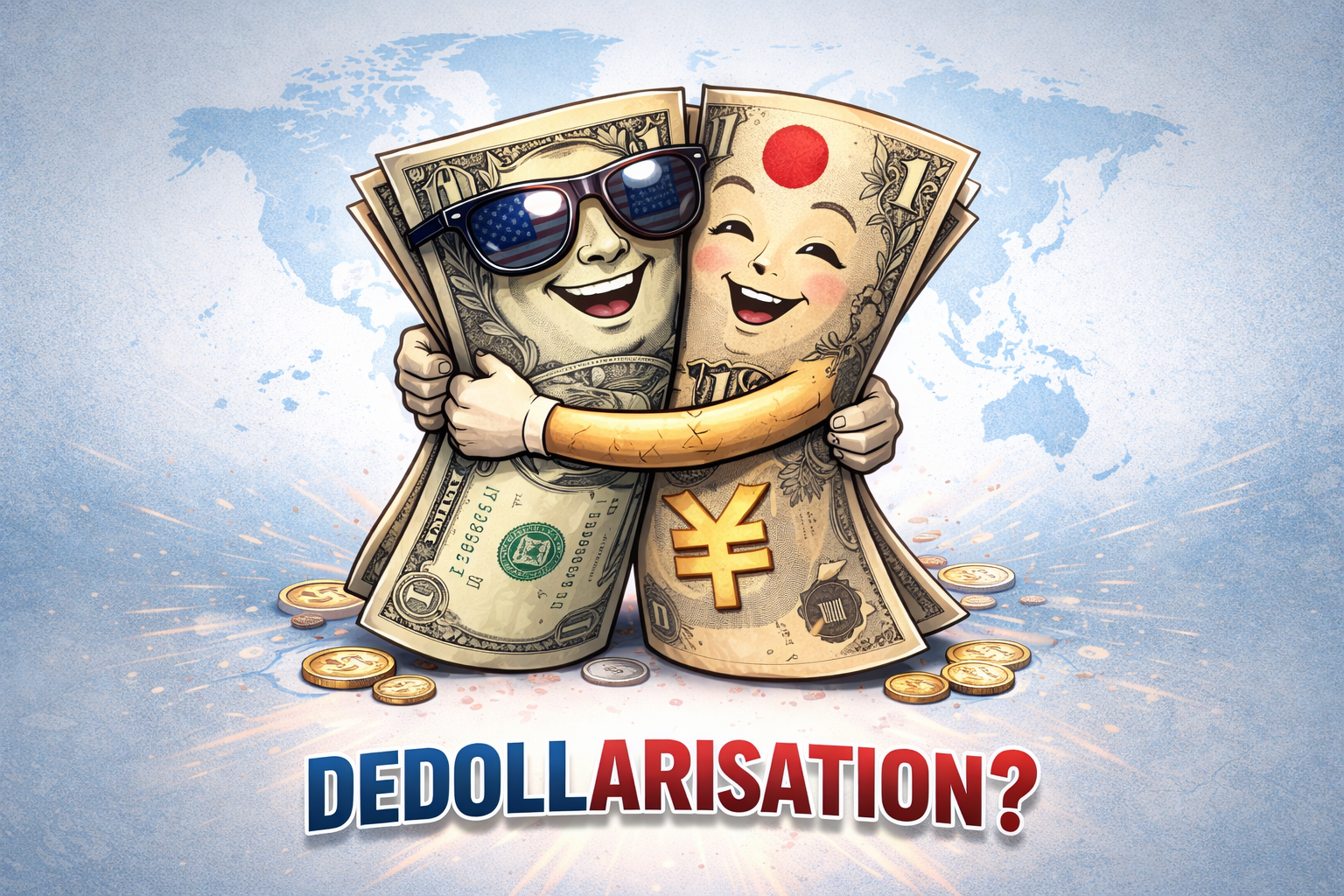
Sanae Takaichi’s convincing victory in the Japan general elections is being hailed as a political landslide, but it is unlikely to trigger a financial one. With her Liberal Democratic Party (LDP) securing 316 of 465 seats in the lower house, the largest post-war mandate ever won by a single party, Takaichi now has an extraordinary level of domestic authority. Alongside her coalition partner, the Japan Innovation Party, she effectively holds a supermajority, giving her government unprecedented legislative liberty. Yet, amid this shift in Tokyo’s political landscape, one speculative question has gained traction in global financial circles: Will Japan now pursue dedollarisation?
The short answer is: almost certainly not.
Despite growing global discussions about reducing dependence on the US dollar — particularly among emerging economies and BRICS nations — Japan’s economic and strategic architecture remains deeply intertwined with the greenback. Tokyo is one of the largest holders of US Treasury securities, its financial markets are closely linked to dollar liquidity, and much of its trade settlement structure still orbits around the US currency.
Takaichi’s campaign did not signal any intention to challenge this status quo. Her priorities appear firmly rooted in domestic economic revival, fiscal stimulus, tax reforms, and a more assertive defence posture in an increasingly volatile Indo-Pacific region. If anything, her agenda suggests deeper alignment with Washington rather than a drift away from it.
Ironically, the market’s immediate reaction to her landslide win underscored this reality. Rather than moving away from the dollar, the yen weakened and exhibited heightened volatility against it — a reminder that Japan’s financial system remains structurally tethered to the US-led monetary order.
This should come as no surprise. Japan’s post-war economic model was built under the protective umbrella of its security alliance with the United States. Since 1945, when Japan emerged from defeat into a period of American military administration, its political, economic, and strategic trajectory has been closely aligned with Washington. That alliance has endured for nearly eight decades and remains the bedrock of Japan’s global positioning.
Takaichi’s likely focus on military strengthening, which Chinese state media has already framed as inevitable remilitarisation, further cements this partnership rather than undermining it. In a region increasingly shaped by US-China rivalry, Tokyo’s calculus is more about deterrence and alliance-building than monetary revolution.
In that sense, Takaichi’s victory is less about rewriting the rules of global finance and more about redefining Japan’s role within them. Japan is not preparing to dethrone the dollar, it is preparing to play a stronger hand alongside it.
The world may be inching toward a more multipolar financial system, but for now, Tokyo is content to operate firmly within the existing one.
Subscribe Deshwale on YouTube


