 Deshwale
Not Just Chanting: 160 Children from 19 States Bring the Bhagavad Gita’s Wisdom to Life
In brief · AI summary The National Bhagavad Gita Chanting Competition (CGCC) 2026, organised by Chinmaya Mission in Pune as the Chinmaya Movement completes 75 years, brought together 160 young finalists from 19 states to chant verses from Chapter 12. The competition reached approximately 3.75 lakh students through 3,215 schools and Chinmaya Mission centres across the country. Organisers stress that the aim is for children to understand the values behind the verses and apply them in everyday life, not just memorise them.
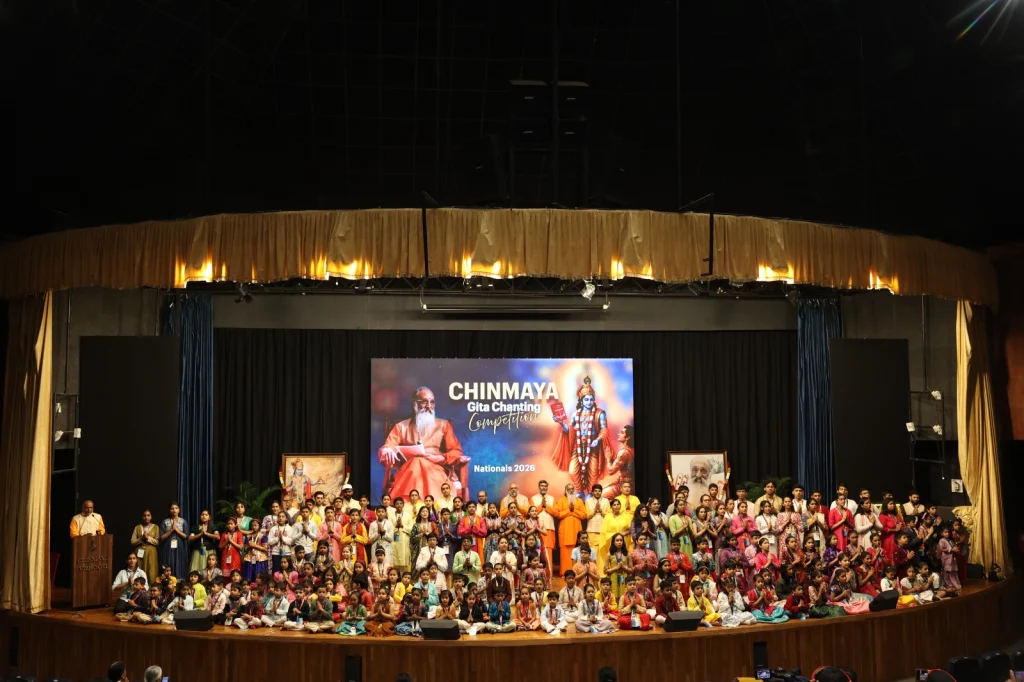
As the Chinmaya Movement completes 75 years, a national competition brings together young students to celebrate devotion, discipline and the timeless teachings of the Bhagavad Gita.
In an age when children spend an increasing amount of time surrounded by digital screens, online entertainment and fast-changing trends, an initiative that encourages them to learn, understand and practise ancient wisdom offers a refreshing perspective. The Bhagavad Gita, one of India’s most respected spiritual texts, is finding a place in the lives of a new generation through an initiative that combines learning with devotion.
The National Bhagavad Gita Chanting Competition (CGCC) 2026, organised by Chinmaya Mission at Chinmaya Vibhooti in Pune, brought together 160 young finalists from 19 states for a two-day celebration of India’s spiritual and cultural heritage. More than a competition, the event demonstrated how traditional knowledge can continue to inspire children when it is introduced in an engaging and meaningful manner.
The scale of this year’s initiative was particularly impressive. The competition reached approximately 3.75 lakh students through 3,215 schools and Chinmaya Mission centres across the country. The participation reflects the growing interest in introducing children to the Bhagavad Gita, not simply as a religious text but also as a source of values and guidance for everyday life.
More than memorising sacred verses
The competition was organised across six age categories, with participants chanting verses from Chapter 12 of the Bhagavad Gita, known as Bhakti Yoga. This chapter explores the meaning of devotion and the qualities of a person who follows the path of love, faith, humility and dedication.
For the participating children, preparing for the competition involved more than remembering Sanskrit verses. Correct pronunciation, rhythm, concentration and regular practice were important parts of the learning process. The exercise also offered an opportunity to become familiar with the meaning and significance of the verses.
This distinction is important. Memorising a verse may help a child remember its words, but understanding its message can influence how that child thinks and behaves. The larger purpose of such initiatives is to encourage young learners to move beyond recitation and discover the values behind the words.
Congratulating the national winners, Pujya Swami Swaroopananda, Global Head of Chinmaya Mission, emphasised this very idea. He observed that the Bhagavad Gita is not merely a book of knowledge but a guide to living life. According to him, the real reward comes when its teachings are practised in everyday situations.
Taking India’s spiritual heritage to the next generation
The initiative carries particular significance as Chinmaya Mission completes 75 years of the Chinmaya Movement in 2026. Founded by Swami Chinmayananda in 1951, the organisation has worked to make Vedantic knowledge and India’s spiritual traditions accessible to people through educational, cultural and spiritual activities.
Its approach to teaching the Bhagavad Gita is reflected in the guiding message: “Chant, Study, Understand and Apply.”
The four steps offer a simple but meaningful learning process. Children first become familiar with the verses through chanting. They then study their meaning, understand the ideas behind them and, most importantly, learn how those ideas can be applied in daily life.
Values such as patience, self-discipline, compassion, dedication and emotional balance are relevant to children irrespective of their backgrounds. Introducing these ideas at an early age can encourage them to think about their responsibilities towards themselves, their families and society.
A tradition looking towards the future
The national competition has also created an opportunity for children from different states to come together through a shared interest in India’s spiritual literature. Their participation highlights how cultural traditions can connect young people across geographical and linguistic boundaries.
The celebrations will continue with the international finale scheduled for December 20 and 21, 2026, at Chinmaya Vibhooti. Participants from India and abroad are expected to come together for the concluding stage of the competition.
Ultimately, the success of such an initiative should not be measured only by the number of participants or the winners announced. Its greater value lies in whether children carry something meaningful from the experience into their everyday lives.
A Sanskrit verse remembered during a competition may eventually become a lesson recalled during a difficult moment, a reminder to remain patient or an inspiration to act with kindness.
That is when the true purpose of teaching an ancient text to a modern generation is fulfilled. The Bhagavad Gita then becomes more than something children learn to chant; it becomes something they learn to live.
Subscribe Deshwale on YouTube