



paid friendship loneliness India
The rent-a-friend economy is real, it is growing, and it is asking us a question we are not comfortable answering.
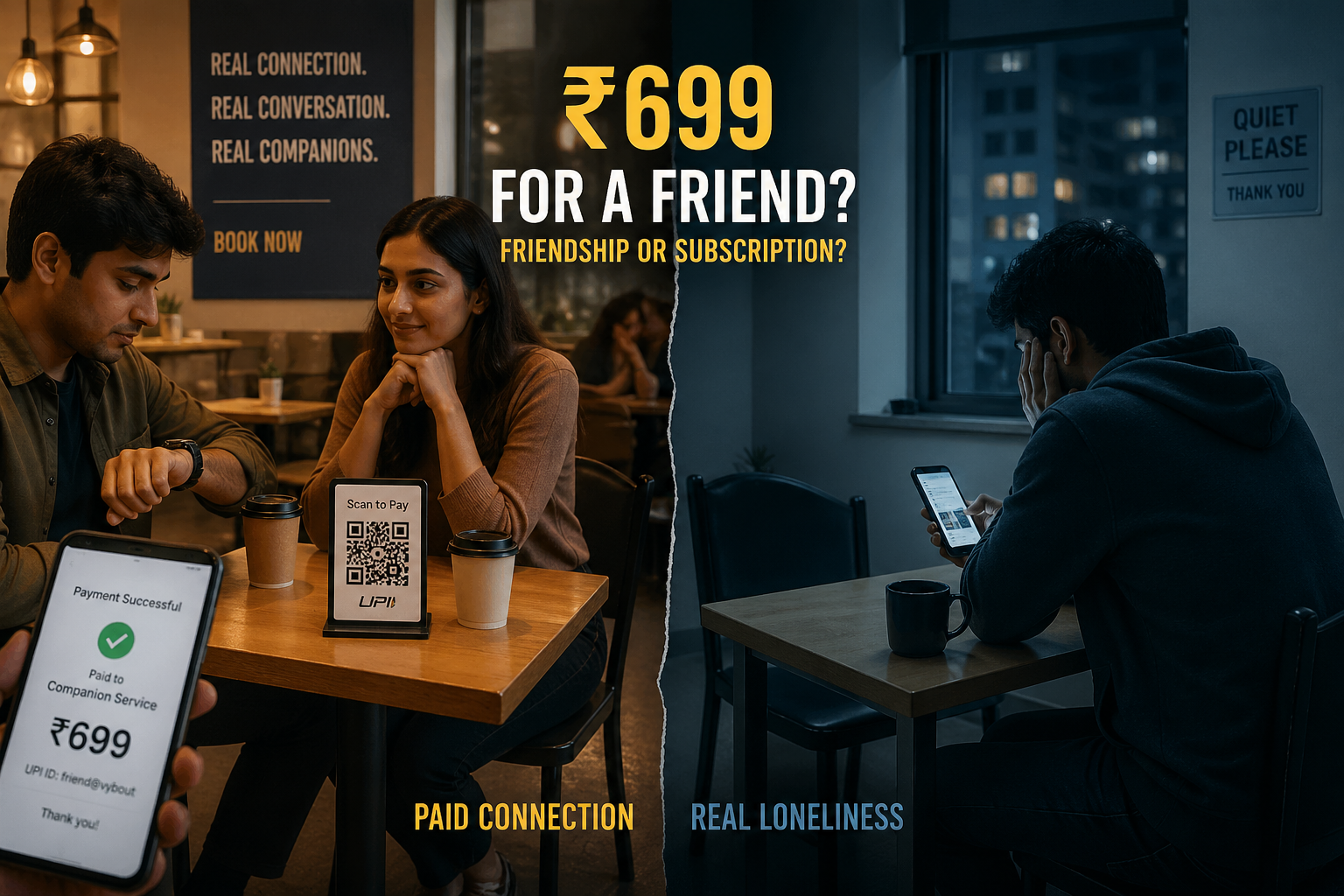
I want to be honest with you about something. The first time I came across the idea of paying ₹699 an hour to have someone sit across from you at a café and simply talk, my instinct was to laugh. It felt like a punchline, the loneliest possible end point of an app economy that has already turned everything from car rides to home-cooked meals into a tap-and-order transaction.
Then I stopped laughing. Because the more I thought about it, the harder the question became.
Platforms like Vybout, Friend-on-Rent, and RentAFriendIndia are not underground operations. They are verified, structured, and growing. Their rules are strict meetings in public places only, payments through the platform, no cash, no physical contact, strictly platonic. Companions are identity-verified. The services run across Bangalore, Mumbai, Delhi, Hyderabad, Chennai, and a dozen other Indian cities. The pricing is transparent: a coffee chat at ₹699 an hour, a wedding plus-one at ₹1,999 for three hours, medical appointment companionship at ₹1,200 an hour for someone who simply does not want to go alone.
These are not desperate people. They are engineers, students, migrants, and elderly men and women living in cities that never asked their names. And they are paying, not for anything illicit or even complicated, but for the oldest thing in the world. A warm body in the same room. A person who shows up.
Which brings me back to the question I cannot shake: is this friendship? Or is it loneliness repackaged with a UPI handle?
Here is what the data says, and it is not comfortable reading. In November 2023, the World Health Organization declared loneliness a global public health threat not a lifestyle complaint, not a personality flaw, an actual health threat. The WHO Commission on Social Connection found that one in six people worldwide experiences loneliness. Former US Surgeon General Dr. Vivek Murthy, who co-chaired the Commission, put it this way: the health impact of loneliness is the equivalent of smoking fifteen cigarettes a day. Lonely people are twice as likely to develop depression. Social isolation raises the risk of stroke, heart disease, and premature death.
And then there is this: a 2024 GWI study found that 80% of Gen Z, the most digitally connected generation in history, reported feeling lonely in the past year. Compare that to 45% of baby boomers, people who grew up without the internet, without four hundred social media followers, without algorithms designed to show them exactly what human warmth looks like from a distance. The more connected we became online, the worse it got in real life.
So when someone in Bangalore, who moved there three years ago for a tech job and has not yet found their people, books a two-hour outing with a verified companion through an app, are they doing something pathetic? Or are they doing something quietly brave?
I have been a journalist long enough to know that the stories which make us most uncomfortable are usually the ones pointing at something we would rather not see. The rent-a-friend industry is not the disease. It is a symptom. It exists because nuclear families replaced joint ones, because cities swallowed communities whole, because we built the most elaborate social networks ever invented and then used them to feel worse about ourselves.
There is a version of this conversation where we talk about what real friendship means: the kind built on shared history, reciprocal vulnerability, the accumulated weight of years. No paid companion can replicate that. Friendship, properly understood, cannot be invoiced.
But there is another version of this conversation, and it is the one I think we keep avoiding. Which is this: while we debate the philosophy of authentic connection, real people are eating dinner alone, going to hospital appointments alone, attending their cousin’s wedding as the only one without a plus-one. For them, the choice is not between paid companionship and genuine friendship. It is between paid companionship and nothing.
And nothing, as the WHO has now formally confirmed, can kill you.
I do not know if booking a friend online is a solution or a workaround. I genuinely do not. What I do know is that a society which finds the concept shocking should perhaps spend less time judging the people who download the app and more time asking why they needed to in the first place.
The ₹699 is not the story. The silence it is trying to fill is.
Subscribe Deshwale on YouTube
