








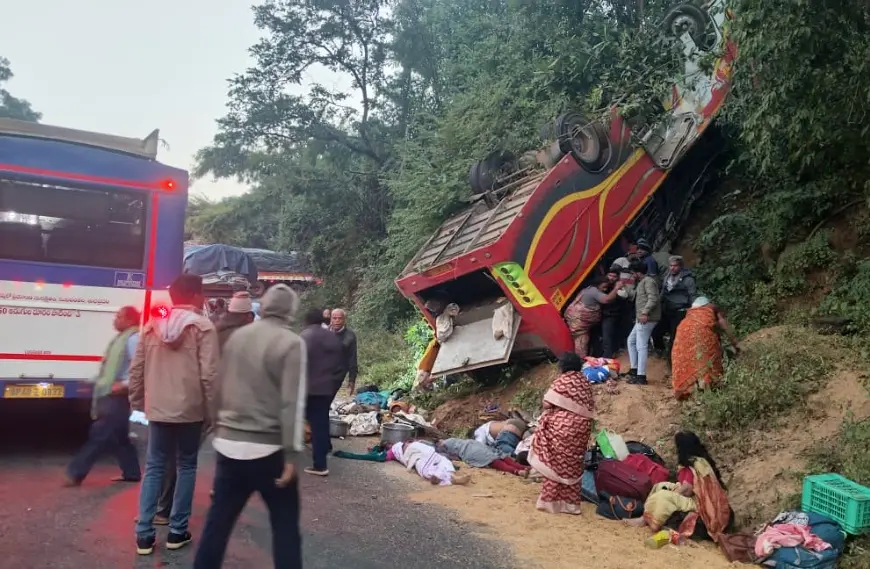
A tourist bus on a well-known temple route lost control on a steep ghat stretch in Andhra Pradesh and plunged into a gorge, leaving several families shattered.
And guess what?
This is not the first time a hill pilgrimage road has turned dangerous. The tragedy has pushed everyone to look again at pilgrim travel safety, especially on routes used daily by devotees.
When news broke about the early-morning crash on the Chinturu–Bhadrachalam ghat road, the first reaction many people had was: ‘How could this happen on such a busy pilgrimage stretch?’
But then, if we are being real, these accidents keep happening on the same bends year after year.
The bus carried 35 passengers who had just visited a major temple. They were heading towards another shrine when the driver reportedly lost control on a sharp curve near Tulasipakalu village. It was around 5.30 in the morning. Visibility was low. The terrain was unforgiving. And suddenly everything changed for the people on board.
Honestly, this one incident reflects a bigger truth. Pilgrim travel safety is often assumed rather than ensured.
Why these busy routes stay unprepared
At first I thought the issue was a lack of attention. Turns out the reality is more complicated. Many pilgrimage roads were built decades ago for lighter vehicles, not packed tourist buses. They wind through hills, forests and narrow ledges where even one mistake becomes costly.
And guess what? Overspeeding was again a suspected cause in this tragedy. The local police officer who reached the site said the driver probably misjudged the curve on a slope known for its twists. To be fair, even experienced drivers struggle on these bends because the margin for error is tiny.
Meanwhile, thousands of people use these same roads daily. Families. Senior citizens. Tour groups. Most assume that a road used by so many must be safe. Believe it or not, that assumption often leads to more danger than the road itself.
Official teams reached soon after and continued through the morning. Some survivors were taken first to a nearby community health centre, then shifted to a larger hospital. Authorities confirmed nine deaths, and several more were seriously injured.
The tragedy drew quick national attention. PM Narendra Modi shared a message on X, saying:
“Pained by the loss of lives due to a bus mishap in the district of Andhra Pradesh. My thoughts are with the affected people and their families. Praying for the speedy recovery of the injured.”
He also announced financial assistance for the families of those who died and those who were hurt. To be honest, such messages bring comfort, but they also remind us how frequently these accidents hit the same kind of routes.
Why safety still falls behind on pilgrim roads
Now here’s the crazy part. Everyone knows which stretches are risky. Drivers know it. Local officers know it. Residents definitely know it. And yet improvements often move slowly. Some sections need wider turns. Some need new railings. Others need stricter speed checks. Meanwhile, the crowd of pilgrims keeps growing every year.
Eventually something becomes clear. Pilgrim travel safety is not just about driving cautiously. It is about fixing the road system before another tragedy forces us to look back in regret.
Think about it. These journeys are emotional, spiritual and meaningful for millions. The roads that lead to these temples should be the safest, not the scariest.
If we want real change, we need a mix of better road engineering, regular maintenance, stronger enforcement and clear communication about danger zones. None of this is impossible. It just needs consistent action, not urgency that appears only after a disaster.
And that’s how it all started in my mind, understanding that faith brings people to these hills, but safety must bring them home.
Subscribe Deshwale on YouTube