



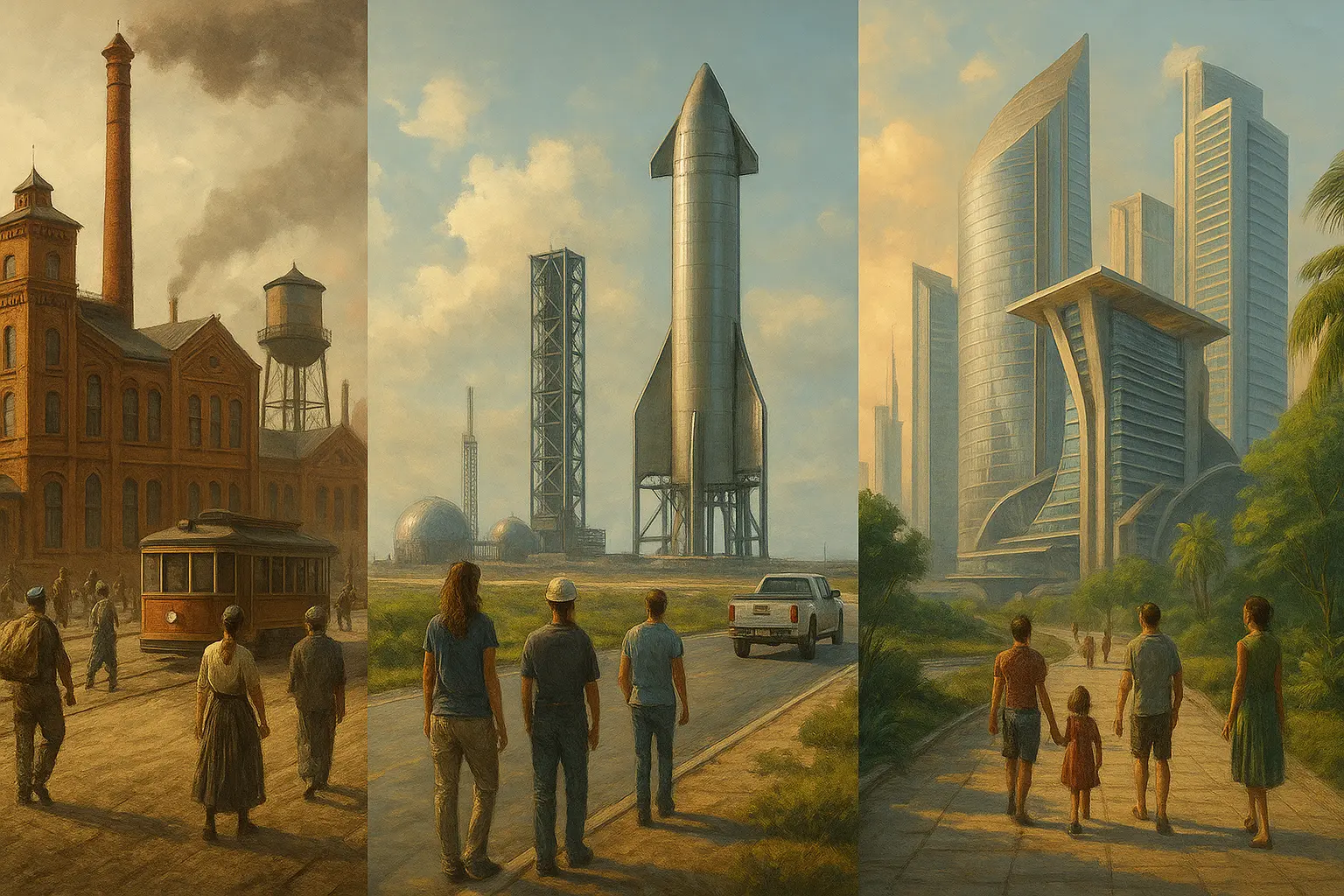
In the shadow of towering factories and sprawling launchpads, a rare breed of city has emerged, urban enclaves owned not by governments or collectives, but by industrialists with singular visions. These are not mere company towns of the past, where a coal mine or textile mill dictated life’s rhythm, but ambitious experiments in urban design, economic freedom, and sometimes, utopian idealism. From the manicured streets of Irvine, California, to the nascent Starbase, Texas, and the libertarian dream of Prospera in Honduras, privately owned cities are a testament to the audacity of individuals who dare to build worlds in their image. This feature delves into their history, purposes, and current realities, weaving together the voices of founders, residents, and critics to reveal the human heart of these concrete dreams.
A historical tapestry: From pullman to prospera
The concept of a city owned by an industrialist is not new, it is woven into the fabric of the Industrial Revolution. In the late 19th century, company towns sprang up across the United States, often in remote areas rich with resources. George Pullman, the railroad car magnate, built one of the most famous in 1880 near Chicago. Pullman, Illinois, was a model town, with neat rows of brick houses, a library, and a theater, all designed to foster a productive workforce. “I wanted to create a place where workers could live in dignity, not squalor,” Pullman once said, as quoted in historian Richard Ely’s 1885 report. But dignity came at a cost: Pullman controlled rents, banned alcohol, and quashed dissent, leading to the infamous Pullman Strike of 1894 when workers rebelled against his iron grip.
Across the Atlantic, industrialists like the Lever brothers in England crafted Port Sunlight in 1888, a garden village for soap factory workers. With its green lawns and cottage style homes, it was a paternalistic paradise, but as historian Walter Creese noted, “The Lever brothers believed happy workers were productive workers, yet the town’s rules ensured compliance over freedom.” These early experiments set a precedent: privately owned cities could elevate living standards but often at the expense of autonomy.
Fast forward to the 20th century, and the model evolved. In the U.S., the Irvine Company, founded by James Irvine in the 1860s, transformed 93,000 acres of California ranchland into the city of Irvine by the 1960s. Unlike Pullman’s rigid control, Irvine was a master planned community, with the company owning most commercial and residential properties while allowing an elected government. “We aimed to build a city that’s safe, clean, and vibrant, a place where innovation thrives,” said Donald Bren, the Irvine Company’s chairman, in a 2010 interview with Forbes. Today, Irvine is a gleaming hub of tech and education, but its high costs reflect the company’s profit driven ethos.
In the 21st century, the idea has taken a libertarian turn with Prospera, a semi autonomous city on Honduras’ Roatan Island, launched in 2020 by a group of investors led by Erick Brimen. Marketed as a “prosperity hub,” Prospera operates under a special economic zone with its own laws, taxes, and governance, aiming to attract businesses with minimal regulation. “We are building a place where people can live freer, innovate faster, and prosper without bureaucratic shackles,” Brimen told Bloomberg in 2021. Yet, local resistance and legal battles with the Honduran government cloud its future.
Purposes: Profit, Paternalism, and Progress
Privately owned cities have always served multiple purposes, often a blend of profit, control, and idealism. In the 19th century, industrialists like Pullman and the Lever brothers sought to maximize productivity by housing workers in controlled environments. As historian Alan Singer notes, “These towns were economic machines, but also experiments in social engineering.” Profit was paramount, with company stores charging exorbitant prices, as documented in a 1910 U.S. Senate report on company towns.
Modern iterations like Irvine prioritize real estate revenue. The Irvine Company leases land to businesses and homeowners, creating a cycle of economic growth. “Our model proves private investment can build better cities,” Bren claimed in a 2015 speech. But high living costs and median home prices hit $1.4 million in 2024 exclude many, raising questions about inclusivity.
Starbase and Prospera, meanwhile, are driven by ideological missions. Musk’s Starbase is about survival, his oft stated goal of making humanity multi-planetary to avoid extinction. “If we do not get to Mars, we are stuck on a single planet, and that’s a death sentence,” he told Everyday Astronaut in 2021. Prospera’s libertarian founders aim to rewrite governance, offering a “blank slate” for innovation, as Brimen put it. Yet, both face the same challenge as their predecessors balancing vision with the needs of residents.
Pullman, Chicago: The original company town
In the late 19th century, industrialist George Pullman established the town of Pullman, Illinois, as a model community for his railroad car company workers. Designed to offer a harmonious living environment, the town included housing, shops, and recreational facilities. However, Pullman’s paternalistic control over the town’s operations led to tensions, culminating in the infamous Pullman Strike of 1894. This early experiment highlighted the challenges of balancing corporate interests with residents’ autonomy.
Lavasa, India: A vision unfulfilled
Nestled in the Western Ghats near Pune, Lavasa was envisioned as India’s first privately planned hill city. Developed by Hindustan Construction Company, it aimed to replicate the charm of an Italian hillside town, complete with modern infrastructure and amenities. Despite its ambitious blueprint, Lavasa faced legal hurdles and environmental concerns, leading to stalled development and financial woes. Today, it stands as a cautionary tale of grand visions meeting complex realities.
Starbase, Texas: Elon Musk’s galactic gateway
Elon Musk’s SpaceX transformed the small community of Boca Chica, Texas, into “Starbase,” a hub for space exploration. Musk’s vision extended beyond rocket launches, he imagined a city that would serve as a launchpad for humanity’s interplanetary aspirations. While the area has seen significant development, including infrastructure upgrades and increased employment, concerns about environmental impacts and community displacement have surfaced. Starbase exemplifies the intersection of private ambition and public interest.
Prospera, Honduras: A libertarian experiment
On the island of Roatan, Prospera represents a bold attempt to create a semi-autonomous city governed by its own charter. Backed by private investors, it aims to attract businesses and residents with promises of low taxes and streamlined regulations. While proponents tout it as a model for economic freedom, critics question the implications for national sovereignty and local communities. Prospera’s success or failure could influence future endeavors in private urban development.
Lanai, Hawaii: Larry Ellison’s Island retreat
In 2012, Oracle co-founder Larry Ellison purchased 98% of Lanai, Hawaii’s sixth-largest island. His vision involved transforming it into a sustainable paradise, with investments in renewable energy, organic farming, and luxury tourism. While some residents have welcomed the economic opportunities, others express concerns about the concentration of power and the island’s cultural preservation. Lanai’s evolution under private ownership continues to spark debate about the balance between innovation and tradition.
Neom, Saudi Arabia: A futuristic megacity
Spearheaded by Saudi Crown Prince Mohammed bin Salman, Neom is a planned $500 billion city aiming to redefine urban living. Envisioned as a hub for innovation and sustainability, it promises cutting edge technology, zero carbon emissions, and a reimagined social contract. While still in its early stages, Neom has garnered global attention for its ambitious scope and the challenges of building a city from scratch in the desert.
Current status: Thriving, struggling, or stalled?
Irvine stands as the success story. With a population of 310,000, it is a bustling city with top schools, low crime, and tech giants like Blizzard Entertainment. But its homogeneity critics call it a “sterile bubble” and high costs draw scrutiny. “Irvine’s beautiful, but it’s not for everyone,” said resident Maria Gomez in a 2023 Reddit thread. “You feel the company’s hand in everything.”
Starbase is still embryonic, its 1.5 square miles a work in progress. Incorporation has granted it taxing and zoning powers, but its reliance on SpaceX makes it vulnerable. “If SpaceX falters, Starbase could become a ghost town,” warned urban planner Sarah Moser in a 2025 Forbes interview. Environmental lawsuits and beach access disputes further threaten its stability, though Musk’s relentless drive keeps it forging ahead.
Prospera’s fate is murkier. With only a few hundred residents and $84 million in investments by 2024, it is a bold experiment teetering on the edge. The Honduran government’s 2022 repeal of the special economic zone law sparked a $11 billion arbitration claim by Próspera’s backers. “We are fighting for our right to exist,” Brimen told The Wall Street Journal in 2025. Locals, like fisherman Juan Morales, resent the project, saying, “They are taking our land for their utopia.”
The human cost and hope
Privately owned cities are paradoxes, beacons of innovation and cages of control. They reflect the dreams of their creators, from Pullman’s orderly streets to Musk’s Martian gateway. But they also expose the tension between individual vision and collective needs. As Moser notes, “These cities prioritize profit or ideology over citizens’ voices.” Yet, for some, they offer opportunity. Starbase resident Jenna Petrzelka, a SpaceX engineer and commissioner, said in 2025, “Living here feels like being part of history.”
In the end, these cities are human stories tales of ambition, sacrifice, and resilience. They remind us that while industrialists can build cities, it is the people within them who give them life. As Samuel Johnson wrote in 1777, “When a man is tired of London, he is tired of life.” Perhaps, in the streets of Irvine, Starbase, or Prospera, the same holds true flawed, fascinating, and undeniably alive.
