



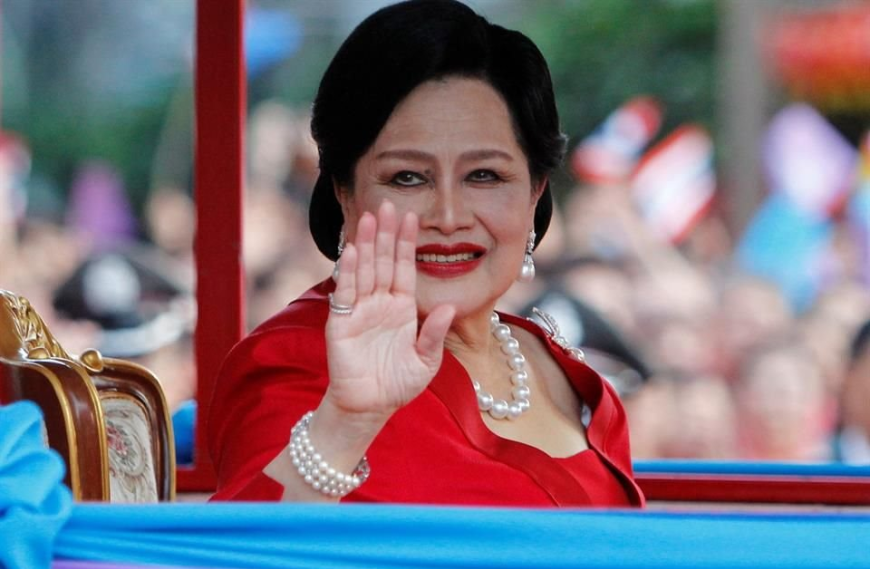
When Thailand’s Queen Mother Sirikit passed away at the age of 93, the nation reflected not just on the end of an era, but on the remarkable legacy of a woman who quietly but steadily made her mark. Though she lived for many decades in the shadow of her husband, King Bhumibol Adulyadej (Rama IX), and later her son King Maha Vajiralongkorn (Rama X), Sirikit built a distinct identity through service, culture, and compassion.
Born Sirikit Kitiyakara on 12 August 1932 into an aristocratic family in Bangkok, she moved to France with her diplomat father and studied music and languages during her early years. At the age of 16 she met the future king in Paris and a year later the pair were engaged; they married in 1950 just before his coronation.
From the beginning, Sirikit’s role was more than ceremonial. As queen consort, she travelled widely with the king and later turned her focus inwards, to the Thai people and the land. By the 1970s she and the king were confronting domestic challenges: rural poverty, tribal opium addiction, and communist insurgencies.
One of her lasting initiatives was the establishment in 1976 of the SUPPORT Foundation (Foundation for the Promotion of Supplementary Occupations and Related Techniques). Through this foundation thousands of villagers were trained in silk-weaving, jewellery-making, ceramics, and other traditional crafts helping preserve Thai culture while creating sustainable livelihoods.
Her efforts in cultural revival gained global recognition. Thai silk, once a local craft, became an international symbol of elegance under her patronage. Fashion magazines lauded her style, and she collaborated with French couture houses to showcase Thai silk at home and abroad.
Sirikit also earned the nickname “Green Queen” for her environmental and conservation work. She initiated projects such as “Small House in the Big Forest” for sustainable living amid nature, and sponsored wildlife breeding centres and forest-water preservation schemes.
Her compassion extended to social welfare and health. She visited remote villages, listened to the concerns of ordinary people, and supported mobile medical teams and refugee programmes. Her image became a maternal symbol: her birthday, 12 August, was marked as Thailand’s Mother’s Day beginning in 1976.
Though she did not seek the limelight, Sirikit’s influence also touched politics. In 1998 she publicly urged Thais to unite behind then-Prime Minister Chuan Leekpai, showing the subtle power of her position. Her attendance at the funeral of a protester killed in 2008 was seen as a royalist endorsement.
Her passing on 24 October 2025 in Bangkok followed a bloodstream infection. The royal household announced a one-year mourning period for the royal family and staff.
In a lifetime lived with grace and purpose, Queen Mother Sirikit carved a unique space. She may have started in the traditional role of queen consort in a long reign alongside one of the world’s longest-serving monarchs but she expanded that role into one of service, cultural stewardship and quiet leadership. For many Thais, she was more than a member of the royal family: she was a caring figure, deeply involved with everyday people, their crafts, their land, their traditions.
As Thailand turns the page on this chapter, it is those quieter contributions, silk-weaving workshops in rural villages, forest conservation programmes, healthcare visits to remote hill tribes that form the true legacy of this “quiet queen”. Her story offers a model of leadership rooted in compassion rather than spectacle; a reminder that influence need not always be loud to be lasting.
Subscribe Deshwale on YouTube
